
Honour Killing in Balochistan Viral Video Sparks National Outrage
How a horrific act, caught on camera, ignited protests, arrests, and calls for reform in Pakistan’s most remote province.

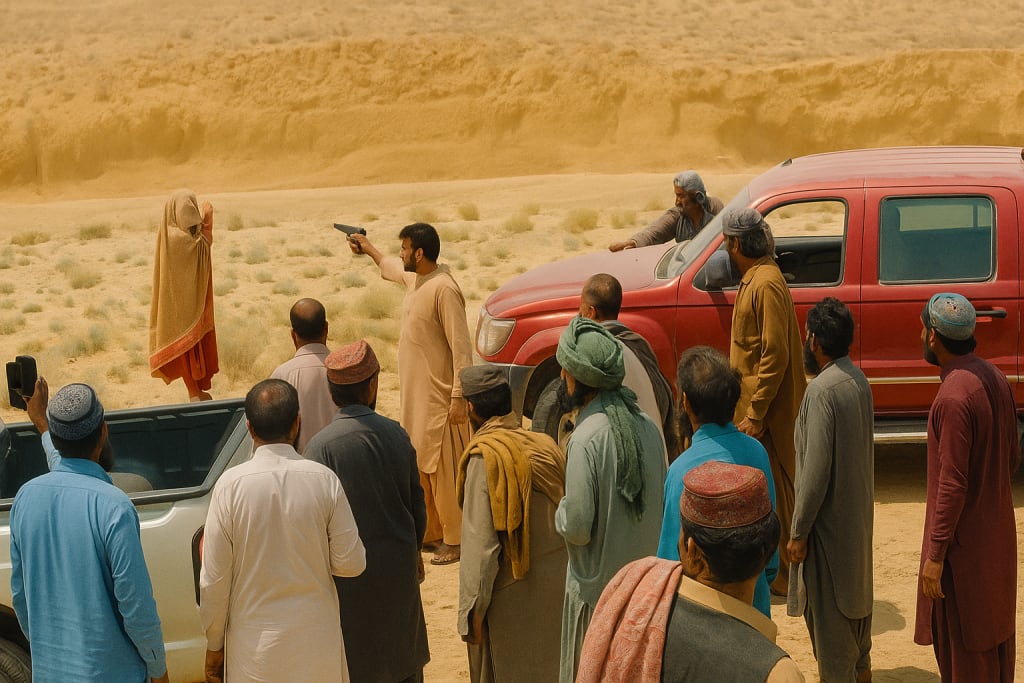
The Incident That Shocked a Nation
In late July, a chilling video began circulating on social media across Pakistan. It showed a barren, sun-scorched patch of land in Balochistan, Pakistan’s least populated and often most overlooked province. In the video, a young woman later identified as Bano Bibi stands silently, her head bowed and body wrapped in a beige shawl. A few feet away, her companion, Ehsan Ullah Samalani, is surrounded by armed men. The tension is palpable, the air heavy with the knowledge of what’s about to happen.
Within moments, gunshots ring out. Both Bano and Ehsan fall lifeless to the ground. The crowd of onlookers some holding mobile phones, others just watching does nothing to intervene. According to local authorities, the killings had been ordered by a jirga, or tribal council, as a so-called “punishment” for the couple’s alleged relationship, deemed dishonourable by the community elders.
The Video That Went Viral
The footage, shocking in its brutality, spread like wildfire on WhatsApp, Facebook, and X (formerly Twitter). It wasn’t just the act itself that horrified viewers it was the fact that it had been filmed openly, almost as a warning to others. Hashtags like #JusticeForCouple and #EndHonourKillings began trending nationwide within hours.
In an age where such incidents might once have remained buried in rural silence, social media became a force multiplier for outrage. People who had never heard of the small, remote district in Balochistan now demanded justice for its victims.
Law Enforcement Response
The public outcry was so intense that local authorities were forced to act quickly. Within days, 16 individuals were arrested, including members of the jirga who had ordered the killings. Police also seized several firearms used in the execution. The Chief Minister of Balochistan condemned the act and vowed that the perpetrators would face the full force of the law.
However, activists remain sceptical. Pakistan criminalised honour killings in 2016, after the high-profile murder of social media star Qandeel Baloch, but legal loopholes and weak enforcement often allow perpetrators to walk free. In rural areas where tribal customs still hold sway, the jirga system often operates parallel to, and sometimes above, the formal legal system.
A Deep-Rooted Problem
Honour killings are tragically not rare in Pakistan. According to the Human Rights Commission of Pakistan, hundreds of such cases are reported every year and many more go undocumented. The practice is rooted in deeply entrenched patriarchal traditions, where family “honour” is tied to controlling women’s choices in marriage, love, and mobility.
In provinces like Balochistan, where tribal authority remains strong and access to education is limited, change has been slow. Honour killings are often framed as a form of justice within these communities, despite being a criminal offence under national law.
The Role of Social Media and Public Pressure
What made this case different was the undeniable proof the video. Social media has, in recent years, become a powerful tool for justice in Pakistan. While it cannot bring back the victims, it can amplify their stories far beyond the villages where they occur.
In this case, social media pressure did more than just create hashtags it forced politicians, police, and even tribal leaders to acknowledge the crime. Without that viral footage, there’s a strong chance the murders of Bano and Ehsan would have been quietly buried, both literally and figuratively.
Protests and Activism
Following the video’s release, protests erupted in Quetta, Karachi, and Islamabad. Human rights groups organised vigils, while women’s rights activists demanded not only justice for the couple but also structural reforms. The call was clear: dismantle parallel justice systems that enable such killings, and ensure that no “honour” crime can be excused or pardoned by family members.
The Road Ahead
As the case moves forward, the arrests are only the first step. For many activists, true justice will come only when convictions are secured and when reforms ensure that such acts cannot be sanctioned under any traditional or tribal law.
Pakistan’s struggle with honour killings is a battle between centuries-old customs and a growing movement for human rights and gender equality. The deaths of Bano Bibi and Ehsan Ullah Samalani are another painful reminder that change is not just necessary it’s urgent.
Final Thought:
The viral video from Balochistan didn’t just show a crime it exposed the fractures in Pakistan’s justice system and the dangerous power of outdated traditions. While the outrage it sparked offers a glimmer of hope for accountability, lasting change will require more than arrests. It will require dismantling the cultural and legal shields that protect those who kill in the name of “honour.”
About the Creator
Farooq Hashmi
Thanks for reading! Subscribe to my newsletters.
- Storyteller, Love/Romance, Dark, Surrealism, Psychological, Nature, Mythical, Whimsical
Keep reading
More stories from Farooq Hashmi and writers in Journal and other communities.
The goals I did not achieve
Every writing goal I made for the year is a wash. It has been this way for a while, but I think it's important to be open about my failures and the reality of how life can get in the way. This is especially true considering the several times I have posted on Vocal about my writing goals, how I was changing my approach, and where I was hoping to be for the upcoming year. I will probably do that again in a couple months, but for now, it is time to acknowledge where I am today.
By Kay Husnick23 days ago in Journal
The World Is Talking About War—But the Real Crisis Was Quietly Admitted
A World That Suddenly Feels Louder The world has grown unusually loud in recent days. Not loud with celebration—but with warnings, threats, and carefully chosen words meant to intimidate.
By Shahjahan Kabir Khan3 days ago in Journal




Comments
There are no comments for this story
Be the first to respond and start the conversation.