
Hong Kong’s Level-5 Fire Didn’t Just Burn Homes — It Exposed the Hidden Fragility of the City
The Night We Realized No Home Is Truly Safe

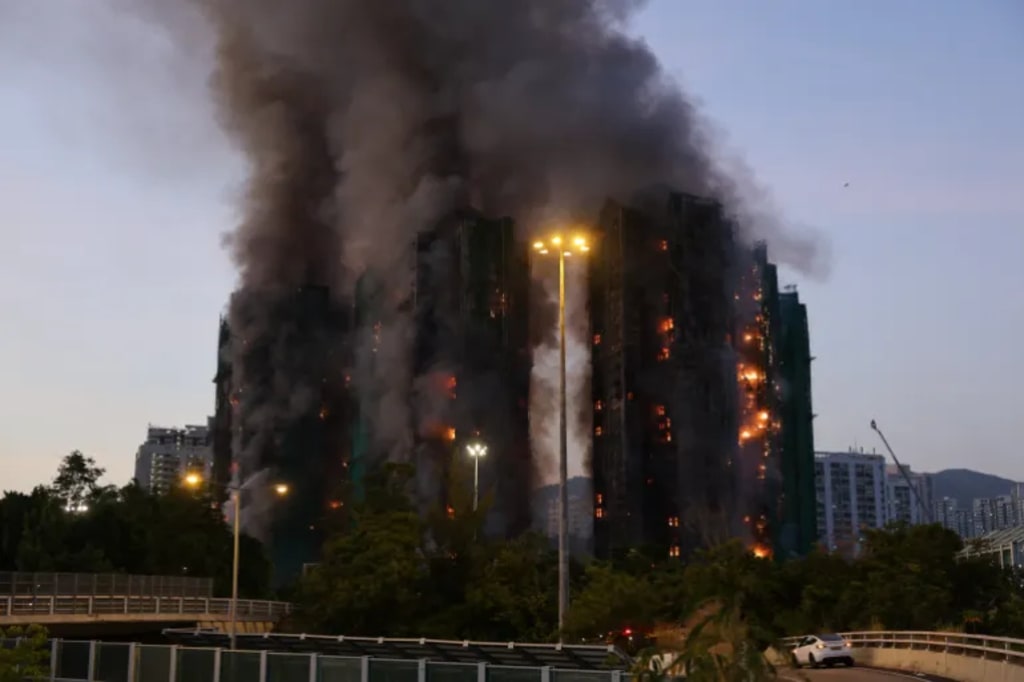
On the 26th, a catastrophic Level-5 fire broke out at Wang Fuk Court in Tai Po, Hong Kong.
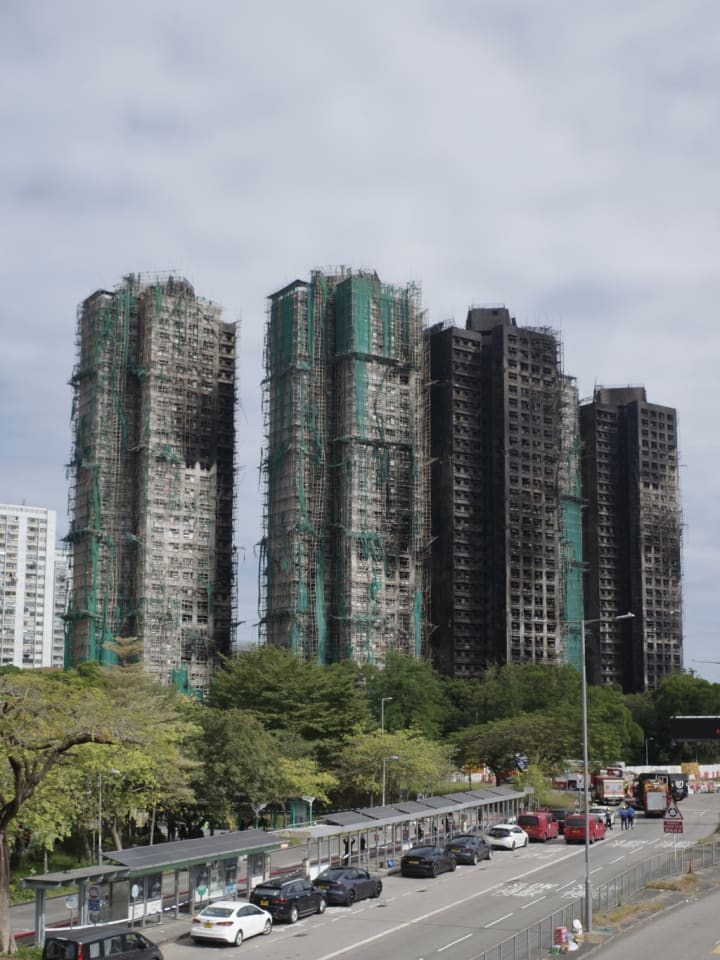
Seven of its eight residential blocks were engulfed in flames.
As of 2 December 2025, the death toll has risen to 156, with approximately 30 individuals still unaccounted for.
This is the most devastating fire Hong Kong has seen in nearly three decades.
As a Hong Konger, the impact of this tragedy on me goes far beyond the disaster itself.
What I find hardest to accept is this:
It was a “structural” catastrophe — one that was entirely preventable.
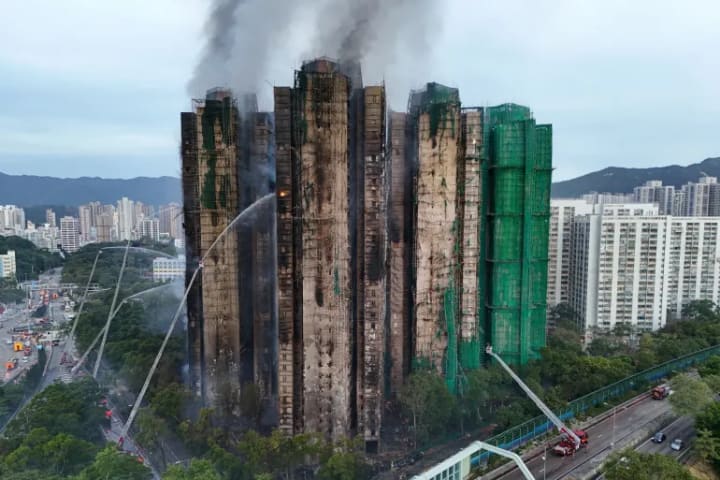
The estate where the fire broke out — Wang Fuk Court in Tai Po, Hong Kong — is a 42-year-old residential complex.
High-rise buildings, compact units.
In Hong Kong, it falls under the category of Home Ownership Scheme (HOS) housing — a term every local knows well.
It’s public housing for middle- to lower-income families, filling the gap between rental public estates and private flats.
Part of the cost is subsidized by the government, and residents purchase the remaining share — the idea being that “those who live here should have a home to call their own.”
In the memories of different neighbors, the estate carries different shapes:
For many, it was their very first home — no balcony, but windows with a glimpse of the sea.
Narrow corridors, aging facilities, and the occasional trash thrown from above.
Every day, uncles and aunties greeted each other with a smile, and at Christmas, the sound of carols would echo between the blocks.
When the tragedy happened, the entire estate was undergoing a major exterior renovation.
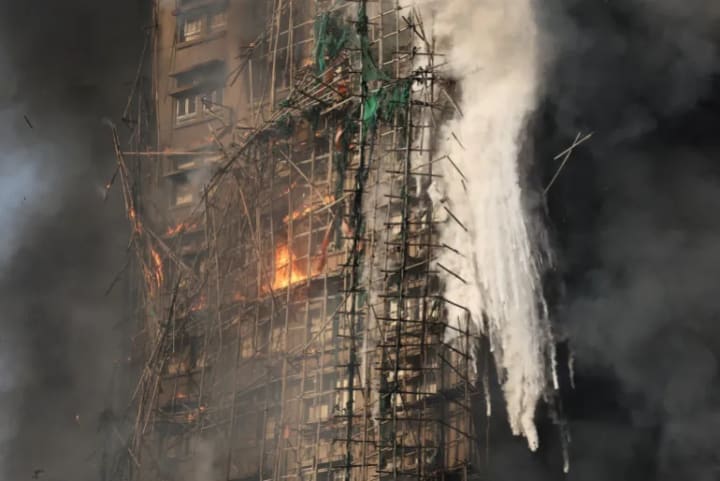
The contractor had erected traditional bamboo scaffolding along the outer walls and wrapped the buildings with layers of protective mesh, waterproof tarps, and plastic sheeting.
And then the unimaginable happened.
On the afternoon of the 26th, a small blaze ignited at the base of one of the buildings.
At first, it was just a minor fire — but it spread rapidly.
Two blocks.
Then three.
Until seven out of eight buildings were engulfed in flames.
The entire estate turned into a sea of fire — a scene beyond anything words can fully capture.
Many residents were trapped inside, unable to escape.
Rooms were swallowed by flames one after another, windows spitting out tongues of fire.
Homes that were once warm and familiar became cages of death within minutes — like massive burning charcoal columns, standing in the smoke and inferno, their facades punctured by charred, gaping wounds.
It was a sight even disaster movies could not replicate.
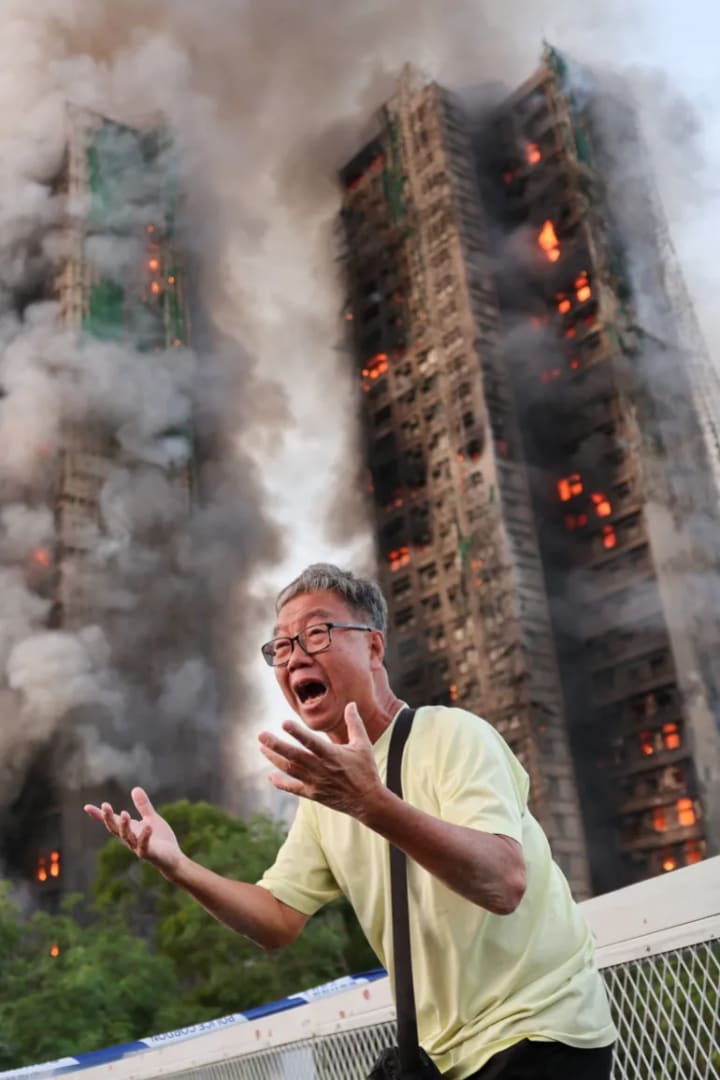
Survivors recalled that even from 50 meters away, they could feel the scorching heat on their faces.
The air reeked of burnt bamboo, melted plastic, and the sharp smell of chemicals.
Bamboo poles snapped with explosive cracks.
Debris rained from above.
Those outside watched in horror.
Those inside were fighting for their lives.
One girl was trapped inside the burning building.
Her mother, standing outside, called her — trying her best to sound calm:
“Mom is here. Hold on, please. Don’t give up.”
The woman fell to her knees outside the safety line, staring at the building gnawed down to its blackened bones. Her voice tore apart as she cried:
“My whole family is in there… none of their phones are going through…”
The man broke down, unable to control his sobs.
“I’ve called for rescue dozens of times, and she’s still trapped inside. She left… with the cat she loved so much. Alive or not — just get her out first.”
A firefighter has lost his life.
Yesterday afternoon at three o’clock, firefighter He Weihao arrived at the scene, in charge of the underground rescue operation. Half an hour later, he suddenly went missing. When found, he was lying on an open ground, his face burned — he didn’t make it.
This handsome young man had a girlfriend he had been with for ten years. They were supposed to get married next month.
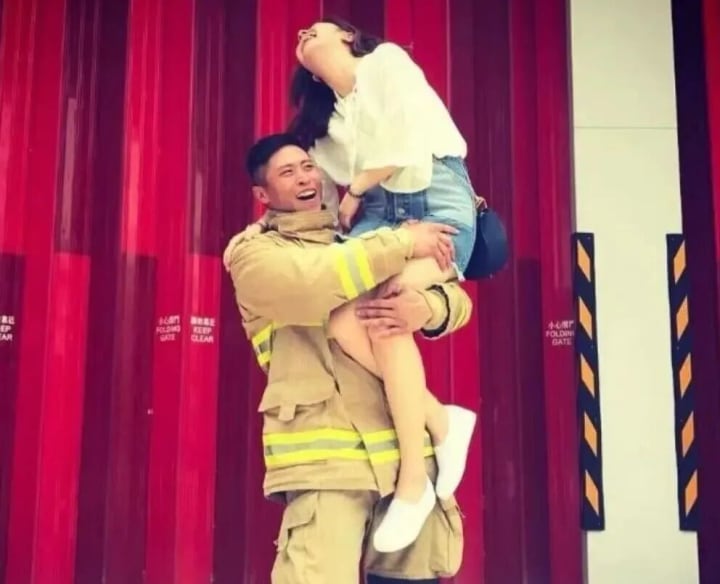
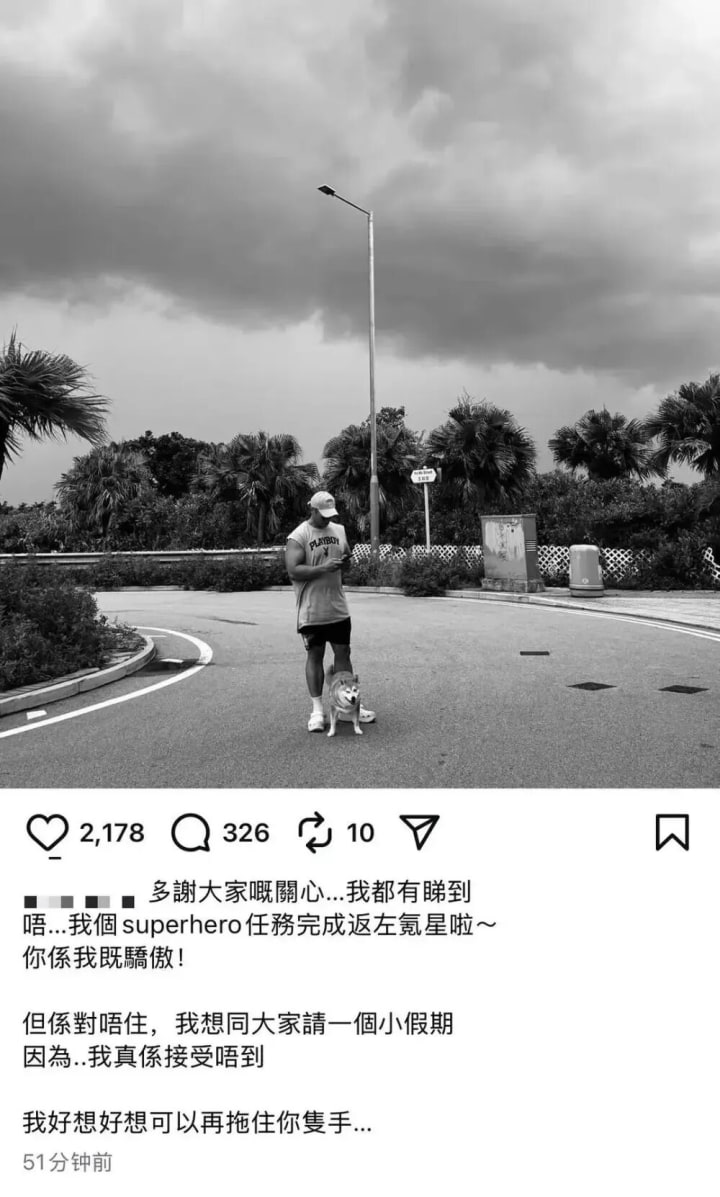
His girlfriend was devastated and posted a tribute:
“My superhero has completed his mission and returned to Krypton. You are my pride. But I’m sorry — I need to take a little break from everyone, because I just can’t accept this. I so, so wish I could hold your hand one more time.”
A fire destroyed the happiness of so many. Among the ashes lies endless pain — perhaps a wound that will never heal in this lifetime.
But what the public found hardest to accept was that this devastating fire could have been prevented. Those 156 vibrant lives could still have been with their families.
Last year, when the Hongfuyuan exterior wall renovation began, and the fire, residents had already sensed something was wrong and kept raising concerns.
Everyone realized that the green protective nets and bamboo scaffolding were not fireproof materials. They would ignite instantly — extremely dangerous.
Yet the feedback they received was: “This is the material we’re using. No substitutions allowed.”
Some residents also noticed that the construction workers completely ignored the no-smoking rules. They smoked on the scaffolding and casually tossed the cigarette butts, causing serious worry.
The response they still got was muddled and vague.
They knew, but they didn’t fix it.
And it turned out that the residents’ concerns were far from excessive.
Yesterday afternoon, shortly after two o’clock, a fire broke out at Hongfuyuan. The blaze started at the bamboo scaffolding on the ground floor. It is suspected that a construction worker carelessly discarded a cigarette, igniting the fire.
At first, there were only tiny sparks of flame.
But there were far too many factors on site that let the fire spiral out of control.
Hongfuyuan is located by the sea, where the wind is strong.
Once the bamboo scaffolding and flammable protective nets caught fire, they began to splinter and fly apart.
Embers danced wildly in the wind, landing on surrounding buildings.
In just four hours, the fire swept through seven buildings in the complex.
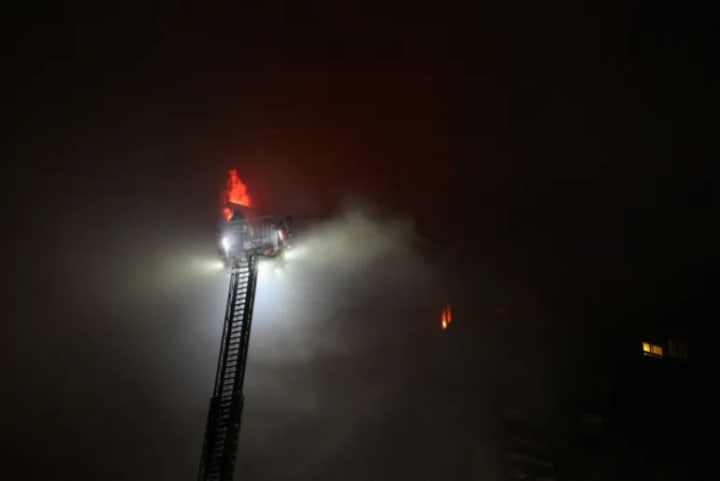
After the incident, many people shared the same question:
One of the culprits — the bamboo scaffolding.
It’s clearly flammable and unstable, long since phased out internationally.
Yet, for some reason, even advanced and developed Hong Kong is still using it.
This brings us to the Hong Kong Bamboo Association, established in 2010. The organization serves 2,500 bamboo scaffold workers in Hong Kong, monopolizing the construction market. They have been lobbying the government, arguing that bamboo scaffolds are environmentally friendly and cheap, and that steel scaffolds shouldn’t replace them.
Their reasoning: bamboo scaffolds have been in use for many years, and there are plenty of qualified workers for them. If switched to steel, there wouldn’t be enough skilled workers.
Also, bamboo can be discarded after use, whereas steel must be stored. In a land as precious as Hong Kong, storing things is impractical.
By this logic, using bamboo scaffolds does make some sense.
But reasonable doesn’t always mean correct.
Many things in human society are both reasonable and wrong. People are often hijacked by all sorts of messy justifications, making blatantly wrong decisions, and are unable to correct them.
Think about it — it’s absurd.
Take the bamboo scaffolding issue, for example.
Bamboo scaffolds protect the environment, but steel scaffolds protect lives.
Which is more important: the environment or human life?
Such a simple question, yet when too many “wise” people come together, they give the wrong answer.
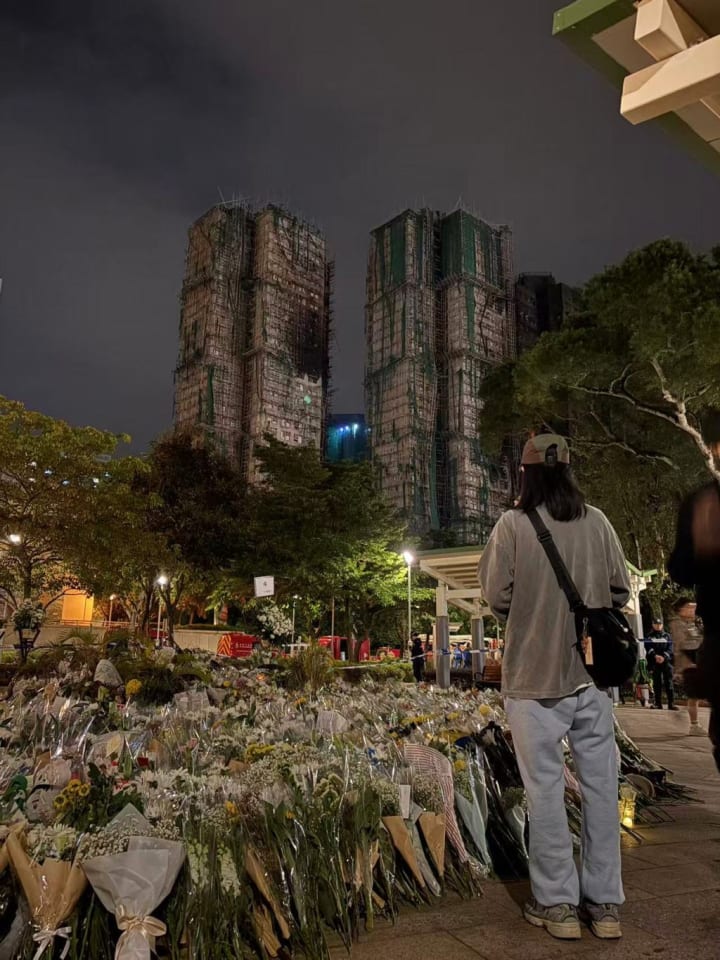
The tragedy has already unfolded. This fire destroyed not only the homes of Hongfuyuan residents but also people’s illusions of Hong Kong as a civilized city.
Hong Kong once shone brightly, but over the past decade, influenced by geopolitical shifts and economic decline, more and more capable people have left, relocating elsewhere.
What remains are aging modern high-rises and the older generation of Hongkongers steadfastly holding onto their homes.
Many people still live in Hongfuyuan.
These towering buildings, once soaring modern epics, now conceal enormous hidden risks.
A single flicker of flame is enough to expose their fragility.
Preventing similar tragedies from happening again is a monumental challenge for the Hong Kong government.
In the past, we always thought big cities were hubs of civilization and safety.
But in reality, big cities may not be as safe as we imagine.
First, most of us haven’t lived in high-rises long enough; our experience is limited.
Second, there are too many unforeseen factors that lead people to make irrational choices.
Take Hong Kong, a city almost at the pinnacle of civilization.
Yet it still uses 30-year-old bamboo poles to repair 40-year-old high-rises.
It relies on 50-meter aerial ladders to fight 100-meter-high fires.
These bizarre events make it hard to predict who might be affected next.
What truly wounds ordinary people in the Tai Po fire is a shared sense of vulnerability that comes with living in high-density cities.
As ordinary people, what can we do?
If you’re lucky enough not to have settled in these high-rises, then take a moment to reassess your purchasing standards.
You’re not just buying “location” or “investment potential” — you’re betting on a combination of structural safety, building quality, and regulatory oversight.
A safe and comfortable life should be the ultimate pursuit for ordinary people.
If your home is already in a high-rise, and it’s beginning to age, then the following advice is something you absolutely need to read:
1. Don’t wait for disaster to learn how to escape:
After the fire, many residents shared the same reflection:
“I never thought something like this would happen in my home.”
“I didn’t know where to run.”
The reality is — knowledge of escape routes is the only thing you can rely on when disaster strikes.
As ordinary people, we should at least know:
- Where the two or more escape exits on your floor are
- Whether you have escape ropes, a flashlight, or a wet towel at home
- When the fire is outside, the rule is to stay indoors and close the doors, not blindly run out
- Smoke is more deadly than fire
These things won’t magically jump into your mind — you have to learn them.
2. Don’t treat safety hazards in old buildings as “habit” or “inevitable”:
Many residents in old buildings get used to certain issues in their complexes, such as sealed windows, clutter, exposed wiring, lazy property management, or renovations done without reporting…
These may seem minor, but any one of them could become a trigger for a similar disaster.
Be vigilant about these hazards — “habit” is not an excuse, “it’s always been like this” is not safety.
One extra awareness can prevent one tragedy.
May the living be safe, and the departed rest in peace.
About the Creator
Cher Che
New media writer with 10 years in advertising, exploring how we see and make sense of the world. What we look at matters, but how we look matters more.
The goals I did not achieve
Every writing goal I made for the year is a wash. It has been this way for a while, but I think it's important to be open about my failures and the reality of how life can get in the way. This is especially true considering the several times I have posted on Vocal about my writing goals, how I was changing my approach, and where I was hoping to be for the upcoming year. I will probably do that again in a couple months, but for now, it is time to acknowledge where I am today.
By Kay Husnick24 days ago in Journal
Ludacris and Nelly draw backlash over bookings at MAGA-coded music festival
Ludacris and Nelly headlining a mostly right-wing event is good for them. It’s also great for the genre of hip hop. The two rap veterans have showcased their talents on other stages. Why can’t they perform for mostly MAGA folks and grab that bag?
By Skyler Saunders5 days ago in Beat


Comments
There are no comments for this story
Be the first to respond and start the conversation.