
Healing Smarter: Advanced Wound Care Market Accelerates with Biotech Breakthroughs
In the coming years, the focus of the healthcare system will shift toward personalized, preventive, and value-based care. That means the role of advanced wound care will only continue to grow.

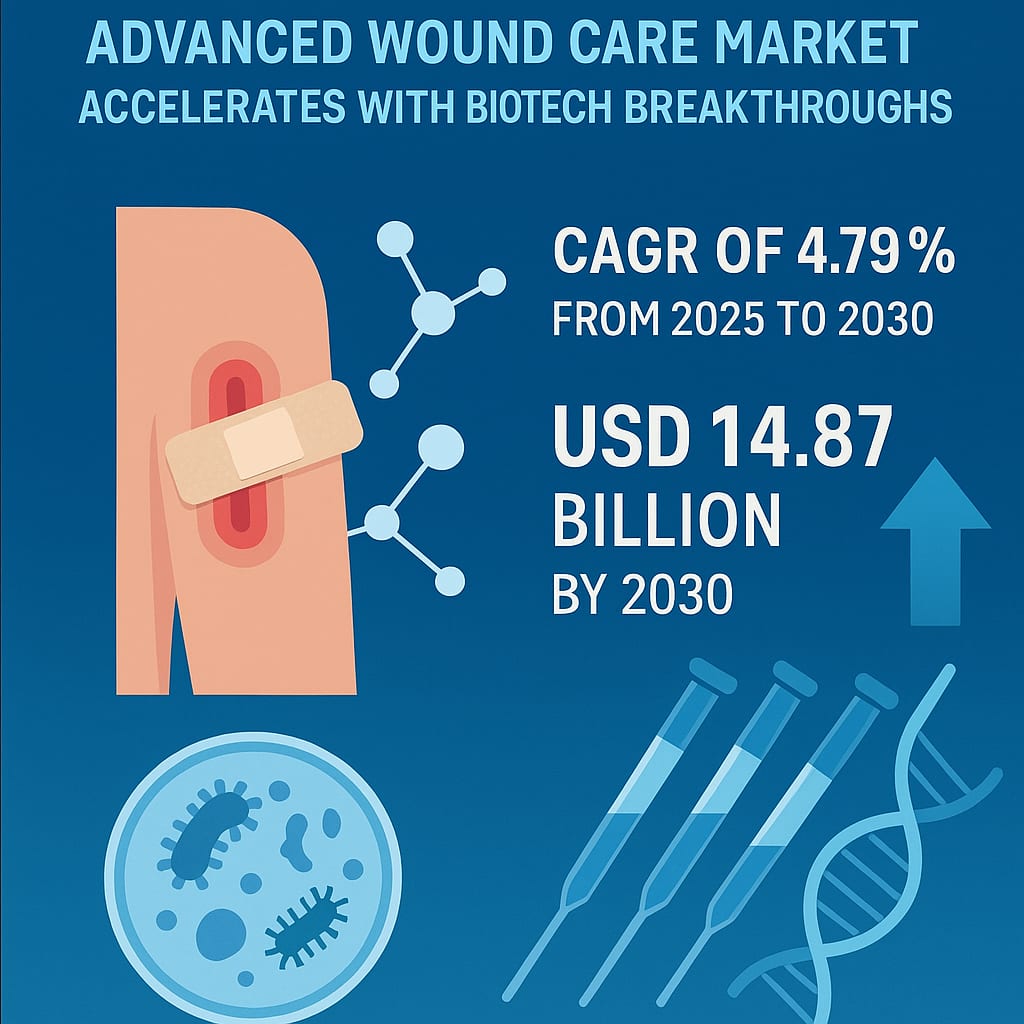
With the rapid pace of biotech innovations, an aging population, and a rise in chronic conditions like diabetic foot ulcers and pressure ulcers, the world of wound care is entering a new era. While advanced wound care products already play a role in first-line treatment, traditional dressings and bandages don’t provide enough benefit for serious or complex wounds. Enter biotech-driven wound care. With improved healing times and reduced risk of infection, there’s no question why biotech is revolutionizing wound care — healing faster, smarter, and better.
Transition from traditional to advanced wound care
Traditional first-line wound care solutions have been protecting wounds for centuries — using gauze, bandages, and even antiseptics. However, for more serious and complex wounds, they are simply not enough. Biotech has emerged as the solution to speed up healing times, combat infections, and accelerate the healing process.
Bioengineered skin substitutes, growth factors, and other cell-based therapies, plus negative pressure wound therapy (NPWT), are being used to speed up healing times and lower the risk of infection.
While some older technologies like hydrocolloids and alginates help protect wounds, the real power of advanced wound care lies in accelerating healing, via:
- Maintaining moist wound healing environments
- Antibacterial properties
- Stimulating cellular processes
- Delivering bioactive compounds to the wound site
These biotech products are starting to see a wide range of use cases:
Bioactive dressings containing recombinant growth factors or antimicrobial peptides that help improve tissue regeneration and infection control
Cell-based therapies, like MSCs, that regenerate damaged tissue and increase angiogenesis in chronic wound beds
3D bioprinting and tissue-engineered skin substitutes that replace lost layers of skin in burns or post-surgical wounds
Smart dressings with sensors and drug delivery systems that release medication on-demand and measure pH, temperature, and moisture levels in real time
These products help heal faster, reduce infection, and improve patient outcomes by lowering hospitalization rates and reducing costs.
The market for advanced wound care is projected to be valued at USD 11.76 billion in 2025 and is estimated to reach USD 14.87 billion in 2030 at a CAGR of 4.79% during the forecast period 2025 to 2030.
Key factors behind this growth include:
The high prevalence of chronic conditions like diabetes and vascular disorders
An aging global population that is more susceptible to skin breakdown and slow-healing wounds
Outpatient and home-based care
Government initiatives and funding for wound care in developed countries
Surgical procedures, like cosmetic and bariatric surgery, that require post-op wound care
North America is the biggest market because of higher healthcare spending and higher technological advancements, but the Asia-Pacific region is seeing rapid growth because of an increase in healthcare infrastructure and patient awareness.
Challenges and opportunities
While this industry is promising, there are challenges and opportunities. Costs associated with advanced therapies, limited reimbursement policies in certain regions, and the lack of trained personnel to manage complex wounds are among the barriers to growth.
But the market is ready to take off. With biotech companies collaborating with medtech companies, there’s a focus on more affordable products, AI-based remote wound monitoring, and telehealth platforms that make wound care accessible — a win-win for affordability and outcomes.
Where is wound care headed?
What was once a passive act of applying a dressing is now a data-driven and biotech-enabled approach to wound care that can go beyond treating and improve the quality of healing.
Biotech-driven wound care products of the future will be based on a patient’s genetic profile, connected to monitoring systems that analyze patient data in real-time, and connected to a continuum of care with AI and robotics.
In short, the phrase “heal smarter” is no longer a catchy slogan — it’s the future of wound care and biotech is driving the movement.
Read More at "Advanced Wound Care Market Report Scope"
About the Creator
Paxton Templeton
I’m a storyteller at heart with a passion for turning data into compelling narratives. With a focus on industry trends, market insights, and growth statistics, I bring clarity to complexity
Keep reading
More stories from Paxton Templeton and writers in Journal and other communities.
Securing the Edge: Endpoint Security Market Rides the Wave of Digital Transformation
Our digital landscape now dominated by hybrid workforces and IoT devices along with cloud computing requires us to protect every access point like never before. The endpoint security market stands as a key element of global cybersecurity strategies because of the rapid increase in device connectivity and expanded cybersecurity threats. The global endpoint security market valued at USD 17.43 billion in 2024 is expected to reach USD 28.80 billion by 2030 with a compound annual growth rate (CAGR) of 7.4%.
By Paxton Templeton9 months ago in Journal
Hottest in the Office
Dear Rafi, You’re very distracting to work around. For the first second I saw you the other day, I thought you were some type of executive. It took a moment to realize no, you were just the new guy, dressed up for the job he wants. Be still, my heart.
By Gabriel Shames2 days ago in Pride




Comments
There are no comments for this story
Be the first to respond and start the conversation.