
Guy de Maupassant - selected short stories
Boule de Suif and life lessons

My appreciation of short stories was given a false start when my first exposure to this genre was through reading the likes of Frederick Forsyth and Geoffrey Archer. Or watching "Tales of the Unexpected". All of those stories were fast paced and always ended with an unexpected twist that made me smile, made me gasp or wonder how on earth the author came up with that idea?
From those canons of popular culture, I regressed to reading a collection F Scott-Fitzgerald's short stories. Some of which, according to legend, he frantically penned in motel bedrooms and sold to pay for medicines for his wife Zelda and alcohol for both of them. From what I can remember none of them ended with what could best be described as "Forsythian" or, "Archerian" twists. In some respects they were anticlimatic. That was how I felt after reading them over thirty years ago.
It was while I was reading Henning Mankell's "Quicksand - What it Means to be Human" that I became aware of the French writer Guy De Maupassant (1850-1893) and that he wrote short stories. Through some undiluted serendipity I found a copy of his "Selected Short Stories" published in the Penguin Classics series in a local charity shop.
This volume became my travelling companion for about a month. On clifftops overlooking the ocean, hotel rooms waiting not at all like Scott-Fitzgerald I hasten to add, cafes the garden and in the car waiting.
The text on the back cover described the author as "...having raised the art of storytelling to a pitch rarely equalled".
Writing short stories of any length is something I enjoy doing for my own satisfaction and sometimes for competitions. Where I struggle in these endeavours is finishing off with one of those "Forsythian" or "Archerian" endings. So, I thought when I picked up Maupassant's collection, maybe by reading it I would acquire some inspiration for my own writing.
I did, but not in the way I was expecting.
The first story "Boule De Suif" (Ball Of Fat) is based in the region of Rouen and Le Havre in northern France at the time of the Prussian occupation in the early 19th century. It is centred on a group of passengers in a stagecoach travelling in the depths of winter sharing the hardships of the journey equally regardless of class until they are snowbound at an inn and only allowed to progress at the discretion of the Prussian soldiers garrisoned there.
It is only when they realise that the only way to reach their destination with the permission of the soldiers that distinctions of class and profession surface with a vengeance. This leads to one of them having to betray their standards for the so called "greater good". That betrayal of standards was not the ned of the story. What was the end of the story was how they all continued their journey.
No twist to end the story and make me go "Wow". Instead, there is an ending that illustrated how following a moment of great drama in which relationships have taken a seismic shift to serve narrow and selfish self-interests at the expense of someone of a lower class, life carries on within a new realm of normality.
What I learnt from this collection of short stories that maybe I didn't appreciate when I read Scott-Fitzgerald's short stories over thirty years ago is that it is ok not to "Wow" the reader. What is more important is to get the life lessons across. As in Guy de Maupassant's stories those lessons are about betrayal, class, friendship, love and loyalty. If they lead to a "Wow" ending, then that is a bonus for both writer and reader.
I am now perusing the charity shops for a collection of F Scott-Fitzgerald's short stories.
About the Creator
Alan Russell
When you read my words they may not be perfect but I hope they:
1. Engage you
2. Entertain you
3. At least make you smile (Omar's Diaries) or
4. Think about this crazy world we live in and
5. Never accept anything at face value
Keep reading
More stories from Alan Russell and writers in Journal and other communities.
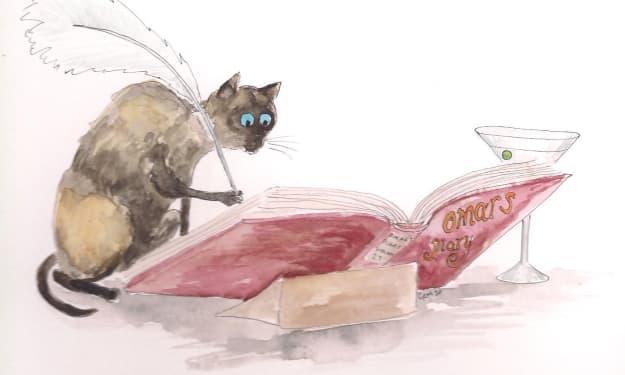
Omar's Diary to 31st October 2022
Words would fail me if I tried to tell you how absolutely thrilled I was to have won first prize with this photograph in a local village show. The brief in the show schedule was for a "Woodland Glade". I just wonder how many of the demographic of Burley village defined as "blue rinses" or "silver seniors" noticed the cheeky activity in the lower right-hand corner of the shot?
By Alan Russell3 years ago in Journal
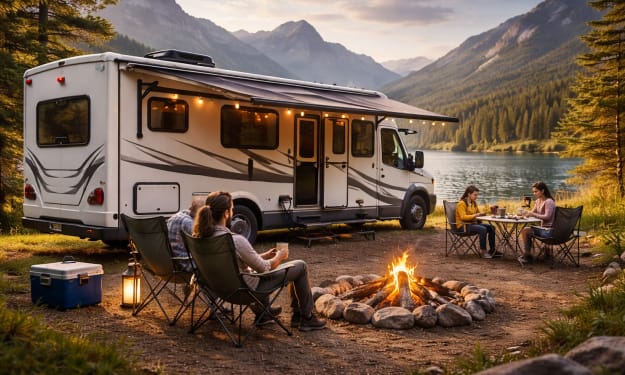
Recreational Vehicle Market: Why Life on the Road Is Rising
Recreational vehicles have long embodied freedom and adventure. Yet in recent years, they have also become symbols of a shifting travel culture. one that values flexibility, comfort, and connection with the outdoors over traditional hotel stays. At the heart of this evolution is the Recreational Vehicle Market, where lifestyle meets mobility and demand is shaped by changing consumer preferences.
By james robert3 days ago in Journal


Comments
There are no comments for this story
Be the first to respond and start the conversation.