
Global AI in Agriculture Market to Reach $12.95 Billion by 2033: Key Trends and Growth Forecast
The AI in Agriculture Market is experiencing rapid growth, driven by the rising need for sustainable farming, real-time crop monitoring, and data-driven decision-making.

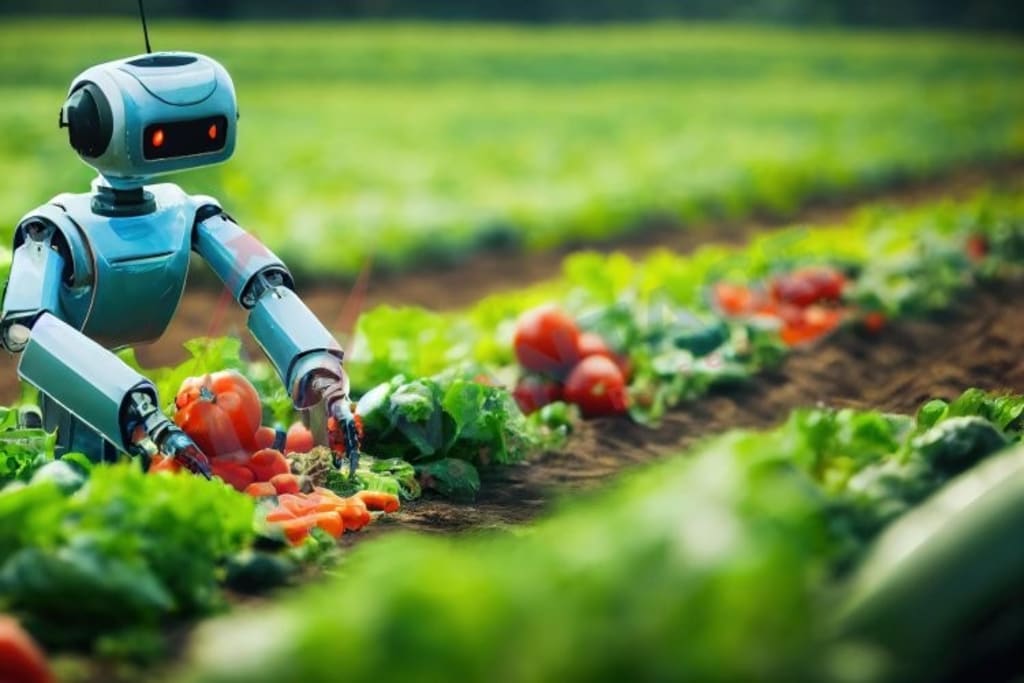
Market Size & Growth
- Market Size (2024): USD 2.18 Billion
- Projected Market Size (2033): USD 12.95 Billion
- Compound Annual Growth Rate (CAGR) (2025-2033): 19.48%
Key Market Drivers:
- Increasing Need for Precision Farming
- Rising Adoption of Agricultural Drones and Robotics
- Advancements in Machine Learning and Data Analytics
Emerging Trends
- Expansion of Smart Greenhouses
- Use of Natural Language Processing (NLP) in Advisory Systems
- Integration with Blockchain for Supply Chain Transparency
Segmentation Highlights
- Analysis By Offering
- Analysis By Technology
- Analysis By Application
- Regional Insights
Market Overview:
According to IMARC Group's latest research publication, the global AI in agriculture market size was valued at USD 2.18 Billion in 2024. Looking forward, IMARC Group estimates the market to reach USD 12.95 Billion by 2033, exhibiting a CAGR of 19.48% during 2025-2033.
This detailed analysis primarily encompasses industry size, business trends, market share, key growth factors, and regional forecasts. The report offers a comprehensive overview and integrates research findings, market assessments, and data from different sources. It also includes pivotal market dynamics like drivers and challenges, while also highlighting growth opportunities, financial insights, technological improvements, emerging trends, and innovations. Besides this, the report provides regional market evaluation, along with a competitive landscape analysis.
Claim Your Free "AI in Agriculture Market" Analysis Sample Report Here
- Market Dynamics
- Market Trends and Market Outlook
- Competitive Analysis
- Industry Segmentation
- Strategic Recommendations
Growth Factors in the AI in Agriculture Industry:
- Increasing Need for Precision Farming
Farmers are increasingly turning to AI-enabled precision farming to meet rising productivity demands while coping with soil degradation, climate variability, and limited arable land. These systems leverage multisource data—from IoT sensors to weather satellites—to fine-tune irrigation, seeding, and fertilization schedules. In Brazil, AI-driven models now offer real-time alerts on rainfall patterns, enabling timely nutrient application and disease prevention. Similarly, variable-rate technology (VRT) powered by machine learning helps reduce fertilizer usage by over 20%, cutting input costs and boosting soil health. As global food security concerns rise, precision farming technologies are becoming indispensable for long-term agricultural sustainability.
- Rising Adoption of Agricultural Drones and Robotics
The deployment of drones and robotics in agriculture is accelerating as farms seek efficiency amid labor shortages and climate uncertainty. Equipped with AI, drones can now identify weed clusters, evaluate crop maturity, and generate prescription maps for targeted spraying. For instance, in Spain, vineyards use drones with thermal imaging to assess vine water stress, enhancing irrigation decisions. Meanwhile, robots are being deployed for autonomous seed planting, harvesting, and real-time field mapping. Companies like Agrobot and Blue River Technology are creating specialized AI robots tailored for high-value crops. This mechanized precision is not only reducing human error but also ensuring more sustainable use of inputs.
- Advancements in Machine Learning and Data Analytics
Machine learning is fueling a major shift from reactive to predictive farm management. Today’s AI systems continuously learn from environmental data, enabling farmers to anticipate crop diseases, optimize harvesting times, and plan resource allocation months in advance. In China, ML algorithms are helping rice farmers balance fertilizer applications across large plots based on satellite imagery. Decision platforms integrate soil, climate, and yield data to create dynamic risk maps, enhancing insurance and lending models. These tools are particularly valuable for smallholder farmers, offering access to insights previously available only to large agribusinesses. ML’s growing integration into agri-platforms is enhancing both productivity and resilience.
Key Trends in the AI in Agriculture Market:
- Expansion of Smart Greenhouses
AI-driven smart greenhouses are optimizing environmental controls with real-time feedback loops. Systems now regulate light spectra, temperature, and humidity based on plant growth models, achieving superior yields with minimal waste. In Canada, growers using AI-powered controls have reduced energy usage by 18% while boosting output. Smart sensors track microclimatic conditions and AI models interpret these signals to automate irrigation or trigger CO₂ enrichment. AI vision systems also detect pest outbreaks or fungal development before visible symptoms appear. This high-tech approach is enabling continuous cultivation cycles and better resource efficiency, making AI-integrated greenhouses vital for controlled-environment agriculture.
- Use of Natural Language Processing (NLP) in Advisory Systems
NLP is transforming agricultural advisory by making expert insights more accessible through voice, text, and chat interfaces. Farmers with limited literacy can now ask questions in regional dialects and receive AI-curated guidance on disease management or market pricing. In sub-Saharan Africa, mobile-based NLP platforms are delivering customized weather updates and planting tips to over a million users. These systems integrate with national databases to deliver hyper-local recommendations based on soil profiles and crop history. NLP also enables two-way communication, allowing extension workers to gather field insights at scale. This democratized information flow is narrowing the knowledge gap in global agriculture.
- Integration with Blockchain for Supply Chain Transparency
Blockchain integration is creating tamper-proof, real-time records of every stage in the agricultural value chain. When combined with AI, these systems offer predictive analytics on spoilage, fraud detection, and optimal logistics routing. For example, an AI-blockchain hybrid used in Southeast Asia tracks shrimp from pond to plate, ensuring transparency and regulatory compliance. AI algorithms flag anomalies such as temperature breaches in cold chains or mismatched batch records. This fosters accountability across producers, distributors, and retailers. As food authenticity becomes a consumer priority, such systems are boosting trust and unlocking premium pricing opportunities for certified, traceable products.
Unlock Exclusive Insights—Buy the Full Report with a Discount!
Leading Companies Operating in the Global AI in Agriculture Industry:
- A.A.A Taranis Visual Ltd.
- Ag Leader Technology
- AgEagle Aerial Systems Inc.
- Bayer AG
- Deere & Company
- Gamaya
- Granular Inc. (DuPont de Nemours, Inc.)
- International Business Machines Corporation
- Raven Industries Inc.
- Trimble Inc.
- Oracle Corporation
- Wipro Limited
AI in Agriculture Market Report Segmentation:
Analysis By Offering:
- Software
- Hardware
- AI-as-a-Service
- Services
Software represents the largest segment due to the increasing adoption of AI-powered software solutions for crop management and yield optimization.
Analysis By Technology:
- Machine Learning
- Computer Vision
- Predictive Analytics
Machine learning accounts for the biggest segment as it enables advanced data analysis and predictive modeling for precision agriculture.
Analysis By Application:
- Precision Farming
- Agriculture Robots
- Livestock Monitoring
- Drone Analytics
- Labor Management
- Others
Precision Farming exhibits clear dominance as it offers farmers enhanced control over crop production and resource utilization.
Regional Insights:
- North America (United States, Canada)
- Asia Pacific (China, Japan, India, South Korea, Australia, Indonesia, Others)
- Europe (Germany, France, United Kingdom, Italy, Spain, Russia, Others)
- Latin America (Brazil, Mexico, Others)
- Middle East and Africa
Research Methodology:
The report employs a comprehensive research methodology, combining primary and secondary data sources to validate findings. It includes market assessments, surveys, expert opinions, and data triangulation techniques to ensure accuracy and reliability.
Note: If you require specific details, data, or insights that are not currently included in the scope of this report, we are happy to accommodate your request. As part of our customization service, we will gather and provide the additional information you need, tailored to your specific requirements. Please let us know your exact needs, and we will ensure the report is updated accordingly to meet your expectations.
About Us:
IMARC Group is a global management consulting firm that helps the world’s most ambitious changemakers to create a lasting impact. The company provide a comprehensive suite of market entry and expansion services. IMARC offerings include thorough market assessment, feasibility studies, company incorporation assistance, factory setup support, regulatory approvals and licensing navigation, branding, marketing and sales strategies, competitive landscape and benchmarking analyses, pricing and cost research, and procurement research.
Contact Us:
IMARC Group
134 N 4th St. Brooklyn, NY 11249, USA
Email: [email protected]
Tel No:(D) +91 120 433 0800
United States: +1–201971–6302
About the Creator
James Whitman
With years of experience in analyzing global industries, I specialize in delivering actionable market insights that help businesses stay ahead in an ever-changing landscape.
Keep reading
More stories from James Whitman and writers in Journal and other communities.
Global Inhaled Nitric Oxide Market to Reach $1,732.93 Million by 2033: Key Trends and Growth Forecast
Market Size & Growth Market Size (2024): USD 1,002.83 Million Projected Market Size (2033): USD 1,732.93 Million Compound Annual Growth Rate (CAGR) (2025-2033): 5.64%
By James Whitman6 months ago in Journal
The goals I did not achieve
Every writing goal I made for the year is a wash. It has been this way for a while, but I think it's important to be open about my failures and the reality of how life can get in the way. This is especially true considering the several times I have posted on Vocal about my writing goals, how I was changing my approach, and where I was hoping to be for the upcoming year. I will probably do that again in a couple months, but for now, it is time to acknowledge where I am today.
By Kay Husnick24 days ago in Journal
The Rosary and How It Leads to Christ
The Rosary is one of the most recognizable and cherished prayers in the Catholic Church. To many, it may appear as a repetitive sequence of words, beads, and Hail Marys, but in reality, it is a spiritual journey that leads the faithful closer to Christ. Praying the Rosary is not about counting prayers as if they were tokens. It is about meditation, reflection, and entering into the mysteries of salvation history through the life of Jesus.
By Sound and Spirit5 days ago in Journal


Comments
There are no comments for this story
Be the first to respond and start the conversation.