

A Tiny Land with Colossal Significance
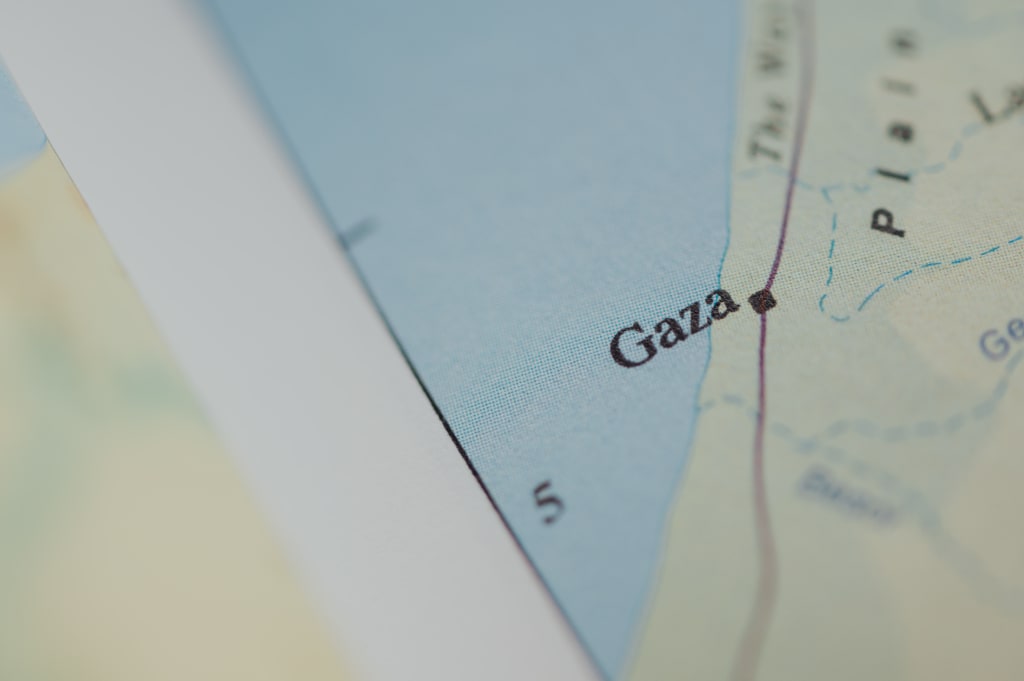
In the heart of the Middle East, the Gaza Strip is a minuscule piece of land, but don't be deceived by its modest size. With just 365 square kilometers, this territory holds immense importance. In 2020, UN estimates indicated a population of around two million Palestinians, resulting in an extraordinary population density of approximately 5,000 people per square kilometer. Like a powder keg ready to ignite, the rapid population growth only accentuates the already-present tensions.
The Religious Mosaic and Palestinian Identity
The overwhelming majority of Gaza Strip's inhabitants follow the Sunni Muslim faith. This small territory is home to a significant part of the Arab groups within Islam, contributing to the richness of the region's religious mosaic. But beyond religion, the Gaza Strip has a complex and fascinating history.
Origins: Divisions and Connections
The history of the Gaza Strip dates back to 1947 when the UN established it as part of a division of Palestine aimed at creating space for the State of Israel. However, right from the start, the Gaza Strip maintained a strong bond with Palestinian identity, a connection that only grew over time.
From Palestinian Governments to Israeli Occupation
Between 1948 and 1959, the Gaza Strip was governed by a government composed entirely of Palestinians, established by the Arab League. Subsequently, between 1959 and 1967, Egyptian groups controlled the region. But the pivotal moment came in 1967 during the Six-Day War when Israel occupied the Gaza Strip and other Arab territories, solidifying its political, military, and territorial control.
The Spark that Ignited a Lasting Conflict
The Israeli occupation of the Gaza Strip served as the spark that initiated a series of enduring conflicts between Palestinians and Israelis. The territorial dispute over the Gaza Strip is deeply rooted, with Palestinians claiming it as their right based on the original partition of Palestine by the United Nations, while Israelis also base their claims on deep historical and religious connections.
Jerusalem: A Desired International City
In 1947, the UN declared Jerusalem as an international city, an area that would not be controlled by either Arabs or Israelis. However, over time, a significant part of Jerusalem came under Israeli control, transforming it into an even more fervently disputed point.
The Oslo Accords: Hope in the Quest for Peace
In an effort to achieve peace in the region, the Oslo Accords were established between 1993 and 1995. These accords required Israel to return the Gaza Strip to Palestinians, which finally occurred in 2005. However, Israel retained considerable control over the area, including airspace and land crossings, using fences and walls that continue to fuel conflicts.
Crucial Diplomatic Recognition
In 2012, the UN took a significant step by recognizing Palestine as a nation-state with territory, government, and population. This act had a substantial impact on international diplomacy, leading several countries to acknowledge Palestine as a sovereign state. Nevertheless, the Gaza Strip remains the epicenter of tensions in the region, due to its territorial disputes, religious differences, international influences, and a long history of conflicts between Arabs and Israelis.
Conclusion: The Gaza Strip - A Crossroads of History
The Gaza Strip is the stage where these persistent conflicts continue to unfold. These deeply buried roots of mutual recognition and territorial disputes have not been easy to eradicate. This is a land where history is continually being written and rewritten, a narrative that continues to develop before our eyes, with an uncertain future but an undeniable legacy. It's a place that carries the weight of the past while wrestling in the whirlwind of the present, a story that has not yet found its epilogue.
About the Creator
Keep reading
More stories from writers in Journal and other communities.
The Town That Banned Wi Fi. A 10 Year Case Study on Electrosensitivity.
A small European town took a radical step. Local leaders banned public Wi Fi. They removed routers from schools, libraries, and offices. Private hotspots faced strict limits. The decision followed complaints from residents who reported headaches, fatigue, and sleep problems. They linked these symptoms to wireless signals. Officials labeled the condition electrosensitivity.
By Wilson Igbasi7 days ago in Journal
Rachel Reviews: The Spiral Archive by Pieter Hendrik
It's difficult for me to know where to start with a review of this book as it was, for me, an entirely unique experience and one that I'll probably never have again. I don't want that to be interpreted as unenjoyable but it has left me scratching my head a little and ruminating on its content, its themes and its characters.
By Rachel Deeming3 days ago in BookClub


Comments
There are no comments for this story
Be the first to respond and start the conversation.