
G20 Summit 2025 in Johannesburg: What to Expect, Key Agendas, and Global Timings
World leaders will gather in Johannesburg, South Africa, for the G20 Summit 2025 — a critical global meeting shaping the future of finance, climate policy, and technology.

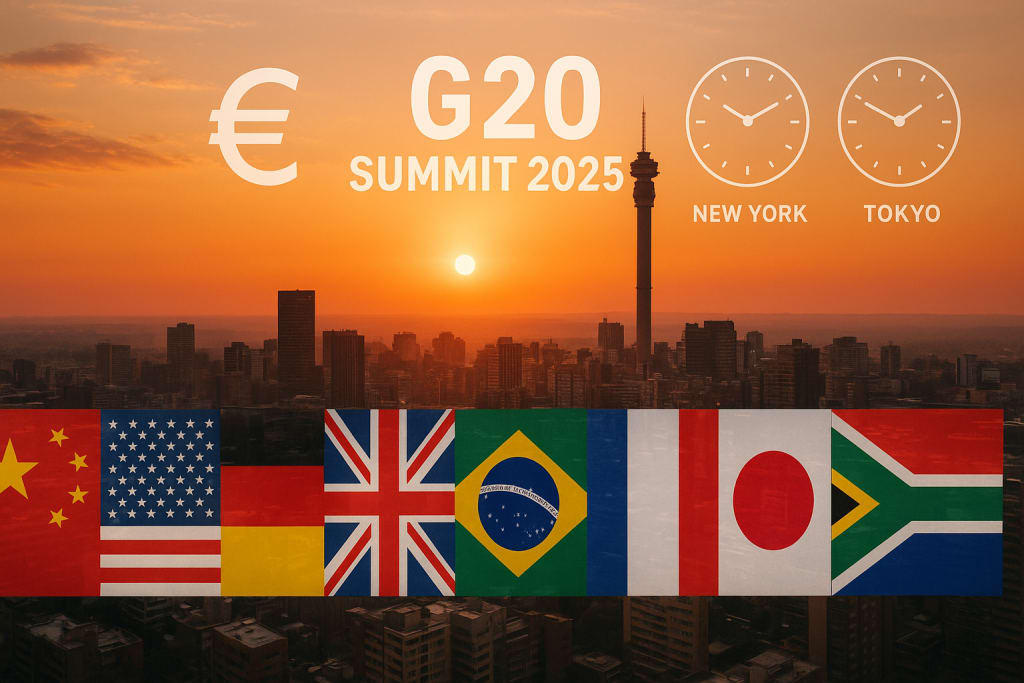
The G20 Summit 2025, set to be held in Johannesburg, South Africa, from November 22–23, 2025, will mark a defining moment in international cooperation. As world leaders converge to address global challenges — from economic reform to climate change — the summit will also highlight Africa’s growing influence on the global stage.
For anyone planning to follow the event live or coordinate across different time zones, knowing Johannesburg’s local time is essential. You can easily check the exact city time and convert it to your region using WorldClocksTime.com — a simple tool that instantly shows accurate local time anywhere in the world.
What Is the G20 Summit?
The Group of Twenty (G20) brings together the world’s largest economies — representing about 85% of global GDP and 75% of international trade. Members include the United States, China, India, Japan, Germany, the UK, and the European Union, among others.
Each year, the G20 presidency rotates among member countries. In 2025, South Africa takes the honor, becoming the first African nation to host the summit since the forum’s inception in 1999.
This year’s meeting is expected to focus on inclusive growth, energy transition, digital innovation, and equitable financial reforms — themes that resonate globally as nations rebuild from economic uncertainty.
Why Johannesburg Matters
Johannesburg isn’t just South Africa’s largest city; it’s also the financial heart of Africa. Hosting the G20 here reflects a shift toward greater representation for developing economies in global decision-making.
The city’s advanced infrastructure, thriving business districts, and cultural heritage make it a symbolic and practical venue. The summit will likely be held at the Sandton Convention Centre, a world-class facility that has previously hosted high-profile international events.
If you’re planning to follow or cover the event, remember: Johannesburg is in the South Africa Standard Time Zone (SAST, UTC+2) — no daylight saving time.
To instantly convert it to your city’s local time, check WorldClocksTime.com — type “Johannesburg” in the search bar, and you’ll see the current time immediately.
G20 Summit 2025 Key Dates
- November 20–21, 2025 → Ministerial and Sherpa meetings
- November 22, 2025 → Opening ceremony, economic sessions
- November 23, 2025 → Final statements, joint declarations, closing ceremony
These two days will be packed with announcements, side events, and press conferences that influence global policy directions for the coming year.
Main Agenda Themes
Sustainable Economic Growth
With inflationary pressures and debt crises affecting multiple countries, leaders will discuss long-term strategies for stability and fair trade.
Climate Action & Green Energy
Expect strong calls for renewable investment, carbon reduction, and financing mechanisms to support developing nations’ sustainability goals.
AI and Digital Regulation
As artificial intelligence reshapes industries, the G20 will focus on building frameworks for ethical and inclusive technology use.
Global Health & Resilience
Building on lessons from the pandemic, discussions will explore global vaccine access and preparedness for future health threats.
Africa’s Economic Integration
As host, South Africa will spotlight the African Continental Free Trade Area (AfCFTA) and digital economy opportunities across the continent.
Expected Participants
Top leaders attending will include:
- Donald Trump (U.S. President)
- Xi Jinping (China)
- Rishi Sunak (UK)
- Narendra Modi (India)
- Emmanuel Macron (France)
- Cyril Ramaphosa (South Africa, Host)
- Olaf Scholz (Germany)
- Fumio Kishida (Japan)
- Ursula von der Leyen (European Commission)
This year, the discussions will likely emphasize cooperation between developed and emerging economies — especially regarding climate finance and technology sharing.
How the World Will Follow the Event
Global media outlets such as BBC, Reuters, and Bloomberg will provide live coverage, while local broadcasters in South Africa will air daily summaries.
For those outside Africa, time zone differences can make it tricky to track speeches and announcements in real time.
That’s why tools like WorldClocksTime.com are so helpful — allowing you to check Johannesburg’s local time and compare it instantly to your city, ensuring you never miss a key moment.
Global Reactions and What to Expect
The G20 Johannesburg Summit will be closely watched for policy shifts, especially regarding:
- Debt relief for developing nations
- Climate financing commitments
- Global tech regulation
- Digital currency cooperation
There’s also growing anticipation about the role of Africa as a stronger voice in global governance — a milestone moment that could redefine multilateral diplomacy for the next decade.
Travel and Local Insights
For those attending or reporting onsite, November in Johannesburg offers mild spring weather, with average temperatures around 22°C (72°F).
Visitors are advised to plan transport and accommodations early, as hotels near Sandton and Rosebank districts are expected to fill quickly.
Local attractions such as Nelson Mandela Square, Apartheid Museum, and Maboneng Precinct will likely draw international delegates seeking cultural experiences between sessions.
And before you set your itinerary, remember to check your local time difference — visit WorldClocksTime.com and search for “Johannesburg” to ensure you’re aligned with SAST (UTC+2).
Looking Ahead
As the 2025 G20 Summit approaches, expectations are high for concrete action on inclusive growth and technology-driven sustainability.
Hosting the summit in Africa for the first time is both symbolic and strategic — signaling that global cooperation must include all voices to be effective.
From shaping economic recovery strategies to defining digital governance, the Johannesburg summit is more than a meeting — it’s a moment in history that reflects the evolving balance of global power.
Final Note
Time zones shouldn’t stand between you and world-changing conversations. Whether you’re a journalist, student, business owner, or policy enthusiast — staying updated with global events begins with being in sync.
Use WorldClocksTime.com to track Johannesburg’s local time before and during the summit, and explore accurate times for any city worldwide in seconds.
About the Creator
Alicia Black
Alicia Black is a dynamic digital marketing professional with a strong foundation in web and app development, email marketing, content creation, and AI-driven strategy.
Keep reading
More stories from Alicia Black and writers in Journal and other communities.
Nubiz Solutions’ SEO Services in El Paso, Texas
El Paso, Texas, has long been a city where tradition meets transformation. Known for its strong local economy, diverse communities, and cross-border commerce, El Paso has always stood at the crossroads of opportunity. But in today’s digital-first world, local business growth depends not only on word-of-mouth or reputation — it depends on how well a business appears online. Every café, law firm, medical practice, and real estate agency in El Paso is now competing for one thing: visibility on Google.
By Alicia Black3 months ago in 01
How Retrieval-Augmented Generation Services Are Transforming Enterprises at Scale
Not long ago, many AI initiatives inside large organizations struggled to move beyond pilot projects. The models looked impressive in demos, but once deployed, they often failed to deliver accurate, reliable, or up-to-date results. Hallucinations, outdated knowledge, and lack of transparency made decision-makers cautious about scaling AI across critical business functions.
By Kanak Appinventiv5 days ago in Journal



Comments
There are no comments for this story
Be the first to respond and start the conversation.