
From Delhi to the White House: The Rise of Rishab Sharma
A Gen Z icon on reshaping Indian classical music through vulnerability, innovation and style

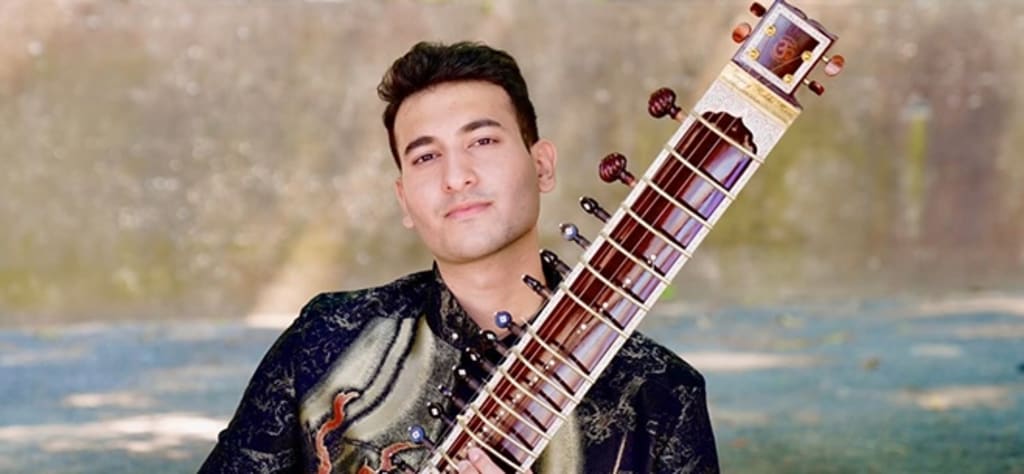
Rishab Rikhiram Sharma has quickly become one of the most recognisable young faces in Indian classical music, especially among Gen Z listeners who discovered him through viral sitar interpretations of pop and film hits. His videos, ranging from a delicate reimagination of “Tumhi Dekho Naa” to a stirring rendition of the Game of Thrones theme, have garnered millions of views and reshaped how young people perceive the sitar. But behind this rapid rise is a deeply personal story, one rooted in grief, healing and a renewed relationship with music.
Sharma was in New York in late 2020 when his maternal grandfather was admitted to a hospital in Delhi. It was the height of the pandemic, with strict restrictions keeping families apart. Unable to return home, he stayed connected through intermittent FaceTime calls, often playing sitar for his grandfather in an attempt to bridge the distance. When his grandfather passed away, the loss devastated him. Speaking from his home in Delhi, the 26-year-old recalls retreating into isolation, losing his appetite and almost abandoning the instrument he had played since childhood.
Therapy eventually helped him begin to recover, and slowly, the sitar became part of that healing process. Sharma started going live on Instagram and Clubhouse, sharing music and speaking candidly about grief and mental health. The sessions became a safe space for both him and the audiences who joined him regularly. What started as a way to cope soon evolved into Sitar For Mental Health, a project where he used improvisation and reflective performances as a form of communal emotional support.

This year, the initiative turned into a ten-city tour across India, where Sharma presented a two-hour set combining pranayama, meditative surbahar passages and immersive sitar improvisations. His original compositions gained the same momentum online as his viral covers. Alongside these milestones, Sharma also made history in 2022 when he became the first sitarist to perform a solo set at the White House. His exploration of ancient Raga Chikitsa traditions has only deepened his interest in music as a tool for emotional and physical well-being.
Sharma’s appearance often surprises people who assume classical musicians must fit a particular mould. When we speak, he is wearing a backward baseball cap and sparkling diamonds in both his ears and teeth. His aesthetic may lean modern, but his lineage is steeped in tradition. Sharma comes from a family of highly respected instrument makers whose creations have been used by legends like Pandit Vishwa Mohan Bhatt, Talvin Singh and Daler Mehndi. He himself is the final disciple of the late Pandit Ravi Shankar, after the maestro came across a video of Sharma performing and invited him to study under him. For Sharma’s parents, it felt like a divine blessing.
Through his teenage years, Sharma immersed himself in rigorous training, first under Ravi Shankar’s guidance and later with the maestro’s disciple Pandit Parimal Sadaphal. He moved to New York at seventeen to study music production and economics, where he found himself enthralled by the city’s thriving rap and jazz cultures. These influences are woven seamlessly into his music today. Tracks like “Text Me When You Reach” place the sitar within a lo-fi hip-hop landscape, while the Spotify-commissioned “Kautilya (The Echo Project)” with Naveen Kumar and Anuradha Pal glides effortlessly between Hindustani classical motifs and contemporary trap-inspired production.
His time in New York also fueled an interest in fashion. Rather than the traditional kurta worn by many classical musicians, Sharma opts for statement looks by designers like Suket Dhir and Agraj Jain. He even wears mehendi during live performances, a choice that initially made him nervous due to gender stereotypes. After trying it for the “Kautilya” music video, he embraced it fully, drawing motifs inspired by Shiva and viewing the designs as a way to channel spiritual energy into his playing.
Despite his growing fame, Sharma remains rooted in his family’s legacy. He still spends time at their musical instrument store in Delhi, where he first developed the idea for his next big project: making sitars accessible for young learners. Many children enter the store curious about the instrument, only to be discouraged by the price of handcrafted sitars. Sharma hopes to change that. The goal, he says, is simple: ghar ghar sitar. He dreams of a future where every Indian household has at least one sitar, ensuring that the instrument continues to evolve and thrive with the next generation.
About the Creator
Aarohi Mehta
Aarohi is an independent journalist and art enthusiast who covers culture, creativity, and modern digital trends. She brings a fresh, expressive voice to her stories, blending clear reporting with a strong artistic perspective.
Keep reading
More stories from Aarohi Mehta and writers in Journal and other communities.
Mame Khan: The Voice Carrying Rajasthan to the World
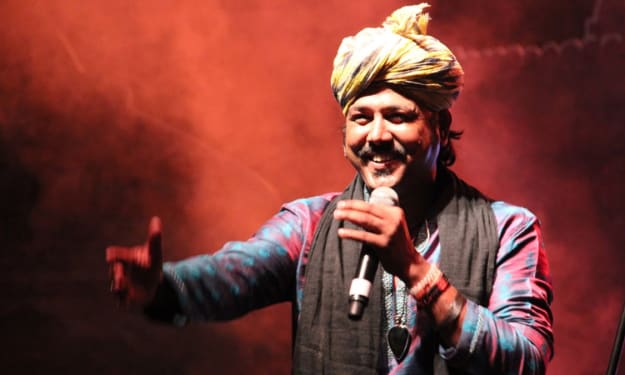
Mame Khan, one of the most recognisable voices of Rajasthani folk music, has spent years expanding the reach of India’s traditional sounds. His latest release, “Dama Dam Mast Kalandar 2.0,” signals another bold step in that direction. The track opens with shimmering electronic textures and rapid fire rap verses that collide with the earthy tones of the sarangi and harmonium. Over this blend floats Khan’s unmistakable voice, powerful and commanding. The song feels like a meeting point of old and new, a merging of sufi poetry, hip hop energy and folk heritage, all held together by Khan’s artistic vision.
By Aarohi Mehtaabout a month ago in Journal
The goals I did not achieve
Every writing goal I made for the year is a wash. It has been this way for a while, but I think it's important to be open about my failures and the reality of how life can get in the way. This is especially true considering the several times I have posted on Vocal about my writing goals, how I was changing my approach, and where I was hoping to be for the upcoming year. I will probably do that again in a couple months, but for now, it is time to acknowledge where I am today.
By Kay Husnick16 days ago in Journal
Gamification Market: Why We're Addicted to Playing for Real Rewards
We've all felt it—that irresistible urge to "just one more level" in a mobile app. But what started as fun mechanics in video games has quietly infiltrated every industry imaginable: corporate training, fitness apps, learning platforms, and even healthcare. The gamification market isn't just about entertainment anymore; it's the invisible architect reshaping how we work, exercise, and grow.
By james robert6 days ago in Journal
'20/20'
"Do It Again" the track that would ultimately open the Beach Boys final album on Capitol Records which was released on February 10th 1969 had originally been released as a single in August of 1968. The track was the first of many post-Pet Sounds era throwbacks to the early Beach Boys sound which would become continually more cliched and eventually lead the Beach Boys to the level of self-parody they would eventually succumb to in the 1980s while their closest contemporaries The Beatles nearing the end of their run in 1969 would go on to be viewed as the most influential band of all time. However, the song itself is not bad on its surface, and it opens with a futuristic sounding (for 1969) drumbeat captured by then-Beach Boys engineer Stephen Desper using tape delays on the drums performed by Dennis Wilson and John Guerin. The song has been re-recorded numerous times over the years on various Beach Boys-related projects most notably the 2011 re-recording at Capitol studios featuring the five surviving Beach Boys at the time backed instrumentally by various members of both the Brian Wilson Band and Mike Loves touring "Beach Boys" to promote the then upcoming Beach Boys 50th Anniversary reunion tour in 2012. The hammering and power drill sound at the end of the song was an excerpt from a track called "Workshop" that was to be a part of the uncompleted "SMiLE" album.
By Sean Callaghan6 days ago in Beat


Comments