
Flying Clean: Sustainable Aviation Fuel Market Grows on Carbon Neutrality Goals and Airline Demand
The aviation industry has discovered its sustainable route forward with Sustainable Aviation Fuel as climate urgency increases and public pressure intensifies

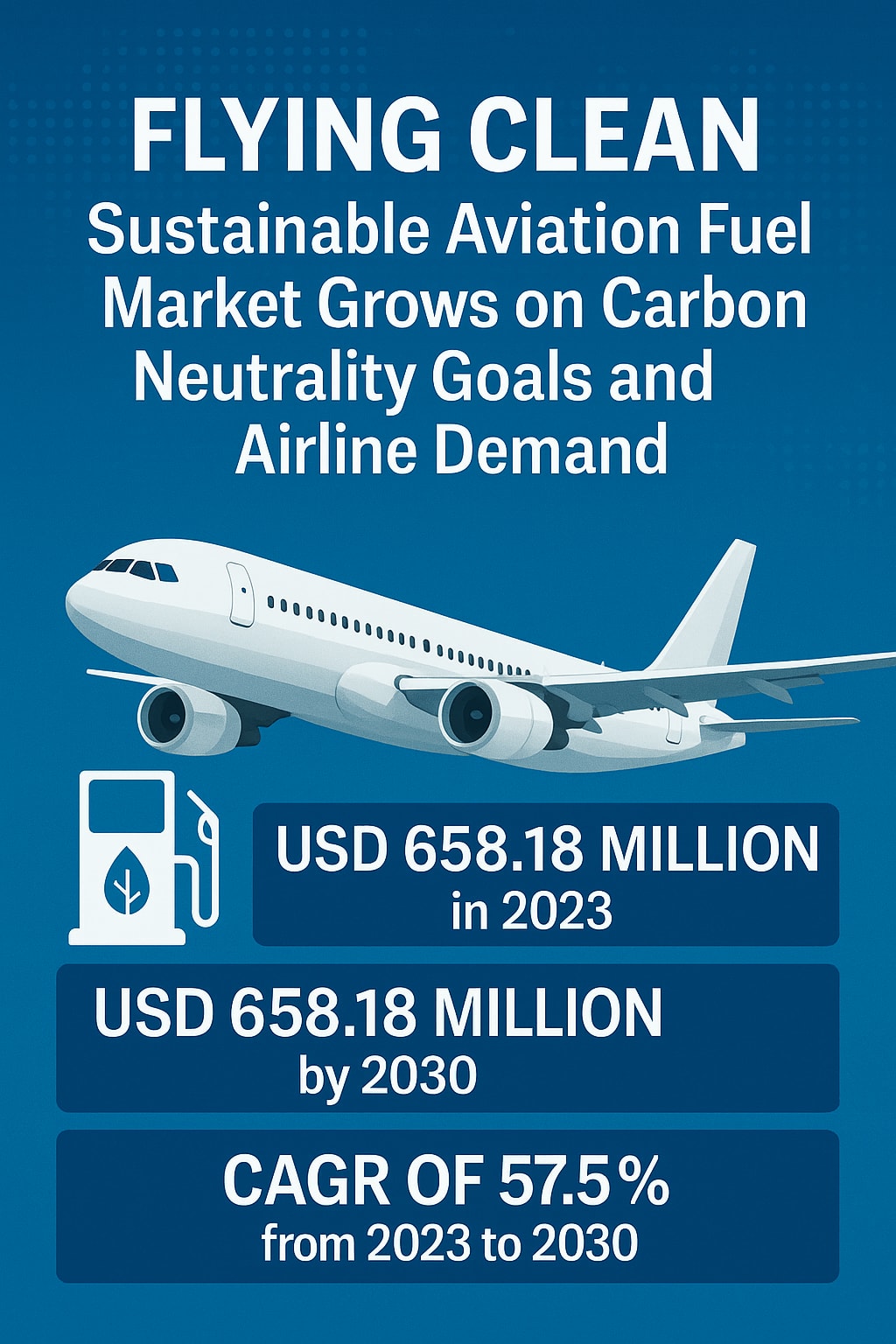
The aviation industry which faces significant challenges in decarbonization now adopts Sustainable Aviation Fuel market as a powerful solution during a time when climate commitments transform entire industries. The aviation industry alongside government and manufacturing bodies is driving toward net-zero emissions which leads to substantial growth in the global SAF market that promises cleaner and greener airways.
🌱 What is Sustainable Aviation Fuel?
Sustainable Aviation Fuel encompasses alternative fuels derived from biomass, waste oils, municipal solid waste, algae, or captured CO₂ which enable aircraft to operate with reduced carbon emissions compared to standard jet fuel.
Depending on both feedstock type and production techniques SAF achieves lifecycle greenhouse gas emission reductions of up to 80% which positions it as a fundamental element of aviation's decarbonization roadmap.
✈️ Why Airlines Are Fueling Up on SAF
The aviation industry presently generates between 2 and 3 percent of worldwide CO₂ emissions which are expected to increase when air travel returns to normal after the pandemic. A growing number of airlines have established bold climate pledges which include achieving net-zero emissions by the year 2050.
SAF delivers a critical contribution to aviation decarbonization by providing a drop-in fuel option compatible with current aircraft and fueling systems which removes the requirement for extensive retrofits or new technology deployment. The production increase enables immediate scalability.
Major airlines such as United Airlines, British Airways, Lufthansa and Emirates have started integrating SAF into their operations through long-term off-take contracts with fuel producers.
📈 Market Outlook: Soaring to New Heights
Projections from the industry suggest the global SAF market will expand from USD 576.18 million in 2022 to more than USD 15.85 billion by 2030 with a CAGR above 57.5%. Key drivers include:
The European Union and United States authorities enforce regulations that require aviation fuels to decrease their carbon intensity levels.
The requirement for sustainable corporate travel is forcing airlines to implement eco-friendly travel options.
The U.S. Inflation Reduction Act’s SAF tax credit operates as an incentive and subsidy for sustainable aviation fuels.
Technological innovations are reducing production costs while simultaneously boosting yield efficiency.
Europe leads the way in SAF adoption because of strict environmental policies and ReFuelEU mandates yet North America and Asia-Pacific focus on building significant domestic SAF production capabilities.
🌍 Global Collaboration: Policy Meets Innovation
Multiple stakeholders beyond airlines contribute to the growing momentum behind SAF. Governments and fuel producers along with airports and technology companies are building strategic partnerships to expand production output.
The Clean Skies for Tomorrow Coalition and ICAO's CORSIA framework develop a unified SAF adoption roadmap. Both startups and large energy corporations are pioneering new production technologies such as power-to-liquid synthetic fuels and carbon capture-based synthesis methods.
🚧 Challenges on the Flight Path
Despite its promise, SAF adoption faces hurdles:
High costs: The price of SAF stands at two to five times higher than that of conventional fossil-based jet fuel at present.
Limited supply: The usage of SAF makes up under 0.1% of the total aviation fuel consumption worldwide today.
Feedstock competition: Bio-based resources face growing pressure because sectors like shipping and road transport require more demand.
Production scaling combined with better logistics systems and growing investor trust works to gradually overcome existing challenges.
🛫 The Future of Green Flight
Experts predict that Sustainable Aviation Fuel needs to make up 65% of all aviation fuel by 2050 to help achieve global net-zero objectives. The future holds significant potential with upcoming advances in advanced biofuels and synthetic fuels that promise to both lower emissions and build a resilient aviation sector prepared for future challenges.
✅ Conclusion
While the journey is far from over, the destination is clear: Travel by air can achieve sustainability while maintaining environmental protection at high altitudes.
The surge in airline demand combined with rigorous climate policies transforms clean flying from a target into an essential global requirement.
About the Creator
Paxton Templeton
I’m a storyteller at heart with a passion for turning data into compelling narratives. With a focus on industry trends, market insights, and growth statistics, I bring clarity to complexity
Keep reading
More stories from Paxton Templeton and writers in Journal and other communities.
Green Is the New Standard: Paper Packaging Market Sees Global Demand Soar
The paper packaging market achieves unprecedented global growth as sustainability becomes an expected norm rather than just an aspiration. The collective efforts of governments and brands along with consumer demand to eliminate plastic create a critical need for paper-based alternatives which transition from environmental solutions to business necessities.
By Paxton Templeton7 months ago in Journal
The goals I did not achieve
Every writing goal I made for the year is a wash. It has been this way for a while, but I think it's important to be open about my failures and the reality of how life can get in the way. This is especially true considering the several times I have posted on Vocal about my writing goals, how I was changing my approach, and where I was hoping to be for the upcoming year. I will probably do that again in a couple months, but for now, it is time to acknowledge where I am today.
By Kay Husnick24 days ago in Journal
Diary of Anony Elle
If you read the last post, forgive me… I was rambling. See, I have a plan! I have learned that perfection is not needed to start that plan. So, I just started it. I am committed and I will not allow my circumstances to deter me like I have many times before. Not this time. This time I am focused, dedicated, and willing to do everything that I need to do to achieve the outcome my babies and I deserve. I now know who I am, who they are, and what I am up against. I do not plan on being nice anymore, now that I know how stupid nice is. I do not wonder if they love me (“they” will be revealed soon) and I know who my enemies are; so I no longer have limits.
By Anony Elle5 days ago in Journal



Comments
There are no comments for this story
Be the first to respond and start the conversation.