
Flexible Displays Are Bending the Future of Screens
From foldable phones to rollable screens, why this market is exploding
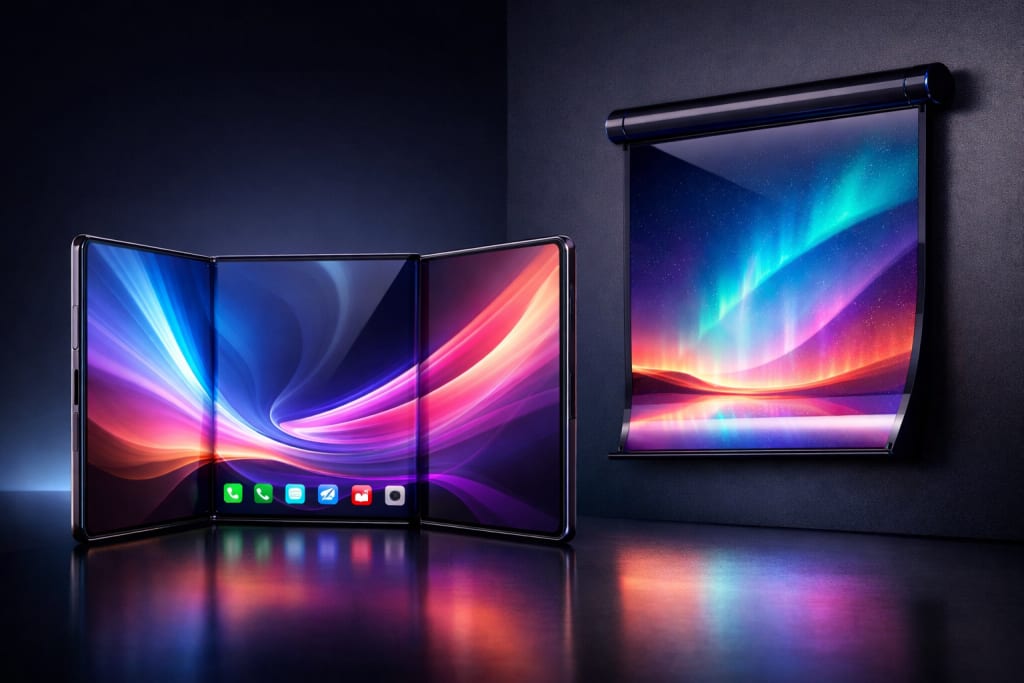
The first time a screen bends without breaking, it feels like a magic trick. One moment it’s a rigid slab of glass, the next it curves, folds, or rolls as if it were paper. That quiet moment—when technology stops feeling mechanical and starts feeling alive—is where the flexible display story truly begins.
What once belonged to sci-fi movies is now in your pocket, on your wrist, and slowly creeping onto walls, dashboards, and medical devices. Behind this visual wonder is a fast-accelerating flexible display market, reshaping how humans interact with digital information—and how industries design their future.
Why the Flexible Display Market Is at a Turning Point
Flexible displays are no longer experimental novelties. They are becoming strategic components in consumer electronics, automotive interiors, healthcare devices, and industrial equipment. Unlike traditional flat panels, these displays can bend, fold, roll, or conform to surfaces—unlocking entirely new product designs.
According to Mordor Intelligence, the flexible display market was valued at USD 20.52 billion in 2025 and is estimated to grow from USD 26.41 billion in 2026 to USD 93.32 billion by 2031, registering a CAGR of 28.73% during the forecast period (2026–2031). This single data point alone explains why global manufacturers, material suppliers, and designers are racing to stake their claim.
So what’s driving this momentum?
- Foldable and rollable consumer devices redefining portability
- Automotive displays blending seamlessly into curved dashboards
- Wearables and medical devices demanding lightweight, durable screens
- Smart infrastructure integrating displays into unconventional surfaces
These shifts are reshaping the flexible display industry, moving it from a niche innovation into a core technology platform.
Inside the Technology: What Makes Flexible Displays Different
At the heart of the flexible display market growth lies a quiet revolution in materials and engineering. Instead of rigid glass substrates, flexible displays use plastic or polymer-based layers, enabling screens to bend without losing functionality.
This shift unlocks several advantages:
Durability: Less prone to shattering than glass
Lightweight design: Ideal for portable and wearable devices
Design freedom: Enables curved, foldable, and rollable form factors
These benefits are reflected in emerging flexible display market trends, where product differentiation increasingly depends on form, not just resolution or brightness.
From a market perspective, manufacturers are focusing on:
Improving display lifespan under repeated folding
Enhancing brightness and color accuracy
Scaling production to improve yields and reduce costs
As these challenges are addressed, adoption widens—fueling changes in flexible display market share across multiple end-use industries.
To understand the broader market landscape and validated figures, explore more details of flexible display industry analysis
Where Flexible Displays Are Making the Biggest Impact
While foldable smartphones grab headlines, they represent only a fraction of the opportunity. The real story of the flexible display market forecast lies in how widely the technology is spreading.
Consumer Electronics
Smartphones, tablets, and laptops are leading adoption, driven by demand for larger screens without sacrificing portability.
Automotive and Mobility
Curved and wraparound displays are transforming vehicle interiors, integrating infotainment, navigation, and controls into a single visual surface.
Healthcare and Wearables
Lightweight, conformable displays improve comfort, usability, and durability—critical for medical monitoring devices and smart wearables.
Industrial and Commercial Applications
From control panels to digital signage, flexible displays adapt to environments where rigid screens simply don’t fit.
This diversification reduces reliance on a single sector and strengthens long-term flexible display market growth, making the industry more resilient to demand shifts.
What the Future Holds for the Flexible Display Industry
In the coming years, expect to see:
- Displays that roll out like fabric
- Screens integrated into furniture, architecture, and clothing
- New interaction models blending touch, gesture, and form
As AI-driven devices evolve, flexible displays will play a crucial role in making interfaces feel more human—adaptive, responsive, and unobtrusive.
The question is no longer if flexible displays will become mainstream, but how deeply they will embed themselves into daily life.
Final Thought: Are Flat Screens Becoming Obsolete?
Every technological shift has a moment when the old standard quietly fades. Flat, rigid screens may soon feel as outdated as physical keyboards on phones. The numbers behind the flexible display market size, combined with rapid innovation, suggest we are witnessing that transition in real time.
As screens bend to our needs literally the relationship between humans and technology becomes more fluid, more intuitive, and more personal.
About the Creator
Keep reading
More stories from Andrew Hamilton and writers in Journal and other communities.
Why Antennas Are Quietly Powering the Connected Future
You never see the moment connectivity almost fails. There’s no warning when a signal weakens, no headline when a network holds instead of collapses. Yet behind every seamless scroll, instant upload, and perfectly timed navigation cue, a hidden system is working relentlessly to keep the world stitched together. At the heart of that system is a technology so overlooked it’s practically invisible until it isn’t.
By Andrew Hamilton7 days ago in Journal
The goals I did not achieve
Every writing goal I made for the year is a wash. It has been this way for a while, but I think it's important to be open about my failures and the reality of how life can get in the way. This is especially true considering the several times I have posted on Vocal about my writing goals, how I was changing my approach, and where I was hoping to be for the upcoming year. I will probably do that again in a couple months, but for now, it is time to acknowledge where I am today.
By Kay Husnick25 days ago in Journal


Comments
There are no comments for this story
Be the first to respond and start the conversation.