
Finesse in Finance and Tactful in Technology - Robin Kiera [Interview]
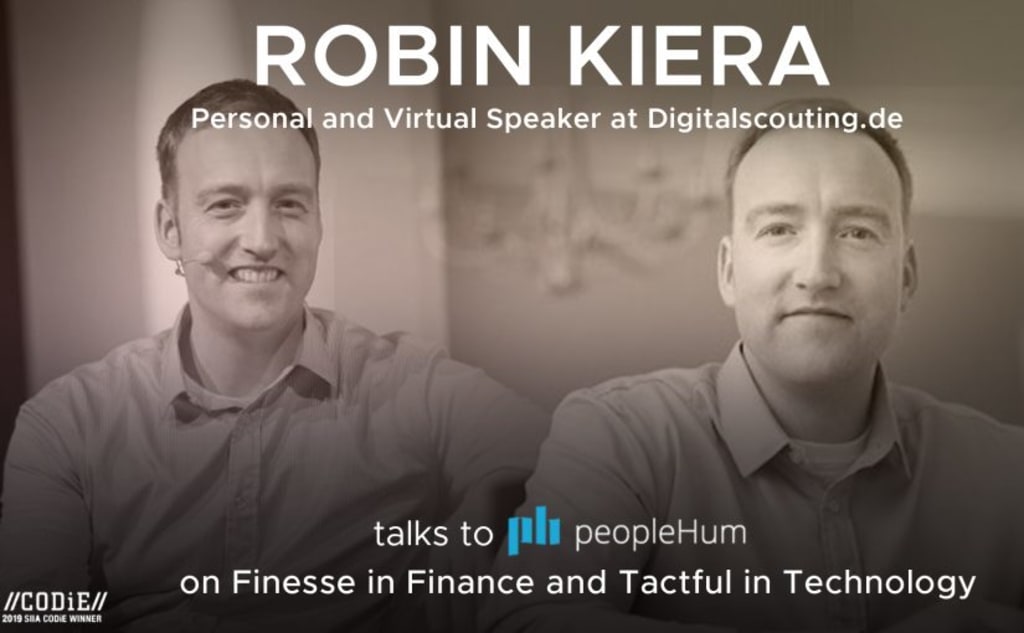
We had the pleasure of welcoming Robin Kiera to our interview series. I am Aishwarya Jain from the peopleHum team.
Aishwarya
Welcome, Robin. We’re thrilled to have you.
Robin
Thank you very much for having an insurance and finance model on board. I'm really appreciating that.
Aishwarya
Oh, well, it’s our pleasure, Robin.
So Robin, tell us a little about your journey so far, what led you to this amazing place that you're right now at?
Robin
So, I'm actually a recovering insurance sales agent. So I sold insurance in the street of Hamburg for quite some time. I went through several junior managerial positions in insurance finance then I went to start-ups when it wasn’t cool to work for startups. My boss said that, since you rightly asked me, into which department are you changing? I’m like, no I’m not changing. I’m leaving. And he was totally in disbelief. And I did not even tell him that I went to a start-up because he would have probably called company doctor and checked me on mental illness.
And then I went to a start-up which exploded from 0 to 1200 people. We build products that make billions in revenue. I did not have any shares of the company which was sold for 700 million euros, so I still need to work, and I also went to the finance industry to a private bank and led the digital and product development there and also again built a, build an app that made a billion in assets and information. Again no shares. So that's my story.
But, what is it you're discovering? So at some point, I was really annoyed by old white men in insurance and finance and especially in insurance a few years ago, totally neglecting what's going on in with the Internet, change of customer behavior.
I mean, they were C-suites out there that said, we're never going to do an app because we don't believe in the phone and everybody laughs going to that agent so totally delusional and I was the guy on stage saying, I'm calling out the elephant in the room. Why? Because I built these other two apps. Of course, it's part of a great team, but nevertheless...
“I thought, if I never get a job in this industry, I don't care. I will find something, but I need to really speak about these topics because you're risking hundreds thousands of jobs by not facing the new reality.”
So what happened was at some point, I found out that it started off as a blog and exploded 10,000 of followers, millions of views each month, unbelievable YouTube all over the place. And, we had, we had all the team members that really support all of that. So it's not only me.
And at some point insurance and banks came to me and said, Robin, well, you know, maybe we did not laugh about everything you said on stage but come, please help us and out. We now have projects that insurers and banks, where we try to help them, with digital strategy, digital products, or what we call attention hacking. So we’re now a small company but funnily enough...
“The company came out of the blog and not the blog out of the company, how it's normally done.”
So yeah, that's our story. And we are about 20 people and yeah, trying to, trying to help insurers and banks and insurtechs, but also other industries the best we can.
Aishwarya
Wow, that's wonderful and too bad you did not have the shares, but I think that's okay, you’re at a good place right now.
Robin
That’s what my mother always says too.
Aishwarya
And, you know, you say, you talked about something called ‘Attention Hacking’. Can you tell us what exactly is that?
Robin
Yeah. So what is the idea is, back in the days you just produced some sort of marketing material, and you would just throw it out there. But what happened over the last years is that the attention of humans changed and we know, okay, the end consumer and the B2C market that has changed.
But funnily enough, a lot of people think human research employees did not change or B2B decision-makers, that they are somehow still reading white papers of 500 pages and books and all of that. But that's not true.
They’re also hanging around on Instagram or TikTok or Linkedin. And we have been exploring on these platforms and also in a super small niche, which is insurance and finance professionals, which is, you know, nobody comes home and says, Oh, honey, let's look at our insurance honey or honey, let's look at our account bank statement. Nobody does this. And still you can grow in the niches and what we saw was that...
“You need to h the attention of your target group. You need to look, where is the attention of your target group? What, where are they? What kind of content are they consuming and where?”
Great story, How not to do it is, for example, the new commercial The Allianz, they hired the super celebrity Usain Bolt. Unbelievable role model, unbelievable body and chieftains he has, no doubt about it. But what they did, they do, they made a commercial that was running around all the time, in the end, they show the Allianz logo. It has nothing to do with this.
“Doesn't deliver any value to the customer. It doesn't help me to get through the financial crises. It's just nice pictures and the logo. This is old school. You can burn a lot of money with that. That’s totally fine, you can get a lot of KPIs with that because you know, there’s a whole industry out there that still produces boring content that doesn't help anybody and still makes a lot of money.”
That's okay but our approach is where is the attention and to deliver value. So what we all would have advised Allianz to do and not spending 10 million euros on that, is producing one video than producing 5000 videos and I really mean this 5000 videos and to target different target groups and to deliver value, not only say look how Usain Bolt is running, but how does Usain Bolt manage his money? What kind of insurance does he have?
Or maybe ask a person like me and, or some other regular person about what do families do in these situations and then go on the channels people watch. I mean, we have TV stations here. Nobody is watching anymore. Their demographic situation is a disaster, they're 60 plus, 70 plus. Okay, if you want to target that, that could go for TV. But most people are watching Netflix and YouTube and that's something we say, they need to go.
“You need to look where the attention of your customer is and then massively go after it."
Like a deer hunter, you know, it's like a hunter who's in the woods. He doesn't just stare where the deer was last year. You know, he goes, looks where the deer is and then gets a deer. I mean, that's like we should do in sales, but a lot of people are still doing it like it was done 15-20 years ago.
Aishwarya
Absolutely. I think you're right. You know, we need to catch the fish and we need to find where that pole of fish is, where is that pond, which has a lot of fish, right? And, you know, targeting, getting, getting the right audience, targeting the right audience, becomes very important. Just like, you know, the Usain Bolt example, it does not make sense to have Usain Bolt running for it, you know some insurance company.
Robin
And made one more thing.
“It's not only to go to the pond and use the bait for the fish, but actually to create a situation where the fish comes to you.”
That's what Attention Hacking does. You're so much constantly on the radar of your target group, that can be employees, that can be B2B decision makers, can be B2C customers. You're constantly on their mind, so in their moment of need, they think about you as a solution. And that's the difference.
And then, because you’re massively out there with content pieces that don't cost you 10 million a piece, but maybe 1000, 5000, 10,000, 50,000 better, then they come to you.
Why? What was the magic in this situation is, before you need, you have a target group of a 1,000,000 customs or 10,000 B2B decision makers in an industry, you need to go from door to door to door to door. And from the 27 first people, nobody wanted to answer you but it’d cost you a lot of energy.
What Attention Hacking does, you work these 10,000 people and there maybe 24 people that have a budget, that want to buy the stuff what you have, and then because they know you, they come to you in the moment of their need, so instead of pushing into the market hard core, they come to you. It takes some time, takes about 9-12 months until you achieve this, that it's a luxury situation.
I mean, I was an insurance sales agent, you know, I had phone number lists. I called people. Nobody wanted to see me. Nobody likes this insurance guy on their couch when they come home from work and would turn around just into them. Nobody.
Nobody wants that. But it's super hard, I would have given probably my hand if I would have had a magic solution where the clients are actually calling me. And that's what Attention Hacking does. And we have proof of that. And we are doing it ourselves, you know?
Aishwarya
Right, so it's just not about going to the fish pond, but even attracting the fish and for them to have your brand embedded in their mind so they come to you, if they have a problem or, and,
Is that exactly why you're also on TikTok? What's the strategy behind that?
Robin
Well, first of all, I’ve heard the first time about TikTok, I was reacting as everybody else. I was saying, Oh, that’s only for young people. This is stupid. And I was like, Robin, you're talking to all these decision-makers, always telling they shouldn't react to YouTube and LinkedIn and all of that.
And now you're wrecking the same way to this new thing. And that's something and I saw media saying, it's dangerous. It's bad. The same stuff they said about Facebook, Linkedin, YouTube like 10-15 years ago. So I was like, Okay, I need to test it. I need to have my own opinion.
And then we made our first videos and I saw what kind of large organic reach you can get. I mean, our first videos had like a 100,000 - 200,00 views. Unbelievable. And so I tried it out over, I think two or three months really intensely, we got a 1,000,000 views. I think 80,000 or 70,000 likes, which is unbelievable.
And we talked only about boring insurance topics or some funny stuff. You know, it's nothing. I mean, I'm not a Russian model. I'm not a sportsperson. I'm not funny. So it's really like boring content but we still got a lot of reach and...
“I wanted to have a personal opinion about it before I say it's something good for my clients or not, and that's the reason why we're on TikTok.”
Aishwarya
That's very interesting.
And do you think the same thing would work for any other industry? Like we’re a tech company, would that work for us, too?
Robin
I think so too, I would test it. I have a client who was a super niche insurer and targets people 50 plus, 40 plus. And they tested a TikTok, and they discovered that their target group was on there and they reached their target group for a fraction of the price they would need to invest in Facebook and other things you know, so they can really, really reach the target group there for a fraction of the price.
“You can win against your competitors. How? When you reach your clients or your leads way cheaper than your competitor does, then you can roll more at a lower price.”
Aishwarya
Wow, that's very interesting. I don't think a lot of people have really explored that yet. It's really to be seen to have been experimented.
Robin
Yeah.
Aishwarya
And how has the insurance and finance industry been responding to, you know, the current situation?
Robin
Well, I think they're very positive thing to start with. If you would have told me if the insurance industry and finance industry would be able to transition within days into a fully remote situation and no, not a single institution breaking down, I would have said that's not possible, I would have said half of them would not BE capable of doing it. But they were.
So I would say, 90% at least, their transition was you know, painful but possible. And they're working. What tells me that the insurance and finance industry is way more capable of doing change, but obviously it needs a pandemic to achieve it.
So my, so we’ve seen that. We have seen insurers and banks, for example suspending payments on loans, on mortgages around the world. We’ve seen insurers around the world reducing premium by themselves, but only a few. So a large part is waiting. Why? I mean now we're not driving so many cars. We’re at home. What does it mean? Fewer car accidents? That means we're home, fewer burglaries, fewer home insurance cases.
"So probably a lot of lines of business will make a lot of money out of this because the level of risk reduces but our premiums stay high, and only a few insurers actually lower the premium for their clients. So, that's the situation there. And I'm curious how that's going to play out."
And another big topic is Business Interruption Policies, which is a super niche product. But now a lot of businesses are interrupted, but these policies were never made for pandemics. But actually, for I don't know, you have your business burned down or you have a technical problem at your business. You know, machine burned down or there’s a damage, and you need to close for five days.
That's what it was actually meant for, so and now a lot of people say, I have this insurance, but the insurers say, A. it's excluded or it's wishy-washy. It's probably not included, and some have it included and they can face severe economic consequences.
Aishwarya
Right. Yeah. Absolutely and I think the consequence is something, the implications is something that we'll have to keep testing out as time goes by. And because of the outbreak, a lot of dynamics have really changed.
So what do you think is you know, the single most important thing that has changed and will stay like that even after the pandemic is over?
That’s NOT all, folks! To continue reading this awe-inspiring blog, click here: https://s.peoplehum.com/qgxn4


Comments
There are no comments for this story
Be the first to respond and start the conversation.