
Father Surprises His 4 Children With Their Own ATM Business
And How You Can, Too.

Due to centuries of physical and political warfare between races in America, oppressive policies have created socio-economic symptoms that make attaining wealth a difficult and often times foreign concept to many.
However, this father is not only passing down love, but knowledge a business and income producing skills to continue the family legacy - true generational wealth.
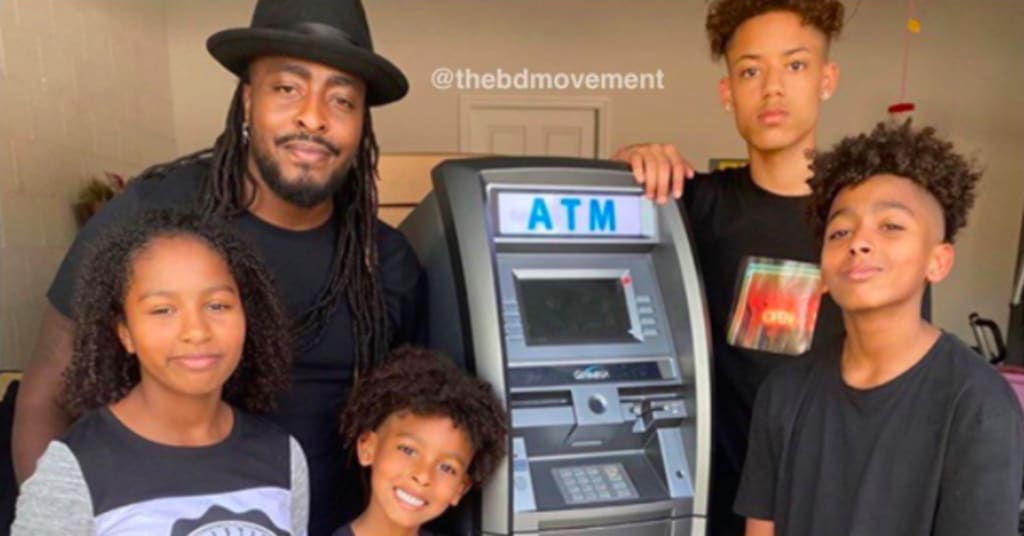
Meet William Moxey, a 34-year old serial entrepreneur and father of 4 from Florida, who is making national headlines for surprising his children with their very own ATM (automated teller machine) business called QuickBuxNow. He says that he wants to teach his children the importance of money management and responsibility!
At an early age of 12, he began with selling CDs, t-shirts, and sneakers until he started venturing into different businesses such as a wallet company, a hookah lounge, nightclubs, and an event space, along with other ventures. Moxey had a knack for business at such an early ago, thanks to his mother who he looked up to for owning and managing a salon since he was born. Her salon “Hair in Motion of New York” currently has three locations.
Wanting to teach his 4 children, ages 16, 13, 11, and 6, the values of money management and financial freedom, he thought of giving them an ATM business. He educated himself on the ins and outs of the business first before finally surprising his children, whom he views as his business partners, with their new business.
ATM fees have experienced significant increases over the last decade, but how much can you actually make by owning your very own little bank in a box?
As of now the national average that operators charge for ATM transactions fees is just under $3 ($2.97 to be exact), according to smartasset.com. With ATM machine prices at all time lows (under $2,500) and surcharges at record highs ($3), imagine just three people per day using your ATM:
(3 people x 30 days x $3.00), that’s over $250 per month from one machine, which is a 10% monthly return, excellent.
Now, imagine your ATM is in a busy location where cash is needed like a marijuana dispensary and used by 10 people per day; now imagine you have 5 or 10 machines in one year, that’s great passive income.
The 4 Types of Independent ATM Operators
There are a number of different types of companies providing ATMs and related services in the retail ATM market that are not owned or affiliated with an Financial Institution.
These independent ATM operators may own their ATMs as well as provide ATMs under contract to merchants, for whom they provide transaction processing and other support services. Here are the four types:
ISOs
These are Registered Independent Sales Organizations (ISOs) that provide ATMs and point-of-sale (POS) terminals to retail stores, gas stations, hotel lobbies and other nonbank locations.
ISOs may own ATMs and lease them to others, sell ATMs outright and/or operate their own fleet of ATMs. Their primary business is management of their own and/or others’ ATMs.
An ISO typically acts as an agent for merchants, including ATM owners, processing ATM transactions on their behalf. Services provided by an ISO include linking ATMs to an ATM/POS transaction network (also known as an EFT or electronic funds transfer network) that routes transactions to the cardholder’s FI, known as the card issuer.
ISO must get registered with the networks, obtain a sponsor bank, and must adhere to Network rules and regulation requirements.
IADs
This acronym refers to Independent ATM Deployers (IADs). IADs own and operate their ATMs. Like ISOs, they are required to have bank sponsorship and to belong to one or more regional and national U.S. ATM/POS networks whose card brands they wish to accept at their ATMs.
IADs are also required to meet all regional and national ATM/POS compliance rules, including data security standards, and comply with ATM industry mandates such as Payment Card Industry Data Security Standard and EMV migration.
IADs must comply with their sponsoring bank’s regulatory requirements, including quarterly reporting and due diligence on operator agreements with merchant clients. Some ISOs work with IADs and offer packaged pricing to incorporate the outsourcing of bank sponsorship, ATM/Debit/POS networks as well as many other available services.
Bank-branded Retail ATMs
Some independently owned ATMs are “branded” ATMs that are owned and operated by an independent company, but a Financial Institution pays for the right to display its logo on the ATM and to allow its customers to access the ATM free of charge.
What Costs do ATM Operators Typically Incur?
Costs can include any of the following:
Rent – Independent ATM operators may pay rent or participate in a revenue share in exchange for installing an ATM in a retail location.
ATM software and hardware – ATM operators must buy, install and upgrade ATM software and hardware when regulations, technology, or if new laws are adopted.
Cash services -- Operators must ensure that ATMs are adequately stocked with cash. They also must monitor transactions to ensure supply meets demand.
Maintenance and repairs – operators must perform routine maintenance, make simple repairs and restock supplies.
Security and insurance – The ATM needs to be in a safe, well-lit area. Optionally, operators may elect to install wireless camera, security systems, or simply obtain insurance to cover the ATM and the cash in it.
Infrastructure and processing – Operators must install and maintain the telecommunications infrastructure for their ATM or negotiate for the location to provide a high speed internet connection.
Network fees – ATM operators pay membership or license fees to the ATM/debit networks in order to route transactions on the networks unless you work with an ATM company that bundles these costs in with the transaction fees or deducts them from surcharge or interchange on a per transaction basis.
Taxes and licenses – While many small ATM operators run the ATM business as a home based business, you may still need to pay appropriate taxes as well as obtain any necessary state and local licenses. Be sure to check with your local county.
Regulatory and compliance costs – Very few independent ATM Operators get stuck paying these costs. Depending on the ATM Company you are working with, you may experience some costs of required inspections and reviews if any are necessary.
Fraud prevention and fraud losses – Operators may need to fund fraud prevention services and could potentially suffer losses from fraud. However new regulations like EMV card readers may shift some of the liability away from Operators with the help of dispute reconciliation services that should be provided by your ATM provider or processor.
Bank sponsorship – ATM operators typically pay to have a Financial Institution sponsor their membership in the EFT networks unless you work with an ATM company that bundles these costs in with the transaction fees or deducts them from surcharge or interchange on a per transaction basis.
If an ATM is owned by the actual business owner instead of an independent investor, the owner may purchase an ATM outright or pay a lease cost of an average $90 to $130 per month depending on credit worthiness and the ATM configuration.
Operators will also need to purchase receipt paper for the ATM, which may cost approximately $50 - $100 per year.
If the owner elects to purchase an optional maintenance contract, those can cost approximately $50 to $150 a month depending on the ATM and distance to the location. It is often better to use the default “time and materials” service option since new ATMs usually include 1 year parts and often labor and are often trouble free. Check with your ATM service company or the ATM manufacturer to see if they offer service contracts if this is something you want.
How Much Does an ATM Itself Cost?
Every ATM manufacturer offers multiple models to fit the merchant’s need. ATM prices range from about $2,000+ for basic free-standing indoor models designed for low-volume sites, to around $6,000 for more feature-rich, outdoor and through-the-wall models. Each model can be upgraded with a list of options, such as EMV card readers for an additional cost. They can also be leased for $79 to $249 per month, depending on the model and the vendor.
The merchant should start by selecting the site(s) where they want to put an ATM and then select the model that best suits their needs.
One of the most important features to look for is whether the ATM supports Internet communications, dial-up, wireless and/or leased lines.
The majority of merchant locations do fewer than 1,000 transactions a month, in which case Internet communications will usually be the best/lowest-cost solution, with a wireless device as a good second choice.
Leasing/rental or purchase
Before making a decision to buy or lease an ATM, merchants should get pricing from multiple IADs and compare costs for both buying and leasing ATMs as well as processing fees. Also, make sure that lease terms are “apples-to-apples.” IADs will often include some servicing support and other items in a lease to make it a more attractive option and may omit processing fees to make it hard to comparison shop.
The trend has been for retailers to either lease or purchase and completely outsource their ATMs to IADs but we are seeing many retailers opt for a placement, co-op deal, or partnership with IADs.
New ATM
Whether the merchant decides to buy or lease, they should always go with a new ATM. This way the merchant is assured the ATM represents the latest technology and has all the necessary software upgrades and compliance/security features.
Some older ATMs that run on Windows XP have a major issue now that Microsoft has discontinued support for XP.
Dealing With the Challenge of Cash Management
One of the biggest challenges of operating an ATM is having enough cash to keep it supplied with funds.
The inability to keep an ATM filled with cash will result in downtime and erode customer confidence in your location.
For that reason, higher-volume and remote ATM sites may want to consider using a vault cash supplier while lower-volume sites can be loaded in house.
A vault cash supplier gets ATM cash directly from a bank’s cash vault, often using an armored carrier company to supply it to its clients’ ATMs. Some IADs offer to vault cash locally and charge on a per transaction basis instead of paying the high cost of armored carrier fees.
According to experts, one of the most common mistakes IADs make is trying to do all their cash management themselves. As an IAD, if you want to vault your own cash, be sure your ATM provider offers help and advice to guide you through the best practices. Once you operate more than a dozen or so ATMs, vaulting the machines can end up consuming a lot of your cash and time and restrict your growth due to cash flow.
There is also some liability if the retailer’s staff stocks the store’s ATMs with cash. Most retailer owners take on that responsibility themselves or opt for a trusted longer term manager to handle that task. Loading an ATM is similar to loading the cash register draw except you only need one denomination and more cash than you typically keep in the cash drawer. Once store personnel are properly trained to put cash into ATMs, they realize how easy and profitable it is.
Positives and Negatives
The positives of a retailer stocking their own ATMs with their own cash are that it costs far less than using an armored carrier to deliver the cash and if your ATM runs out of cash, you can put money from the till directly into the ATM.
But the negative is that if an IAD relies on their merchants to load cash into their ATMs, cash loading is not always the merchant’s top priority – which means the ATMs uptime may suffer.
A good ATM provider will include the ability to set up text message alerts and online monitoring. If cash is running low, you don’t hear it from customers when the ATM runs out of money. You would simply receive a text message from your ATM telling you that the ATM is running low. Setting up a low threshold alert will help keep the proper amount in the ATM and ensure maximum uptime.
The Bottom Line on Profits:
The industry rule of thumb says that approximately 2 to 7 percent of people walking by an ATM in a store will use it.
So let’s say that 200 people visit a location daily, using 4.5% which is half of the 2 to 7 percent range provided above, that means 9 people would use the ATM on any given day.
You could then take those 9 people, multiply them by the
amount of surcharge and interchange you earn for each transaction, then take that figure and multiply it by the number of days of business (how many day’s the location is open) in the week, month or year. This would give an ATM owner, or perspective owner, an estimate on how much revenue could be generated from the machine.
Ways to Further Increase Profits ...
One of the key ways to boost profits is to carefully choose the right ATM business model for the particular establishment involved. There are four models to choose from:
Turnkey – In this model the IAD owns the ATM and is responsible for most aspects of its operations, including ATM monitoring, managing and loading cash, replacing supplies, and providing maintenance, customer- service support, and transaction processing. The merchant provides a place to locate the ATM and an electric outlet to power it.
Merchant-Assisted – In this model the IAD owns the ATM and provides all transaction processing, performs ATM monitoring and related customer-service support, and, in some cases, performs maintenance for more complicated problems. The merchant provides and loads cash as well as performs basic maintenance.
Merchant-Owned and Loaded – In this model the IAD provides transaction-processing services, ATM monitoring, and other services, such as customer-service support and arranging for advanced maintenance. The merchant owns the ATM, responsible for the majority of the operations, including basic maintenance and managing and loading cash.
Merchant Cash-Assisted – In this model, the IAD provides and loads cash, and provides transaction-processing services, ATM monitoring, and other services, such as customer service support and arranging for advanced maintenance. The merchant owns the ATM, responsible for operations, including basic maintenance, but not managing and loading cash.
While most IADs outsource many of the processing and support functions to larger and experience ATM companies, IADs focus on finding locations and customer satisfaction.
The ATM business is now similar to the vending machine business and almost anyone can become an Independent ATM Deployer (IAD)
This is much better than in the past where retailers dealt with independent sales agents and often ended up signing agreements that were too long and didn’t know who to contact when they had a problem with their ATM machine.
Another way to boost profits is to brand the ATM with a well-known Financial Institution (FI).
Under this scenario, the ATM Company would get a Financial Institution to display its logo on the ATM and for its customers to use the ATM free of charge.
This type of arrangement has three benefits for ATM operators:
Use of the machine will increase due to it drawing in customers of the sponsoring bank.
Additional customers will be drawn to use the ATM because they trust the bank’s name and the bank will most likely notify customers of the ATM online, in marketing materials and other customer notifications giving the location more exposure.
Plus, the operator may receive some additional revenue from the branding fee.
One more way to boost profits is to offer additional products and services at ATMs, as well as account transfers and balance inquiries.
Selling non-cash products and services such as prepaid cards, concert tickets, cellphone airtime, bill payments, person-to-person transfers, check cashing and dynamic currency conversion at ATMs helps to compensate for the decline in interchange rates in recent years however the hardware necessary to facilitate these types of transactions can substantially increase the cost of the ATM.
Many experts believe that providing bill payment services at ATMs in convenience stores could prove to be very popular, because of the large number of unbanked and under-banked consumers who use convenience stores.
Advertising toppers and smartphone check-in apps are starting to make their way into the ATM business. Once you have a location with an ATM, the other opportunities will reveal themselves by your ATM provider.
Dynamic Currency Conversion
DCC could be another way to receive additional profits from an ATM. DCC allows individuals traveling in foreign countries to complete ATM or point-of-sale transactions in the currency of their home country instead of in the local currency.
If the customer chooses DCC, the transaction remains in the currency of the card throughout processing and settlement.
The benefit to consumers is that they can see the exact transaction amount and rate of exchange immediately at the point and time of transaction rather than waiting for a bank statement, enabling them to more accurately budget and manage their bank account.
ATMs with DCC can become popular with tourists; however this may limit the surcharge income since international transactions cannot be surcharged.
Prepaid cards
Open- and closed-loop prepaid cards, including gift cards and general purpose reloadable (GPR) prepaid cards, have become a major force in the U.S. payments industry.
They are attractive to consumers because of their flexibility, with GPR prepaid cards having taken on a leading role as a preferred financial instrument among unbanked and under-banked consumers as well as millennials.
If you’re a retailer or an IAD and want to provide any of these services be sure to inquire as to the additional associated costs.
Conclusion
Approximately 300,000 of the 430,000 ATMs currently in use in the United States are operated by IADs, according to the latest statistics. The ATM Trade Association says 75% of ATMs deployed at non-bank locations are operated by IADs.
Clearly, independent investors are catching on to the profitability of ATMs.
Want to learn much more about installing an ATM in a business? Visit Amazon to get Noah Wieder’s book, “The Amazing Money Machine.” This book is available as a Kindle book or in Paperback. The paperback is over 200 pages and reveals everything you need to know about getting started in the ATM business, including:
An in-depth chapter on How the ATM Business Works
Where to Find Locations
What to Say to the Store or Business Owner
Unknown secret opportunities
How to Order Machines, Required Paperwork
And much more
You can read the first few pages of the book for free on Amazon
About the Creator
tribe.
Presenting pan-African efforts, voices and cultures with understanding, honor, and dignity.
Keep reading
More stories from writers in Journal and other communities.



Comments
There are no comments for this story
Be the first to respond and start the conversation.