
Farming the Future: How Industrial Hemp Market Is Reshaping Global Supply Chains
Analysts predict that the worldwide market will expand to USD 16.82 billion by 2030 from the current USD 6.3 billion in 2024 with a compound annual growth rate exceeding 17.5%.

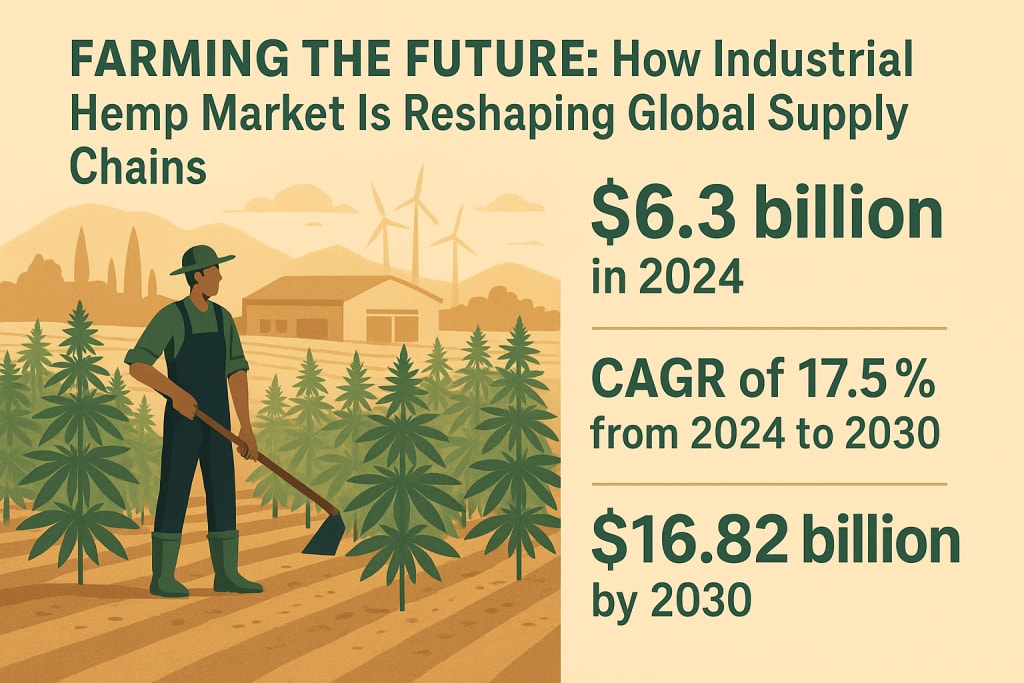
The transition toward sustainable practices is making industrial hemp a disruptive force that impacts both agricultural systems and worldwide supply networks. Hemp has transformed from being a misunderstood crop with heavy restrictions due to its cannabis connection into a versatile renewable crop with diverse applications in textiles, construction, bioplastics, food and health sectors.
The industrial hemp market is experiencing rapid expansion thanks to increasing global demand for sustainable materials and supportive government regulations. The movement represents a fundamental shift in supply chain material sourcing that points toward a future where hemp stands as a competitive alternative to traditional resources both in utility and profitability.
Why Hemp, Why Now?
Industrial hemp which comes from the non-psychoactive Cannabis sativa species emerges as an eco-friendly answer to current industrial problems. Because it uses minimal pesticides and water while restoring soil vitality hemp stands as one of the planet's most sustainable crops. Hemp's ability to serve multiple functions beyond agriculture is fueling its rise as a mainstream manufacturing and retail commodity.
Key sectors benefiting from industrial hemp include:
• Textiles: Hemp fibers demonstrate superior strength and durability compared to cotton while offering enhanced breathability. Eco-fashion brands are now using hemp as a sustainable material for their products.
• Construction (Hempcrete): Hempcrete combines light weight properties with insulating capabilities and carbon sequestration to transform green building practices.
• Bioplastics and Composites: Biodegradable polymers derived from hemp now present alternatives to traditional petroleum-based plastic materials.
• Food and Nutrition: Plant-based food enthusiasts appreciate hemp seeds and oils for their high protein content and essential fatty acids.
• Personal Care and CBD: The wellness product industry experiences major growth from hemp-derived skincare and supplement products that differ from marijuana-derived CBD.
A Global Supply Chain Revolution
Hemp’s versatility across multiple industries creates a distinctive competitive edge. Industrial hemp serves not only as a crop but also functions as fundamental material in circular economic systems. With supply chains changing post-pandemic businesses turn to hemp for its durable nature and local growth options along with its environmental contributions.
• North America: Hemp farming innovations show the U.S. and Canada as leaders post-legalization thanks to major investments in processing infrastructure.
• Europe: The Common Agricultural Policy of the EU provides support for hemp farming. Hempcrete and textile applications are being led by countries such as France and the Netherlands.
• Asia-Pacific: As the leading global hemp producer China controls hemp fiber exports while enhancing its influence in textile and bioplastic industries.
Challenges in the Field
The industrial hemp market encounters significant obstacles even though it is gaining momentum.
1. Regulatory Complexity: International differences in THC thresholds and licensing rules alongside export barriers remain major obstacles to market growth.
2. Processing Infrastructure Gaps: A number of regions do not have the necessary equipment and processing plants required to transform raw hemp into industrial-grade products.
3. Market Education: The legal status and potential applications of hemp remain misunderstood and these misconceptions prevent investment and consumer adoption in some markets.
Policy reform alongside cross-border collaboration and public-private partnerships work together to dismantle barriers by developing hemp ecosystems from the farm through to manufacturing facilities.
The Road Ahead
Industries targeting carbon neutrality along with waste reduction and sustainable sourcing find hemp to be a regenerative solution that delivers both financial gain and environmental sustainability. Research continues to reveal hemp's potential uses in energy storage and nano-cellulose technology which leads to new opportunities for this versatile crop every day.
Industrial hemp market development extends beyond agricultural growth to represent a transformative shift in supply chain operations. As hemp merges with materials science, food systems, and clean tech sectors it establishes a foundation for a sustainable global economy.
Hemp cultivation extends beyond agriculture as it establishes itself within multiple industries and transforms global perspectives on sustainable practices and innovative solutions. Through its applications it demonstrates how ancient crops can provide the strongest answers to present-day problems.
About the Creator
Silvie Karson
Passionate storyteller exploring the world of trends. With a background in digital marketing, I craft compelling narratives that inform and inspire. Whether diving into deep-dive features, growth analysis, or trend analysis.
Keep reading
More stories from Silvie Karson and writers in Journal and other communities.
Depth Meets Data: 3D Camera Market Innovations Drive Smarter Applications Globally
What was once limited to gaming consoles and experimental robotics now stands as a fundamental innovation across multiple industries thanks to the rapid evolution of 3D camera systems. 3D camera market support new data-driven applications across manufacturing and healthcare to autonomous vehicles and retail by leveraging advancements in artificial intelligence (AI), machine learning, and spatial computing which push the boundaries of possibility.
By Silvie Karson9 months ago in Journal
Technographic Data Enrichment: A Practical GDPR Compliance Guide
B2B sales and marketing teams have long relied on knowing who their prospects are. But increasingly, the sharper competitive edge comes from knowing what those prospects use—the software, platforms, and technologies running inside their organizations. That intelligence is technographic data, and it has become a cornerstone of modern go-to-market strategy.
By Metizsoft Inca day ago in Journal




Comments
There are no comments for this story
Be the first to respond and start the conversation.