
Depth Meets Data: 3D Camera Market Innovations Drive Smarter Applications Globally
The worldwide market for 3D camera which reached USD 7.11 billion in 2024 is expected to surpass USD 18.56 billion by 2030 while maintaining a CAGR above 17.3%.

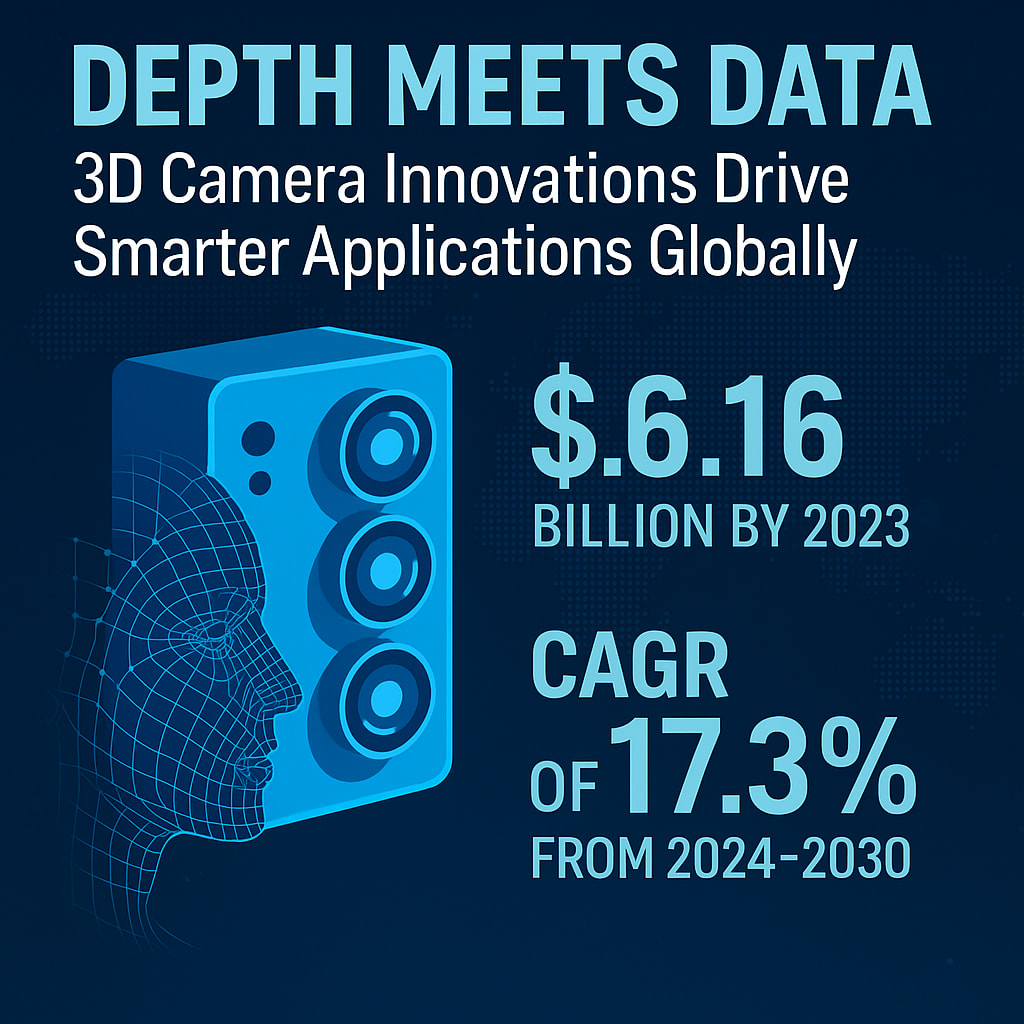
What was once limited to gaming consoles and experimental robotics now stands as a fundamental innovation across multiple industries thanks to the rapid evolution of 3D camera systems. 3D camera market support new data-driven applications across manufacturing and healthcare to autonomous vehicles and retail by leveraging advancements in artificial intelligence (AI), machine learning, and spatial computing which push the boundaries of possibility.
Depth-sensing technology now captures intelligence instead of images by processing visual data into actionable insights in the evolving era of automation and augmented intelligence. Hardware advancements and software development combined with real-world applications requiring spatial awareness drive this market surge.
From Vision to Insight: The Rise of 3D Cameras
3D cameras capture both depth information and traditional height and width metrics which enables machines and systems to determine the shape, size, and spatial position of objects. These cameras produce essential 3D point clouds and volumetric data using stereo vision, time-of-flight (ToF), LiDAR, and structured light to power next-generation smart applications.
3D imaging technologies lead to better precision and efficiency in applications such as warehouse robots navigation, smartphone facial recognition unlocking features, and surgeon operations with augmented assistance.
Key Drivers of Market Growth
1. Industrial Automation and Robotics
Robots depend on 3D cameras to perceive and operate within intricate surroundings. Robotic arms with 3D vision systems execute object detection and quality inspection tasks in addition to precise pick-and-place operations within the logistics and manufacturing sectors.
2. Autonomous Vehicles
A combination of sensors enables self-driving cars to operate while 3D cameras remain crucial for detecting road environments and identifying obstacles including pedestrians. They bridge together with LiDAR and radar to create the fundamental perception systems required for autonomous vehicles.
3. Smartphones and Consumer Electronics
Apple Face ID and Android ToF sensors pave the way for 3D cameras to become standard features in smartphones for security purposes and augmented reality applications along with 3D photographic capabilities. This pattern of technological advancement has now expanded to include smart TVs, VR headsets and gaming systems.
4. Healthcare and Medical Imaging
The use of 3D imaging technology in contactless patient monitoring and 3D body scanning for prosthetic design is revolutionizing diagnostic procedures and surgical strategies. The use of depth data enhances spatial analysis capabilities of human anatomy resulting in improved patient results and experiences.
5. Retail and E-Commerce
3D vision technology is transforming retail through virtual fitting rooms and automated shelf monitoring as well as gesture-based interaction systems. Brands implement 3D cameras technology to customize customer experiences while optimizing business processes.
6. Construction and Smart Cities
Architectural practices and infrastructure maintenance operations are experiencing radical changes because of 3D scanning technology. Smart cities leverage 3D camera-enabled devices to perform environmental mapping which supports safety measures, planning initiatives, and real-time analytics functions.
Regional Trends and Adoption
• North America: North America stands out as the primary market for autonomous driving technologies and AI-powered consumer gadgets due to the significant influence of major tech companies and research financing.
• Europe: The European region prioritizes industrial automation and smart factory deployments with Germany and France leading Industry 4.0 innovations.
• Asia-Pacific: China, Japan, and South Korea in the Asia-Pacific region lead the fastest growth in investments toward consumer electronics and robotics along with 3D imaging enabled surveillance systems.
Challenges and Opportunities
The 3D camera market continues to make strong progress but encounters multiple obstacles.
• High Cost of Advanced Sensors: High-performance 3D cameras required for industrial and automotive uses remain costly to deploy at large scale.
• Data Processing Demands: Powerful computational systems and extensive storage capabilities become necessary for processing large amounts of 3D data which leads to higher infrastructure expenses.
• Interoperability and Standardization: 3D imaging requires common protocols and standards between devices to achieve seamless integration as device numbers increase.
The progress in edge computing technology alongside the reduction in device size and advancement in AI analytics creates solutions for these challenges that facilitate sector-wide implementation.
The Future of 3D Imaging: Beyond the Lens
The future of 3D camera technology holds smaller and smarter devices that are more cost-effective which will open access to broader markets. The advancement of 3D imaging solutions will see significant improvements through event-based vision techniques along with depth-aware AI models and sensor fusion systems.
In today’s fast-paced environment where rapid decisions are necessary and context holds paramount importance, depth becomes the essential form of data. 3D cameras advance beyond simple image capture by enabling comprehensive three-dimensional understanding of our environment through both safety improvements and customer engagement enhancements.
Ongoing advancements in technology will enable 3D vision to create a future where machines can perceive and respond to their environment in real-time.
About the Creator
Silvie Karson
Passionate storyteller exploring the world of trends. With a background in digital marketing, I craft compelling narratives that inform and inspire. Whether diving into deep-dive features, growth analysis, or trend analysis.
Keep reading
More stories from Silvie Karson and writers in Journal and other communities.
From Pathogens to Preparedness: Inside the Rapid Rise of the Biodefense Sector
Global health threats have propelled the biodefense market sector from its military program origins into a fundamental component of public health and national security. The imperative to identify, stop and manage biological dangers has reached its highest level of immediacy when considering pandemics and bioterrorism scenarios. The biodefense market today is going through an extraordinary phase of growth and change as it moves from reactive approaches towards a sophisticated proactive preparedness system.
By Silvie Karson9 months ago in Journal
China’s Top Political Advisory Body Convenes Standing Committee Session
China’s political calendar has once again drawn global attention as the country’s top political advisory institution convened a high-level meeting to discuss national priorities and policy direction. The Standing Committee of the Chinese People’s Political Consultative Conference (CPPCC) gathered in Beijing for a crucial session aimed at reviewing proposals, strengthening political unity, and shaping the agenda ahead of key national decisions.
By Sajida Sikandar5 days ago in Journal



Comments (1)
3D cameras are huge! Transforming industries like manufacturing and healthcare. They're key in robotics and self-driving cars, enabling precision tasks.