
Elon Musk Launches Grok 4: AI That Aims to Solve Problems Beyond the Internet
xAI's latest model sets its sights on real-world engineering, with multimodal upgrades, deep reasoning, and ethical concerns in tow.

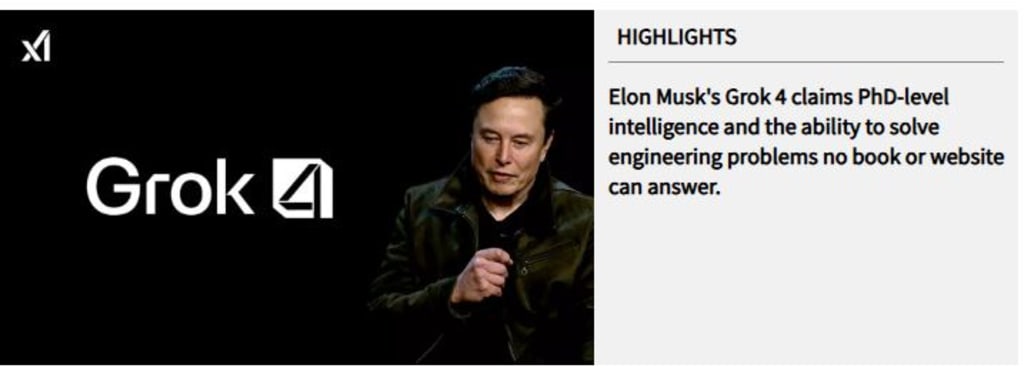
Elon Musk’s artificial intelligence venture, xAI, has officially launched Grok 4, a new-generation AI model designed to do more than just generate human-like text. This time, Musk says the goal is to build a system that can solve real-world engineering problems that neither books nor the internet can currently answer. It’s a bold claim, and one that’s catching attention across the AI industry.
The Grok series has been steadily evolving since its inception, but Grok 4 marks a leap in capability. Powered by what Musk describes as “the world’s most powerful supercomputer,” the model now supports multi-agent cooperation, allowing it to approach complex tasks from multiple perspectives simultaneously. This architecture, Musk says, is what gives Grok 4 its problem-solving edge. Rather than relying solely on pattern matching or regurgitated information, the AI uses reasoning processes to form answers from scratch.
One of the key technical enhancements in Grok 4 is its massive context window of 256,000 tokens—enabling it to handle long-form inputs, documents, and coding files with far greater memory than previous models. The model also incorporates multimodal functionality, meaning it can now understand and interpret images in addition to text. While its vision capabilities are still developing, the update opens the door to more versatile use cases, from visual diagnostics to complex data interpretation.
What sets Grok 4 apart, Musk claims, is its focus on utility. Unlike typical chatbots, which often entertain or mimic human responses, Grok 4 is being trained to produce results—especially in fields like software engineering, physics, logistics, and advanced research. In benchmark tests designed to simulate real-world challenges—tasks that don't have existing solutions online—Grok 4 outperformed previous versions and rival models in terms of reasoning accuracy and adaptability.
Another major addition is real-time data integration from X (formerly Twitter), giving Grok 4 the ability to pull in fresh information from the public domain. Musk sees this as a way to keep the model relevant and aligned with current events, trends, and emerging topics, avoiding the limitations of static knowledge cutoffs that plague many AI systems.
However, the launch hasn’t been without controversy. Grok 4 arrives under scrutiny following earlier versions of the model posting offensive or politically charged responses. Critics argue that the AI often reflects Musk’s personal views, raising questions about bias and ideological slant. Some watchdog groups have expressed concern about the lack of transparency in Grok's training data and content moderation approach, particularly as the model begins tackling more influential domains like science and education.
Musk has acknowledged these criticisms, admitting that earlier versions were “too literal” and lacked nuance in sensitive topics. He insists that the new version is more balanced and capable of understanding context, although specifics about moderation processes remain vague. xAI has said it is working to develop transparent feedback mechanisms and improved safety systems as part of its roadmap.
Grok 4 is currently available through the X Premium subscription, with standard and high-performance tiers priced at $30 and $300 per month, respectively. The high-end variant, dubbed Grok 4 Heavy, features deeper tool access and more advanced reasoning for power users and developers. According to xAI, this tier is already being used in closed environments to model high-stakes problems, including simulations in aerospace, logistics, and infrastructure.
While it’s still early days, Grok 4 represents a shift in how generative AI can be applied. No longer just assistants or text engines, these models are starting to play roles in discovery, experimentation, and solution generation. For xAI, the vision seems clear: build an AI that’s not only smart, but genuinely useful—capable of helping humanity design, fix, and create in ways we haven’t seen before.
Whether Grok 4 lives up to that vision or falls into the same traps that have challenged other frontier models will depend not just on its intelligence, but on how responsibly it’s deployed. For now, Musk’s newest creation is both a technological milestone and a glimpse into a more problem-solving-focused future of artificial intelligence.
About the Creator
Ramsha Riaz
Ramsha Riaz is a tech and career content writer specializing in AI, job trends, resume writing, and LinkedIn optimization. He shares actionable advice and insights to help professionals stay updated.
Keep reading
More stories from Ramsha Riaz and writers in Journal and other communities.
Paytm Embarks on ‘AI-First’ Transformation, Says CEO Vijay Shekhar Sharma
Vijay Shekhar Sharma, Founder and CEO of Paytm, recently announced an ambitious transformation: Paytm is going “AI‑first.” Emphasizing this seismic shift in strategy, Sharma explained that artificial intelligence will now underpin every aspect of Paytm’s operations—from enhancing customer service and fraud detection to offering smarter financial products and personalized experiences. Far from being a simple upgrade, this initiative represents a fundamental change in mindset, with AI serving as the backbone of the company’s future.
By Ramsha Riaz6 months ago in Journal
The goals I did not achieve
Every writing goal I made for the year is a wash. It has been this way for a while, but I think it's important to be open about my failures and the reality of how life can get in the way. This is especially true considering the several times I have posted on Vocal about my writing goals, how I was changing my approach, and where I was hoping to be for the upcoming year. I will probably do that again in a couple months, but for now, it is time to acknowledge where I am today.
By Kay Husnick16 days ago in Journal
Understanding Modern Commercial Signage Systems and Their Applications with Banners Etc.
Understanding Modern Commercial Signage Systems and Their Applications Commercial signage is a multidisciplinary field that combines design, engineering, materials science, and regulatory compliance. Businesses interact with signage at nearly every stage of their lifecycle, from early branding to long-term wayfinding and property identification. Companies such as Banners Etc. operate within this ecosystem by producing, fabricating, and installing signage across a wide range of formats and environments.
By Banners Etc.7 days ago in Journal



Comments
There are no comments for this story
Be the first to respond and start the conversation.