
Elevating Innovation: The Expanding Role of Small Drones Across Industries
Small drones have swiftly turned into essential instruments that transform industrial processes by collecting data and delivering products while monitoring environments and tackling challenges during an age of agility and intelligent automation.

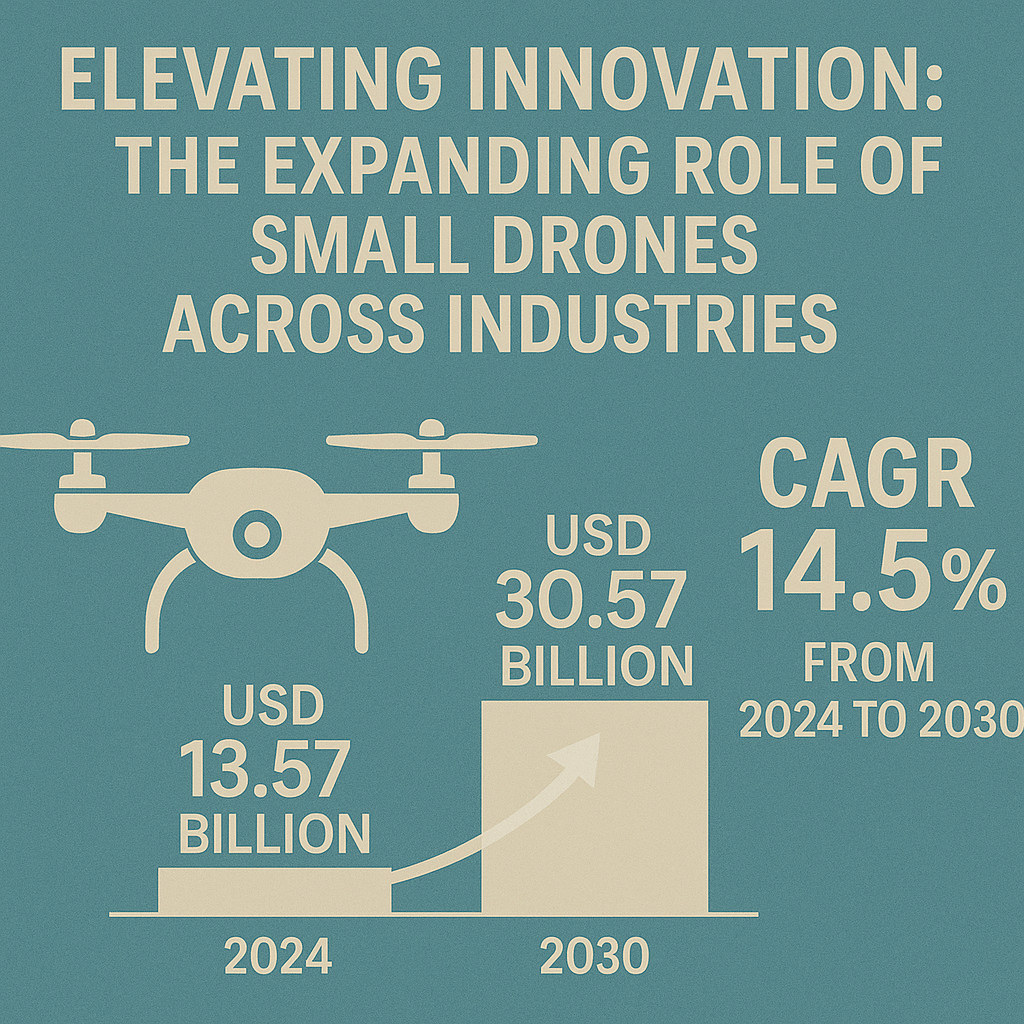
These compact UAVs now serve diverse sectors including agriculture and infrastructure while expanding operational possibilities in logistics and emergency response and more.
The global small drone market expanded substantially and reached approximately USD 12.03 billion in 2023. The industry demonstrates strong potential for growth thanks to a robust 14.5% CAGR expected between 2024 and 2030. Expansion in the market is being driven by rising demand within multiple sectors such as construction, real estate, and media. The market's growth results from technological improvements which boost drone efficiency along with their versatility and usability.
The progress in miniaturization combined with better battery life and improved sensor technology along with AI-enhanced flight capabilities shows that small drones can deliver substantial innovations in compact form.
The Rise of Small Drones
Technological advancements combined with reduced hardware expenses are making small drones more accessible and capable than ever before. These drones combine high-resolution cameras with thermal imaging and LiDAR technology plus real-time communication systems to deliver unparalleled versatility in data capture and task execution within difficult-to-access or dangerous environments.
The lightweight design and low cost of small drones along with their simple deployment procedures enable businesses and governmental agencies as well as research institutions to solve problems more quickly and safely while improving operational efficiency.
Key Applications Across Industries
1. Agriculture: Smarter Farming from the Sky
Small drones are revolutionizing precision agriculture. Farmers rely on drone technology to track crop conditions and determine irrigation requirements while detecting pest invasions and improving yield predictions. The use of multispectral imaging enables detection of hidden problems which allows for precise intervention while conserving time and resources including water.
2. Infrastructure & Construction: Enhanced Site Intelligence
Drones help cut down on manual labor when inspecting bridges and buildings or surveying lands through their use in dangerous or lengthy tasks. The continuous feed of aerial data enables project managers to monitor construction progress while detecting structural faults and ensuring adherence to safety standards which enhances workflow efficiency.
3. Logistics: Aerial Delivery and Inventory Management
Logistics companies alongside retailers investigate drone delivery solutions to reduce the last-mile delivery process and access geographically isolated regions. Warehouses implement tests of small drones which autonomously carry out inventory audits through narrow aisle navigation while simultaneously updating stock levels.
4. Emergency Response and Disaster Relief
Drones deliver essential situational awareness during natural disasters as well as search-and-rescue operations and hazardous events. Emergency responders use thermal cameras and live video feeds to detect victims and evaluate disaster damage while delivering relief supplies more efficiently and safely than older techniques.
5. Environmental Monitoring and Wildlife Protection
Scientists utilize miniature drones to observe ecosystem health while simultaneously monitoring wildlife populations and identifying unlawful activities such as poaching and deforestation. Drones provide researchers with a non-disruptive option to collect information while preserving the integrity of delicate natural environments.
Enabling Technologies Driving Drone Innovation
The expanded adoption of small drones is being driven by advancements in several fundamental technologies.
• AI & Machine Learning: Autonomous navigation capabilities, obstacle avoidance systems, and intelligent image analysis tools represent the key technological advancements in drone operations.
• Edge Computing: The application of edge computing in drones enables local data processing which decreases latency and boosts the speed of real-time decision-making.
• 5G & Connectivity: Improved connectivity with ground stations and cloud platforms enables accelerated data transmission.
• Battery & Material Advances: The advancement in battery and materials technology achieves longer flight times and increased payload limits while simultaneously decreasing drone physical dimensions and mass.
Challenges and Considerations
Vast opportunities exist for small drone adoption but multiple obstacles stand in the way.
• Regulatory Compliance: The rules governing airspace differ significantly among countries which determines the operational limits for drones.
• Privacy and Security: The ability to collect data and conduct surveillance through drones brings up serious ethical and legal questions.
• Skill Gaps: Advanced drone operation and drone data analysis demand specific training.
To develop frameworks which enable safe and scalable drone operations technology providers need to work alongside policymakers and end-users.
Small drones promise great potential as they operate at low altitudes.
Small drones will advance through their ongoing integration with artificial intelligence (AI) systems, robotic technologies, and Internet of Things (IoT) networks. These devices will evolve from basic tools into essential parts of intelligent ecosystems through advancements in their smartness and autonomy which will enable their use in climate monitoring and medicine delivery as well as smart city management.
Small drones are increasing altitude levels while simultaneously advancing global economic innovation.
Latest Press Release: https://www.prnewswire.com/news-releases/small-drone-market-size-worth-30-57-billion-globally-by-2030--exclusive-report-by-the-research-insights-302460381.html
About the Creator
Silvie Karson
Passionate storyteller exploring the world of trends. With a background in digital marketing, I craft compelling narratives that inform and inspire. Whether diving into deep-dive features, growth analysis, or trend analysis.
Keep reading
More stories from Silvie Karson and writers in Journal and other communities.
Bridging Gaps in Healthcare Access: How Innovation Is Reshaping Non-Emergency Medical Transportation
Traditional transportation systems frequently struggle with operational inefficiencies, scheduling delays and inadequate service reach. Contemporary non-emergency medical transportation solutions now incorporate advanced technological features which include real-time tracking systems along with AI-based scheduling and digital health management platforms. The latest advancements enhance routing methods while strengthening reliability to guarantee timely patient transportation which connects care providers with patients more effectively. Smart logistics and data-driven insights enable NEMT to transcend basic transport functions and emerge as an essential tool for delivering equal healthcare access through connected services.
By Silvie Karson10 months ago in Journal
Author’s Advice
If you would’ve asked me 20 years ago did I know I’d become a writer and an author, I would’ve said “nope, ain’t happening”. As fate would have it I did become an author and I can honestly say I’m loving it so far. It really does feel good to be a writer. I’ve learned a lot on this journey and I feel like with even me being as new to this world as I am, there’s some wisdom I need to share with every other aspiring author.
By Joe Patterson2 days ago in Journal




Comments
There are no comments for this story
Be the first to respond and start the conversation.