
Does God Exist? Javed Akhtar vs Mufti Shamail Debate Breakdown
Millions watched the debate, but many still struggled to understand the core arguments behind the question: Does God exist? Here, we unpack their conversation step by step, without bias or complexity.

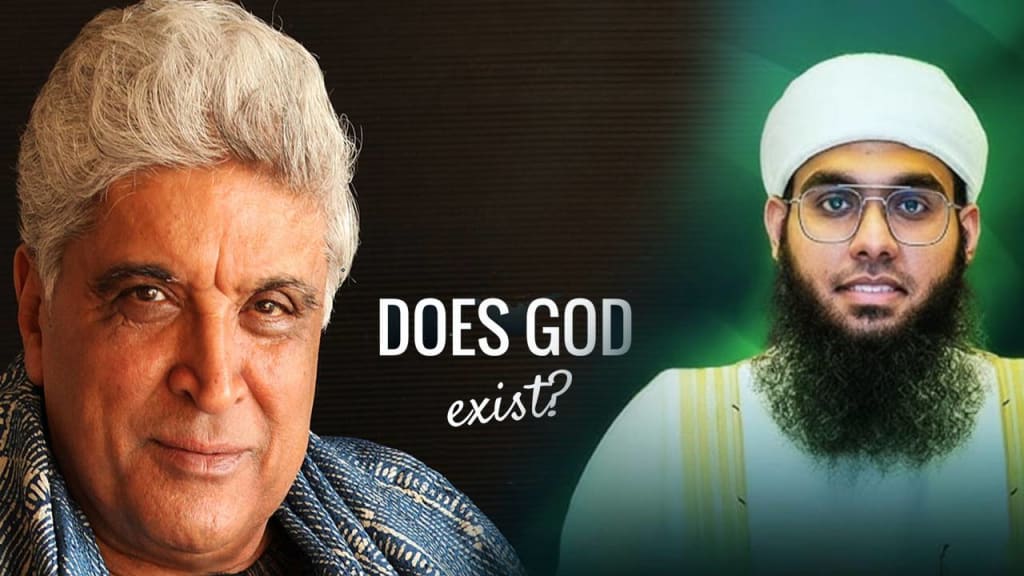
The recent debate between renowned writer Javed Akhtar and Islamic scholar Mufti Shamail has taken social media by storm, sparking fresh conversations around one of the oldest philosophical questions known to humanity: Does God exist?
Clips of their exchange spread rapidly across YouTube, X, and TikTok, with millions searching for explanations, summaries, and logical breakdowns of the arguments presented. Whether you watched the full episode or only the viral snippets, this debate has opened the door to deeper reflection on faith, reason, and human understanding.
In this blog, we break down both sides of the conversation objectively — argument by argument — so you can understand exactly what each participant said and why it resonated with so many people.
Who Are Javed Akhtar and Mufti Shamail?
Before diving into the arguments, it’s important to understand the backgrounds of the participants.
Javed Akhtar, a celebrated Indian poet, writer, and public figure, is open about his atheistic worldview. He often speaks from a rationalist and humanist perspective, arguing that morality and purpose can exist without religion.
Mufti Shamail, on the other hand, is an Islamic scholar known for presenting religious concepts in a logical, philosophical manner. His explanations often bridge theology with reason, making complex ideas accessible to modern audiences.
This contrast — an atheist thinker vs. a theistic scholar — set the stage for a powerful and thought-provoking dialogue.
How the Debate Started
The discussion emerged around the central question: “Does God exist?”
Javed Akhtar has long maintained that he does not believe in God because there is no empirical evidence to support the existence of a divine being. Mufti Shamail responded with classical theistic arguments that rely on logic, causation, and metaphysics rather than physical evidence.
This clash of worldviews quickly captured public attention because it touched on philosophy, science, morality, and existential purpose — all within a single discussion.
Javed Akhtar’s Core Arguments
1. Lack of Empirical Evidence
Javed Akhtar’s primary argument is straightforward: if something exists, there must be physical evidence for it.
Since God cannot be seen, measured, or tested in a scientific way, he argues that belief in a higher power remains unsupported.
2. Human Suffering Questions Divine Intervention
Akhtar questions how an all-powerful, all-loving God could allow suffering, inequality, and injustice.
This is a classic philosophical stance known as the Problem of Evil.
If suffering exists, he argues, the idea of divine perfection becomes contradictory.
3. The Role of Science
Akhtar emphasizes scientific discoveries — evolution, the Big Bang, natural laws — to explain that the universe operates independently and does not need supernatural intervention.
4. Religion as a Social Construct
Another central point he raised is that religions were shaped by societies, not the other way around.
He suggests that human beings created God to explain the unknown or to enforce moral rules.
5. Morality Without God
Akhtar insists that humans are capable of moral values without divine authority.
Compassion, ethics, and justice can exist in a secular world, driven by human conscience alone.
Mufti Shamail’s Core Arguments
Mufti Shamail presented counterarguments based on classical Islamic philosophy and rational principles.
1. The Contingency Argument
His strongest argument was based on the principle that everything in the universe is contingent, meaning it depends on something else to exist.
If everything requires a cause, there must be a first cause that is uncaused and self-existent — which he identifies as God.
This is a foundational argument in Islamic and Western philosophy.
2. Order and Design in the Universe
He emphasized the precision of the cosmos: the laws of physics, the complexity of life, and the order in nature.
To him, such intricate design implies an intelligent creator.
3. Morality Points to a Higher Source
While Akhtar argues for human-driven morality, Mufti Shamail counters that universal moral values — like justice or truth — require an ultimate anchor.
If moral values vary between societies, an absolute source is needed to define right and wrong objectively.
4. The Limits of Human Knowledge
He also pointed out that lack of physical evidence does not negate existence, using gravity, consciousness, and quantum behavior as examples of unseen yet accepted phenomena.
He argues that humans are limited, and expecting divine existence to fit human scientific tools is logically flawed.
5. Spiritual and Scriptural Evidence
Finally, he referenced human spiritual experience and the consistency of scripture as evidence that billions across history have felt or recognized a higher power that transcends physical proof.
Conclusion: Did Anyone Truly Win?
The question “Does God exist?” cannot be resolved in a single debate — and perhaps that’s the point.
Javed Akhtar presented a rational, scientific standpoint rooted in human experience.
Mufti Shamail offered philosophical and theological perspectives grounded in logic and tradition.
In the end, the value of this debate lies not in who won, but in how it encouraged millions to think, question, and explore their own beliefs more deeply.
And that makes the conversation worthwhile for everyone.
About the Creator
Syed Ali
I’m a streamer and writer sharing tips and guides on accessing geo-restricted streaming platforms, helping you watch your favorite content from anywhere in the world.




Comments
There are no comments for this story
Be the first to respond and start the conversation.