
Does Apple Cider Vinegar Really Burn Carbs – Or Is That Just Wishful Thinking?
What Studies from the U.S. Really Say About ACV and Blood Sugar

We have to admit: we've heard that apple cider vinegar burns carbs before. Many people take their ACV as some type of morning ritual, while many others are scared of it and treat it like a runaway salad dressing. So, can this acidic beverage really help your body digest carbohydrates better, or is it simply another health myth with great advertising?
Grab your glass (of ACV water, of course) and let’s find out.
What’s in the “Magic” Anyway?
Acetic Acid is the main active compound within Vinegar and is typically 5-6% of all commercially available ACV. According to Bragg's Blog, they state approximately 750 milligrams of acetic acid are in each tablespoon of their ACV; a dose size they say has been "clinically proven" to slow carbohydrate absorption.
This is not entirely marketing speak, as there are many studies (both domestic and international) that show that acetic acid will alter the way your body absorbs carbohydrates.
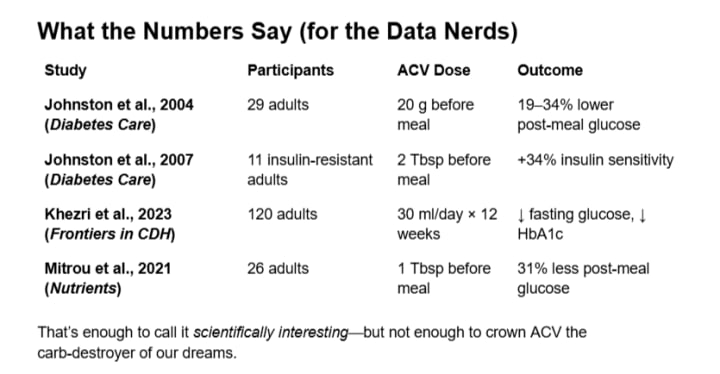
As an example, a 2004 study in Diabetes Care (Arizona State University) demonstrated that 20 grams of apple cider vinegar before a high-carbohydrate meal resulted in a reduction in blood glucose levels by 19-34% for both healthy individuals and those who were insulin resistant.
(Source: Johnston et al., Diabetes Care, 2004)
A second Arizona State (2007) study revealed that vinegar consumption prior to meals improved insulin sensitivity by approximately 34% in insulin resistant participants – equivalent to some first stage medications. This is a very large claim, but is supported by laboratory data. (Source: Johnston et al., Diabetes Care, 2007)
What's Really Going On in Your Body?
This is a quick version of how things work out for you because who wants to feel as if they have to read a chemistry textbook over their morning coffee.
The acetic acid in ACV is telling your stomach to slow down "Let's not rush through this". So food will stay in your stomach longer which allows the sugar to enter into your blood stream much slower.
ACV is blocking some of your carbohydrate digesting enzymes (disaccharidase).
The enzyme (disaccharidase) is essentially told to go on a coffee break. Which means less starch is being instantly turned to glucose.
Your body will be able to react to the insulin better too.
Studies have shown that your cells become slightly more responsive to insulin when using ACV consistently. This helps to manage the high levels of sugar which causes you to crash by 3 PM.
All of this sounds good for you right? Hold up though...there is a little more to the story.
The Good, The Meh, and The “Don’t Overdo It”
Let’s separate the hype from the helpful:
The Good:
Several U.S. studies (ASU, NIH-funded) show modest glucose-lowering benefits.
One 2023 trial (Frontiers in Clinical Diabetes & Healthcare) found lower fasting glucose and HbA1c after 12 weeks of daily ACV.
Some users report fewer energy crashes after carb-heavy meals.
The Meh:
The effect is modest. It’s not “block all carbs forever,” it’s “help your body keep up.”
You still digest those carbs; you just do it more smoothly.
The “Don’t Overdo It”:
Straight shots? Nope. ACV can wreck enamel and irritate your throat.
Stick to 1 tablespoon diluted in 8 oz water, once or twice daily.
And if you’re on meds (insulin, diuretics), always check with your doc.
Real Talk: My Take on the Trend
Personally? I’ve tried the morning-ACV-shot routine. Let’s just say… it’s an acquired taste. But once I switched to mixing it with water and lemon, it actually became a decent pre-meal habit.
Did it melt the pasta carbs I ate last night? Nah. But did I feel fewer sugar crashes later? Yup.
Think of ACV less like a fat-burner and more like a carb speed bump, it slows things down, keeps your blood sugar from roller-coasting, and helps your metabolism handle the load.
So… Should You Drink It?
If your goal is to control blood sugar or feel steadier after carbs, give it a shot (well, a diluted one ).
Try 1 Tbsp ACV in 8-10 oz of water before meals.
Use a straw to save your enamel.
Skip the “gummy” versions, they often lack enough real acetic acid to matter.
Remember: ACV works with your habits, not instead of them. It’s not a hall-pass for donuts or fries.
Final Sip
So, does apple cider vinegar “burn” carbs? Nope, it’s not a metabolic flamethrower. But it does help your body process carbs smarter, not harder.
A tablespoon before a big meal won’t change your life overnight, but it might just keep your energy stable and your blood sugar happy. And honestly, for something that costs a few bucks and smells like pickles, that’s a pretty sweet deal.
About the Creator
Marcia Jordan
Content Creator
Keep reading
More stories from Marcia Jordan and writers in Journal and other communities.
7 Actionable Tips for New Homeowners in Niagara
Buying a home is one of the greatest achievements in life, but it doesn't come without challenges. For many buyers who have never owned property before they may be anxious about learning how to take care of financial responsibility. Especially if you're buying your first house. We know that homeownership comes along with loads of maintenance, financial responsibilities and other commitments that are not required if you were to rent a home. Follow these 7 tips while owning a home.
By Marcia Jordan4 years ago in Lifehack




Comments