

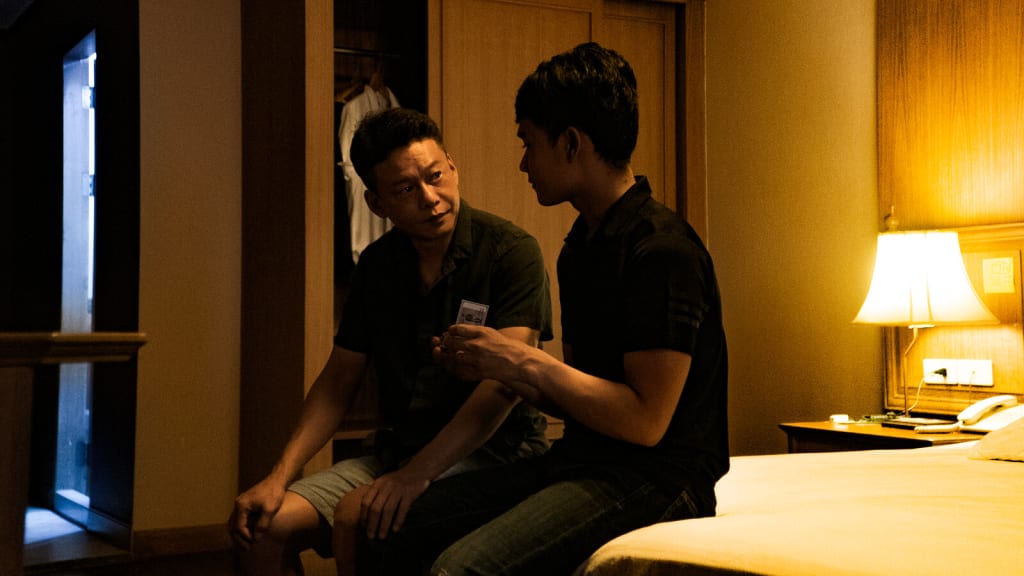
Days Movie
The Taiwanese film "Days" is a unique arthouse creation that some critics may dismiss as a museum installation disguised as a movie. I understand why—it lacks a linear narrative and subtitles. Instead, it embraces a slow rhythm and a subdued aesthetic that only arthouse enthusiasts can truly appreciate. To truly enjoy "Days," you must surrender to its earthy dream logic. It is an extraordinary film, but it may not be an easy watch.
A lot unfolds in "Days," yet the movie doesn't strive to create tension or offer a linear narrative to guide us through its visuals. Most of the film follows Kang (Kang-sheng Lee), an emotionally detached loner, immersing himself in his overwhelming loneliness. Kang retreats into his body and his immediate surroundings, gradually diminishing or perhaps transforming over time. That's the essence of the film.
We observe Kang haunting, nondescript urban interiors characterized by harsh artificial lighting, glossy surfaces, impenetrable shadows, and the usual ambient noise of the city, both rude and reassuring. Kang is on a self-care journey, indulging in luxurious baths, acupuncture sessions, and plenty of time for introspection, detached from any professional obligations (perhaps a vacation of sorts?). During this time, Kang unexpectedly develops a bond with Non (Anong Houngheuangsy), a masseur. This bond lasts longer and proves more uncomfortable than some viewers may be accustomed to.

Writer/director Ming-liang Tsai ("What Time Is It There?," "Goodbye, Dragon Inn") favours mood over plot and often employs ghost-like imagery superimposed on Lee's body or partially obscures our view of his surroundings. For instance, when Kang bathes in the open air, the clear water that envelops his body reflects a beam of light just above his right hip, possibly from a skylight. During an acupuncture treatment, Lee's back is covered with needles and a patchwork of tin sheets and cardboard strips. The acupuncturist replenishes the needles using a well-used, industrial-length lighter (resembling a Dust Devil), and some ashes fall onto Lee's back. However, the acupuncturist doesn't notice or care, and Lee remains motionless. Some of the needles on his back ignite and smoulder.
The spaces Kang occupies are often unremarkable in conventional terms. They are dark, constricting, and often appear abandoned or neglected. Walls bear mildew stains, and rainwater seeps into everything. Iron bars and metal grates cover various elements, while light reflects or directs us toward the corners of open doorways, cracked window panes, and narrow corridors. These images don't transcend their shabby nature, yet we still feel affection for their decaying, tacky, liminal surfaces. We adapt to what we see and even anticipate the harsh clatter of closing doors, the shuffle of flip-flops on cheap-looking tiles, the sigh of old car brakes, and the angry rumble of engines.
Amidst these overwhelming and isolated images and sounds, Kang and Non meet in a hotel room where Kang undresses and receives a massage. Non's touch is systematic and repetitive yet still carries an erotic charge—he rubs Kang between his thighs and kneads his buttocks. Lee sighs with relief. Later, Kang gives a music box to Non, and they listen to it together for an extended period. This scene, presented in a typically static and uninterrupted shot, holds a mysterious quality that matches its length. As this delicate moment unfolds, we witness Kang and Non-sitting together, struggling to halt the passage of time.
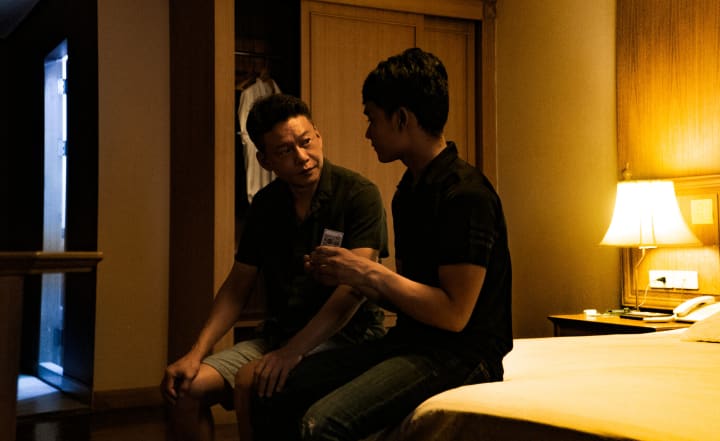
The emotional weight of these simultaneously alienating and enchanting moments can be devastating, but only if you surrender to Tsai's great rhythm and style. "Days" isn't precisely a cold film, but it isn't overly warm. At times, Tsai's movie feels like a literal translation of his dreams, detailed yet intoxicating. As we navigate the labyrinthine corridors of his subconscious, we're encouraged to immerse ourselves in a collection of sensory details that suggest much without explicitly declaring their meaning.
You must sit with "Days" and allow it to reveal itself in its own time, just like the angry purple bruise on Lee's left shoulder during a typical back massage. Such imagery demands an open mind and dedication to appreciate its beauty. And "Days" is beautiful—it exudes a subtle intensity and heady dizziness that becomes intoxicating if you pay close attention. Watch the film at your earliest convenience and in any suitable setting, ideally with an audience and the lights dimmed.
About the Creator
RICHARD
Hai, this is Richard, a seasoned movie reviewer with an unparalleled passion for cinema. With an astute eye for detail and a deep appreciation for the art of storytelling,
Join Richard on this thrilling adventure,Subscribe now
Review of 'Man on the Run'
My wife and I saw Man on the Run, a nearly 2-hour documentary on Amazon Prime, about Wings, Paul McCartney's group that flew around the world from shortly after The Beatles broke up in early 1970 to shortly after John Lennon was murdered at the end of 1980, making a Beatles reunion forever impossible.
By Paul Levinson6 days ago in Beat


Comments
There are no comments for this story
Be the first to respond and start the conversation.