
Cracker Barrel’s Bold Logo Makeover: Why Ditching ‘Uncle Herschel’ Became a Viral Firestorm
As the beloved Old Country Store drops its iconic mascot for a minimalist text-only design, fans and investors are divided—can this bold new era rekindle relevance or risk erasing tradition?

A Shockwave Across Wall Street and Social Media
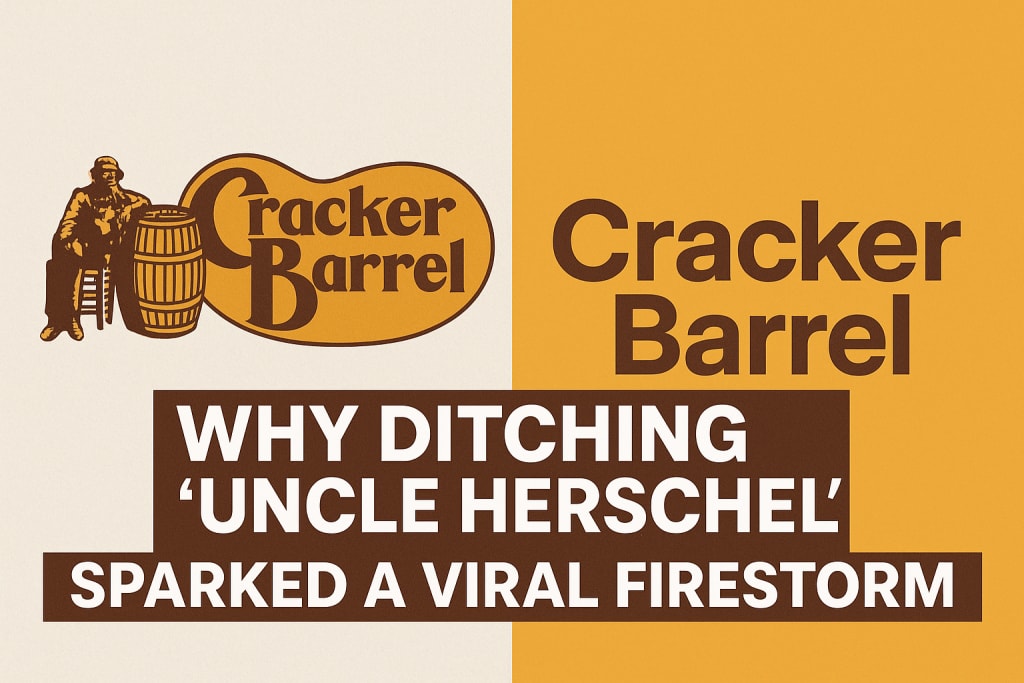
When Cracker Barrel revealed its new logo this week, the internet practically exploded. Gone was the familiar image of “Uncle Herschel,” the bearded man leaning on a wooden barrel that had defined the chain for decades. In its place, a pared-down, text-only design: the words “Cracker Barrel” on a muted gold backdrop, stripped of imagery and nostalgia.
Almost instantly, backlash poured in. On X (formerly Twitter), #NotMyCrackerBarrel trended nationwide. Google searches for “Cracker Barrel new logo” surged by more than 5,000%, and within hours, over half a million posts debated the redesign. Investors, too, responded sharply—the company’s stock plunged as much as 15% before closing down about 7% the same day.
For a brand built on rustic charm and Southern tradition, this wasn’t just a logo update. It was a cultural lightning rod.
---
From Heritage to Minimalism: Why the Change?
Cracker Barrel’s branding journey is long and storied. When the first restaurant opened in 1969, the logo was simple—just text. By 1977, the now-famous image of Uncle Herschel leaning on a barrel was introduced, cementing itself as a visual shorthand for comfort food, rocking chairs, and family road trips.
The new logo marks the fifth redesign in company history, but perhaps the most drastic. Executives framed it as part of their “All the More” campaign—a broad effort to modernize stores, refresh menus, and appeal to younger diners. The simplified wordmark, according to Cracker Barrel’s Chief Marketing Officer Sarah Moore, was designed to “work seamlessly in the digital age,” scaling easily on apps, websites, and delivery platforms.
In short, Cracker Barrel wants to stay relevant in a competitive restaurant landscape. But in doing so, it has risked alienating the very customers who built its reputation.
---
Backlash From Fans, Politicians, and Even Rivals
Public reaction to the new look has been far from subtle. Customers across social media accused Cracker Barrel of “erasing its heritage” and abandoning its small-town soul. One 81-year-old longtime diner put it bluntly: “It takes away from the heritage. When you’re my age, you remember the way it started.”
The controversy quickly spilled into politics and pop culture. Conservative commentators like Donald Trump Jr. blasted the redesign as unnecessary “corporate wokeness.” Meanwhile, California Governor Gavin Newsom’s press office joined the chorus of criticism, calling the logo “cheap.” Even the official Democratic Party account poked fun, posting memes about the downgrade.
The firestorm didn’t stop there. Rival chain Steak ‘n Shake, led by investor Sardar Biglari, took the unusual step of publicly mocking the redesign. Biglari accused Cracker Barrel of abandoning the very nostalgia that made it iconic, framing the move as a brand identity crisis.
What might have been a quiet rebrand quickly became a national debate over tradition, progress, and the cultural meaning of logos.
---
Cracker Barrel’s Response: Defending the New Era
Despite the uproar, Cracker Barrel’s leadership is standing firm. CEO Julie Felss Masino reassured customers that the brand’s values remain intact: “Our story hasn’t changed. Uncle Herschel is still front and center in our restaurants and on our menu.”
Executives argue that the barrel itself—the rounded shape of the new logo—still honors the original wordmark from 1969. The shift, they say, is less about erasing the past and more about meeting the expectations of modern diners who engage with the brand online as much as in person.
The broader “All the More” initiative includes brighter interiors, a streamlined menu, and digital upgrades aimed at making Cracker Barrel feel fresh without losing its Southern hospitality roots. Whether that balance holds remains to be seen.
---
What This Logo War Really Means
At its heart, the Cracker Barrel controversy is about more than fonts and colors. It’s about the role of nostalgia in American culture. For millions, the old logo represented childhood road trips, comfort food, and the safety of tradition. Stripping away the imagery feels, to some, like stripping away a piece of memory.
Branding experts warn that drastic visual changes can alienate core audiences. Jennifer Harrington, a marketing strategist, put it this way: “When you change a logo that carries decades of emotional weight, you’re not just changing a design—you’re rewriting people’s personal histories with the brand.”
And yet, brands that refuse to evolve often risk irrelevance. Younger customers, who value modern aesthetics and digital convenience, may find the new design more approachable. For Cracker Barrel, the challenge will be winning fresh loyalty without losing the old.
---
Conclusion: Can a Brand Modernize Without Losing Its Soul?
The firestorm around Cracker Barrel’s new logo shows just how powerful symbols can be. What might have been a simple design refresh became a cultural flashpoint—one that touched politics, identity, and memory all at once.
For Cracker Barrel, the next chapter depends on whether customers can look past the missing Uncle Herschel and see the brand’s deeper promise of hospitality and comfort. The gamble is clear: modernization may attract a new generation of diners, but if nostalgia-driven customers walk away, the cost could outweigh the benefit.
One question now lingers in the air: Can Cracker Barrel evolve for the future while still honoring its past—or has it already crossed the point of no return?
About the Creator
Waqar Khan
Passionate storyteller sharing life, travel & culture. Building smiles, insights, and real connections—one story at a time. 🌍
Every read means the world—thanks for your support! 💬🖋️
Keep reading
More stories from Waqar Khan and writers in Journal and other communities.
Why Target's CEO Brian Cornell Is Stepping Down—And What It Means for the Retail Giant’s Future
When Target announced today that CEO Brian Cornell will step down on February 1, 2026, it signaled more than just a leadership change—it marked a pivotal moment for a major U.S. retailer facing backlash, sluggish sales, and strategic crossroads.
By Waqar Khan5 months ago in Journal
The goals I did not achieve
Every writing goal I made for the year is a wash. It has been this way for a while, but I think it's important to be open about my failures and the reality of how life can get in the way. This is especially true considering the several times I have posted on Vocal about my writing goals, how I was changing my approach, and where I was hoping to be for the upcoming year. I will probably do that again in a couple months, but for now, it is time to acknowledge where I am today.
By Kay Husnick21 days ago in Journal
I Didn’t Believe in Digital Marketing Until My Business Started Falling Behind
For a long time, I believed that good work would speak for itself. If a product or service was valuable enough, people would naturally find it. That belief felt honest, even comforting. Unfortunately, it was also wrong.
By Anthony Rodgers2 days ago in Journal


Comments
There are no comments for this story
Be the first to respond and start the conversation.