
Container Ship Capacity Explained (TEU): A Complete Guide
A complete guide to understanding TEU, its importance in shipping, and how it's used to measure container ship capacity.

Introduction – Why Container Capacity Matters
In the vast world of global trade, containerization has revolutionized how goods are moved across oceans. Today, over 90% of non-bulk cargo is shipped in standardized containers — and the key metric used to measure a ship’s capacity is TEU , or Twenty-foot Equivalent Unit .
Understanding TEU is essential not only for shipping professionals but also for students, researchers, and businesses involved in international logistics. It helps compare ship sizes, calculate freight rates, and plan port infrastructure.
This guide will walk you through everything you need to know about TEU — from its definition and calculation to real-world examples and future trends.
What Is TEU? Definition and Origin
🔤 Meaning of TEU
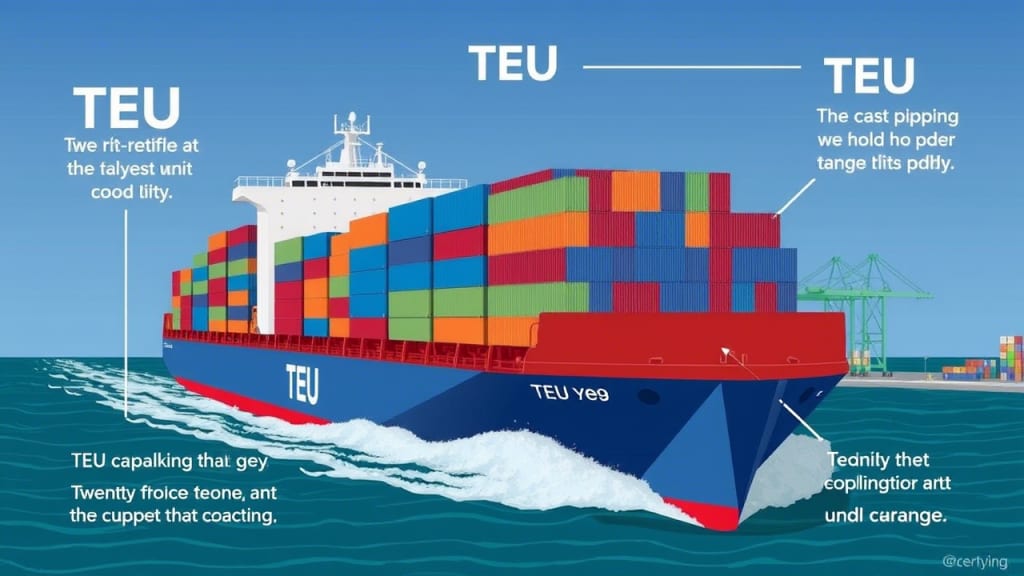
TEU stands for Twenty-foot Equivalent Unit , a standard measurement used in container shipping to represent the capacity of container ships, ports, and terminals.
One TEU equals one 20-foot-long intermodal container , which is approximately 6.1 meters in length. Larger containers, such as 40-foot units, count as 2 TEUs .
🕰️ Historical Background
The concept of TEU was introduced with the rise of intermodal container shipping in the 1950s , pioneered by American entrepreneur Malcom McLean . His company, Sea-Land Service, launched the first container ship in 1956.
Since then, TEU has become the universal unit of measurement in maritime logistics, allowing consistent comparisons between vessels, routes, and companies.
🔄 TEU vs FEU
FEU stands for Forty-foot Equivalent Unit
One FEU = Two TEUs
While TEU remains the standard, FEU is often used when discussing larger cargo volumes
How Is Container Ship Capacity Measured in TEU?
Container ship capacity is measured based on how many 20-foot containers can be loaded onto the vessel. However, this isn’t just a simple math problem — several factors influence actual TEU capacity:
📏 Physical Dimensions
Length : Longer ships can carry more containers.
Beam (width) : Wider ships allow more containers to be stacked side-by-side.
Draft (depth) : Determines how many containers can be stacked vertically without compromising stability.
⚖️ Weight Limits
While TEU measures volume, weight limits imposed by the ship’s structural design and regulatory requirements can restrict how many containers are actually loaded.
🧱 Stacking and Layout
Modern container ships use complex stacking systems, both above and below deck. Containers are secured using twist locks and lashing bridges to prevent shifting during transit.
📊 Use in Fleet Comparisons
Shipping companies and analysts rely on TEU data to:
Compare fleet sizes
Monitor market share
Forecast industry trends
Examples of TEU Across Different Ship Sizes
Container ships come in various sizes, each suited to different types of trade and routes. Below are the main categories:
🚢 Small Feeder Vessels (100–2,000 TEU)
Operate on short-haul regional routes
Connect smaller ports to major hubs
Often used for inland distribution
🌍 Panamax Ships (3,000–5,000 TEU)
Designed to fit through the original Panama Canal
Serve transcontinental and mid-sized trade routes
Still widely used despite newer larger vessels
🛣️ Post-Panamax Ships (6,000–12,000 TEU)
Too large for the original Panama Canal
Require deeper ports and modern infrastructure
Commonly used for Asia-Europe and Asia-US routes
🏁 Ultra Large Container Vessels (ULCVs) (20,000+ TEU)
The largest class of container ships
Built after the expansion of the Panama Canal in 2016
Used for high-volume trade lanes like Asia-Europe
Top 10 Largest Container Ships by TEU
Here are some of the biggest container ships currently sailing the seas:
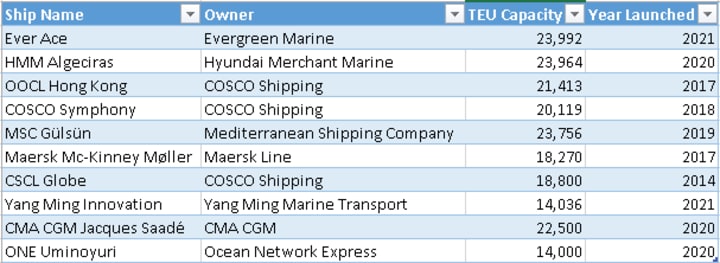
These massive ships reflect the trend toward bigger, more efficient vessels that reduce costs per container and improve economies of scale.
TEU in Logistics and Supply Chain Planning
TEU isn't just a number on a ship's specification sheet — it plays a crucial role in logistics planning.
💰 Freight Rate Calculations
Freight companies often base pricing on TEU, especially for full-container-load (FCL) shipments. Rates can vary depending on:
Route
Seasonal demand
Fuel surcharges
Port congestion
🏛️ Port Infrastructure Planning
Ports must be equipped to handle large TEU volumes. This includes:
Deep-water berths
High-capacity cranes
Efficient rail and road connections
Cities like Singapore , Shanghai , and Rotterdam invest heavily in infrastructure to accommodate ULCVs.
📈 Performance Metrics
Shipping lines use TEU data to:
Track fleet utilization
Measure growth
Benchmark against competitors
A higher TEU capacity doesn’t always mean better performance — efficiency, reliability, and service frequency are equally important.
TEU vs Other Maritime Metrics (DWT, GT, NT)
While TEU focuses on container volume, other metrics are used to describe different aspects of a ship’s size and capabilities:
⚓ Deadweight Tonnage (DWT)
Measures the total weight a ship can carry, including cargo, fuel, crew, and supplies
Used mainly for bulk carriers and tankers
Not directly related to TEU
📏 Gross Tonnage (GT)
Reflects the internal volume of a ship
Required for calculating port fees and taxes
Doesn’t equate directly to cargo capacity
📐 Net Tonnage (NT)
Similar to GT but excludes non-revenue-generating spaces like engine rooms
Also used for regulatory and taxation purposes
Each of these metrics serves a different purpose, and together they give a fuller picture of a ship’s operational profile.
The Future of TEU and Containerization
As the shipping industry evolves, so does the way we measure and use TEU.
🚀 Growth in Ship Size
Over the past two decades, ship capacities have grown dramatically. In the early 2000s, 8,000 TEU ships were considered large; today, 24,000 TEU vessels are common.
This trend is expected to continue, though there are physical and logistical limits to how big ships can get.
🤖 Automation and Digitalization
New technologies like AI, IoT, and blockchain are improving how TEU data is tracked and managed. Smart ports now use real-time TEU monitoring to optimize operations and reduce delays.
🌱 Sustainability Efforts
With pressure to reduce emissions, shipping companies are exploring ways to make TEU more sustainable:
Using alternative fuels (LNG, methanol, ammonia)
Investing in wind-assisted propulsion
Designing more energy-efficient hulls
TEU will remain a key metric, but how ships achieve that capacity may change significantly in the coming years.
Conclusion – Summary and Further Reading
Understanding TEU (Twenty-foot Equivalent Unit) is fundamental to grasping how modern container shipping works. Whether you're analyzing logistics networks, researching investment opportunities, or simply curious about global trade, knowing how TEU works gives you valuable insight into the movement of goods around the world.
From small feeder vessels to ultra-large container ships carrying over 20,000 TEUs , the industry continues to evolve, driven by innovation, competition, and environmental responsibility.
About the Creator
Keep reading
More stories from Johnny Cash and writers in Journal and other communities.
Shipping Container Investment: A Profitable Passive Income Idea in 2025?
In a world constantly driven by global trade and logistics, shipping containers have evolved from simple metal boxes into valuable investment assets. If you're looking for a unique, low-maintenance, and potentially high-yield opportunity, shipping container investment might be your next smart financial move.
By Johnny Cash10 months ago in Journal
What You’ll Spend Before Seeing Your First Patient
Introduction Starting a clinic or private practice requires significant spending before the first patient walks through the door. Many new providers focus on future income but underestimate early expenses. These upfront costs can feel overwhelming without proper planning. Understanding what you will spend before opening helps reduce stress and prevents financial surprises. Expenses begin months before operations officially start. Planning carefully allows you to secure enough funding and maintain stability during the early phase. Being realistic about startup costs protects your business from early cash flow problems and creates a smoother transition into active patient care.
By Abdul Mueed3 days ago in Journal
Trickle Them Down, But Not Out
The thing about smart people is that they should know better, but alas, intelligence is not the same as wisdom. Not only do the mistakes of experts too short on vision—when they are not corrected—have the potential to do great and far-reaching damage, but they also undermine public confidence in the very notion of expertise. This is particularly so when expertise is wielded in defence of the rich and powerful as a cudgel against those laid low. As an academic, this lack of faith in “so-called experts” is painful to see as it plays out in the spread of dis-/misinformation, conspiracy theories, and anti-intellectualism writ large. But it is also an understandable impulse given the catastrophic failure of an economic ideology pushed by certain economic experts. Supply-side economics has shaped a broken system for the last half-century and has arguably done more to undermine the fabric of the American Dream than any policy framework of the past century.
By Cory Wright-Maley6 days ago in Humans



Comments
There are no comments for this story
Be the first to respond and start the conversation.