
Comparing Visible Light Disinfection to UV-C in Real Buildings
What happens when theory meets daily occupancy and why real buildings demand different approaches to disinfection.

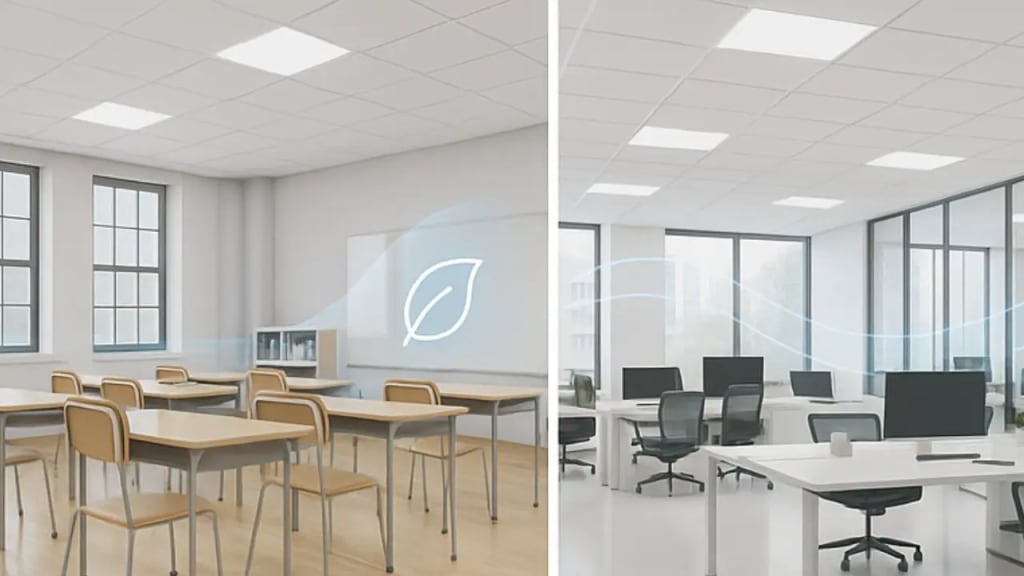
Disinfection often sounds straightforward in theory. Kill microbes. Reduce risk. Keep spaces clean. But real buildings are not laboratories. They are living environments filled with people, movement, moisture, and constant change. What works on paper does not always translate smoothly into daily use.
This becomes especially clear when comparing visible light disinfection and UV-C in occupied buildings.
Both technologies are effective in their own ways. Both are rooted in sound science. Yet they serve very different roles once people enter the space.
I began noticing this distinction when spending time in buildings that used UV-C systems overnight and visible light systems during the day. The difference was not just technical. It was experiential.
How UV-C Disinfection Works in Practice
UV-C light operates at very short wavelengths with high energy. This energy damages the DNA and RNA of microorganisms, preventing them from replicating. It is a powerful tool and has been used effectively in healthcare and industrial settings for decades.
However, UV-C comes with a critical limitation. It is unsafe for direct human exposure. Prolonged or unprotected exposure can damage eyes and skin. Because of this, UV-C systems are typically used when rooms are empty.
In real buildings, this usually means disinfection happens overnight or during scheduled downtime. Doors are closed. Warning systems are activated. The space is treated and then returned to normal use.
From a technical standpoint, this works well. Microbial levels are reduced significantly during treatment cycles.
From a real-world standpoint, something is missing.
The Gap Between Disinfection Cycles
Buildings do not stay clean once people return. Every breath adds carbon dioxide and moisture. Every touch transfers microorganisms. Every movement stirs particles into the air. By mid-day, microbial presence begins building again.
UV-C does not operate during these hours.
This creates a pattern of reset and rebuild. The space is disinfected when empty, then gradually accumulates contamination during occupancy. The cycle repeats.
This is not a failure of UV-C. It is simply a limitation of where it can be used safely.
How Visible Light Disinfection Fits Into Daily Life
Visible light disinfection approaches the problem differently. Instead of attempting rapid sterilization, it focuses on continuous microbial reduction while people are present.
Certain wavelengths of visible light interact with naturally occurring molecules inside microbial cells. These interactions trigger internal reactions that gradually damage the microorganisms and limit their ability to survive. The process is slower than UV-C but operates constantly.
The most important distinction is safety.
Visible light disinfection systems are engineered to stay within photobiological safety limits for human eyes and skin. This allows them to function during normal building use without special precautions.
In real buildings, this changes everything.
Continuous Protection Versus Episodic Intervention
When comparing these two technologies in practice, the difference comes down to timing.
UV-C delivers powerful, episodic intervention. It is highly effective during treatment windows. Visible light delivers continuous, gentle protection that prevents microbial buildup throughout the day.
In a classroom, for example, UV-C may reduce contamination overnight. But students spend hours interacting with desks, equipment, and each other during the day. Visible light continues working during those hours, reducing surface contamination as it forms.
In offices, gyms, and public spaces, this continuity matters. The risk of transmission and contamination is highest when people are present, not when rooms are empty.
Operational Realities in Buildings
Real buildings must balance effectiveness with practicality.
UV-C systems require scheduling, safety interlocks, and strict controls. Mistakes can carry risk. Occupants must trust that systems are operated correctly.
Visible light systems integrate seamlessly into existing lighting infrastructure. They do not require special procedures or training for occupants. From the user’s perspective, nothing changes.
This ease of integration is one reason visible light disinfection is increasingly favored in continuously occupied environments.
Visual Comfort and Perception
Another difference emerges in how spaces feel.
UV-C is invisible to occupants because it operates in their absence. Visible light disinfection becomes part of the lighting environment. When designed properly, it avoids harsh spectral peaks and maintains visual comfort.
People do not feel like they are under a treatment system. They feel like they are in a well-lit space.
This matters because comfort influences trust. When people feel comfortable, they stay longer, focus better, and experience less stress.
Not a Competition but a Complement
The most effective buildings do not choose between visible light and UV-C. They use both strategically.
UV-C excels at deep disinfection during unoccupied periods. Visible light excels at maintaining cleaner conditions during occupancy. Together, they create a layered approach that reflects how contamination actually occurs.
This layered strategy aligns with how healthy buildings are designed. No single system solves every problem. Success comes from combining technologies that work across different timescales.
What Real Buildings Teach Us
Comparing visible light disinfection to UV-C in real buildings reveals an important lesson. Effectiveness is not just about strength. It is about suitability.
A technology that cannot operate when people are present leaves gaps. A technology that works continuously but gently fills those gaps.
The cleanest buildings are not those that disinfect aggressively once a day. They are the ones that maintain balance hour by hour.
Conclusion
Visible light disinfection and UV-C serve different roles in indoor environments. UV-C offers powerful episodic disinfection when spaces are empty. Visible light provides continuous microbial reduction when spaces are occupied.
Real buildings need both.
Understanding how these technologies function in daily use allows building operators to choose strategies that reflect reality, not just theory. In environments where people spend their lives indoors, protection must be present when it matters most.
And that is during occupancy.
About the Creator
illumipure
Sharing insights on indoor air quality, sustainable lighting, and healthier built environments. Here to help people understand the science behind cleaner indoor spaces.
Keep reading
More stories from illumipure and writers in Journal and other communities.
The Science Behind Sensor Fusion in Indoor Air Systems
At first glance, air quality monitoring seems straightforward. Measure carbon dioxide. Track particles. Watch humidity. When numbers cross a threshold, adjust ventilation. For years, this was how buildings tried to manage indoor air.
By illumipure2 months ago in Journal
Author’s Advice
If you would’ve asked me 20 years ago did I know I’d become a writer and an author, I would’ve said “nope, ain’t happening”. As fate would have it I did become an author and I can honestly say I’m loving it so far. It really does feel good to be a writer. I’ve learned a lot on this journey and I feel like with even me being as new to this world as I am, there’s some wisdom I need to share with every other aspiring author.
By Joe Patterson3 days ago in Journal
Inspection Drones Market Enabling Safer and Smarter Infrastructure Monitoring
The Flying Inspector Above Critical Infrastructure Across industries such as energy, utilities, construction, and transportation, infrastructure inspection is essential for safety and operational efficiency. Traditionally, inspections required manual labor, scaffolding, helicopters, or technicians working in hazardous environments.
By james robert3 days ago in Journal
TUS NUA - ch 53
TUS NUA – ch 53 New Beginnings – Mia and Midnight (*)(*)(*) Finola knew Ali’s brother-in-law needed to put his mind at rest. She fed her arm through his and led him outside. “We’ll sit here. If you like, I can put a block around us so our conversation will be private.”
By Margaret Brennan6 days ago in Fiction




Comments
There are no comments for this story
Be the first to respond and start the conversation.