
Claiming the Future: Medical Billing Software Market Thrives with Demand for Revenue Cycle Optimization
Medical billing software becomes the bridge between technological advancement and financial sustainability in healthcare environments where each claim matters and delays carry significant costs.

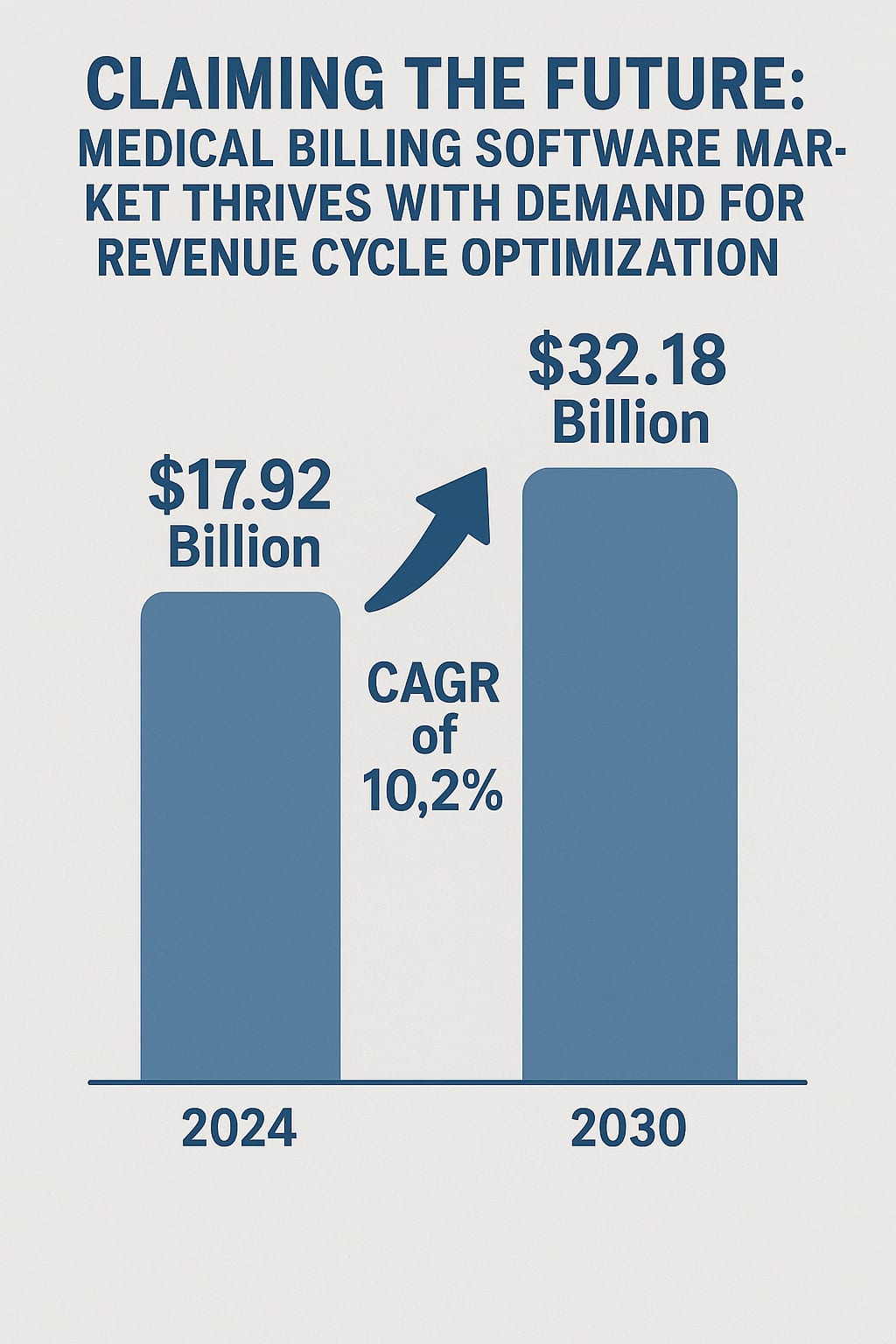
Healthcare providers' immediate demands to improve revenue cycles and patient financial interactions while cutting administrative costs drive a major expansion in the medical billing software market. The sector currently valued at USD 17.92 billion in 2024 will expand to USD 32.18 billion by 2030 with a steady compound annual growth rate (CAGR) of 10.2%. Medical billing software emerges as a fundamental component within modern healthcare systems due to mounting operational pressures faced by hospitals, clinics, and private practices under complex regulatory environments.
The Evolution of Medical Billing
Historically medical billing required extensive manual work including coding procedures, submitting claims, insurance verification processes and reconciling payments. Billing delays and errors create cash flow problems and lead to increased administrative expenses. Healthcare is experiencing digital transformation which enables software solutions to automate claim processing while detecting coding errors and integrating with Electronic Health Record (EHR) systems.
Modern billing software combines cloud computing with artificial intelligence (AI) and machine learning to reduce claim denials and speed up reimbursements while offering real-time financial performance analytics.
Driving Forces Behind Market Growth
1. Rising Healthcare Costs and Reimbursement Complexity
Healthcare providers must deliver precise and prompt billing practices to sustain their financial health while confronting rising costs and ever-evolving payer regulations. Medical billing software supports tracking claims across multiple payers while ensuring compliance with insurance standards and minimizing expensive denials or underpayments.
2. Shift to Value-Based Care
As healthcare delivery moves away from volume-based systems towards value-based care models billing accuracy and efficiency grows in importance. Detailed tracking of patient results along with quality indicators and bundled payments becomes possible through strong billing systems under value-based care.
3. Integration with EHR and Practice Management Systems
Interoperability is now a top priority. Medical billing solutions have been designed to function as integrated systems with EHRs and practice management tools enabling clinical and financial data exchange. Systems provide a comprehensive perspective that merges patient care management with financial operations.
4. Growing Adoption Among Small and Mid-Sized Providers
The adoption of cloud-based solutions and subscription pricing models has increased billing software accessibility for smaller healthcare providers. The organizations gain from lowered initial costs alongside better data protection and software update automation which results in growing market adoption.
Key Features Transforming the Market
Automated Claims Processing: These systems accelerate the reimbursement process while simultaneously reducing the occurrence of human mistakes.
Advanced Reporting and Analytics: The advanced reporting and analytics feature reveals information about revenue losses while tracking payer efficiency and identifying operational delays.
Coding Assistance with AI: The AI-powered system ensures precise medical coding by using documentation which leads to lower denial rates.
Patient Billing Portals: Enhances patient satisfaction by providing billing statements that are clear and easy to access along with convenient payment options.
Regulatory Compliance Tools: The tool maintains compliance with HIPAA regulations as well as ICD-10 and CPT coding standards along with CMS requirements.
Challenges and Market Barriers
The medical billing software market continues to grow but encounters several obstacles.
Data Privacy Concerns: Stringent cybersecurity measures are essential when processing sensitive patient financial and health data.
Resistance to Change: Legacy systems prove difficult for older or smaller practices to move from due to complex new technology requirements and financial barriers.
Training and Adoption: Proper training for software use leads to effectiveness but demands significant resources while the system is first installed.
Regional Insights
The healthcare market in North America leads with the largest market share because of its advanced healthcare systems and insurance coverage alongside early adoption of new technologies.
Europe maintains a close pursuit thanks to its digital health initiatives combined with AI utilization in revenue management.
The Asia-Pacific region will experience the most rapid growth thanks to healthcare digitization trends along with the expansion of private medical facilities and rising awareness of revenue management tools.
Future Outlook: From Billing to Intelligence
Medical billing software will transform into a strategic financial management system as it evolves beyond its transactional origins. The integration of AI in healthcare will transform billing solutions into automated systems capable of delivering predictive insights about revenue patterns as well as payer and patient payment behaviors. Providers will be equipped through these insights to enact data-based decision making while preemptively tackling financial risks.
The combination of patient engagement platforms with telehealth services and wearable data can develop billing strategies that better match financial communication with clinical care pathways.
Conclusion
Healthcare financial management practices are undergoing transformation due to the need for improved billing speed and accuracy. This market is not simply prosperous because it enables improved transparency and compliance while optimizing revenue cycle efficiency—it’s taking ownership of healthcare administration’s future.
About the Creator
Paxton Templeton
I’m a storyteller at heart with a passion for turning data into compelling narratives. With a focus on industry trends, market insights, and growth statistics, I bring clarity to complexity
Keep reading
More stories from Paxton Templeton and writers in Journal and other communities.
From Fossil to Fuel Cell: Methanol Market Expands with Renewable Energy Integration
The methanol market worldwide experiences significant change because the world moves toward cleaner energy forms and sustainable industrial methods. After being largely produced from fossil fuels methanol has become essential to the progress toward low-carbon fuel solutions and sustainable chemical processes. The methanol market expected to achieve a valuation of USD 41.55 billion in 2025 will grow to reach USD 64.14 billion by 2030 with a compound annual growth rate (CAGR) of 9.1%. The leading force behind this growth is the rising methanol demand in energy applications like fuel cells and marine fuel along with renewable methanol initiatives.
By Paxton Templeton9 months ago in Journal
Author’s Advice
If you would’ve asked me 20 years ago did I know I’d become a writer and an author, I would’ve said “nope, ain’t happening”. As fate would have it I did become an author and I can honestly say I’m loving it so far. It really does feel good to be a writer. I’ve learned a lot on this journey and I feel like with even me being as new to this world as I am, there’s some wisdom I need to share with every other aspiring author.
By Joe Patterson4 days ago in Journal
Revenue Planning For Treatment Services
Introduction Revenue planning is a critical aspect of managing treatment services, as it ensures that healthcare organizations remain financially stable while delivering high-quality care. Treatment centers, including behavioral health programs, addiction recovery services, and outpatient clinics, rely on consistent revenue streams to cover operational costs such as staffing, facilities, medical supplies, and program development. Without careful revenue planning, treatment services may face financial shortfalls, which can compromise patient care or limit program availability. Effective revenue planning involves analyzing potential income sources, estimating patient volume, forecasting insurance reimbursements, and exploring alternative funding opportunities. By implementing a structured revenue plan, treatment services can maintain operational sustainability and focus on providing effective care.
By Abdul Mueed4 days ago in Journal
A System That Isn’t Working Challenge Winners
Systems promise order. They organize behavior, distribute opportunity, and suggest that if everyone follows the rules, things will work. The entries in A System That Isn’t Working look closely at what happens when that promise begins to slip.
By Vocal Curation Team4 days ago in Resources




Comments
There are no comments for this story
Be the first to respond and start the conversation.