
China Showcases Humanoid Martial Arts Robots: Should Europe Be Worried?
A dazzling tech spectacle raises questions about global power, AI competition, and the future of robotics
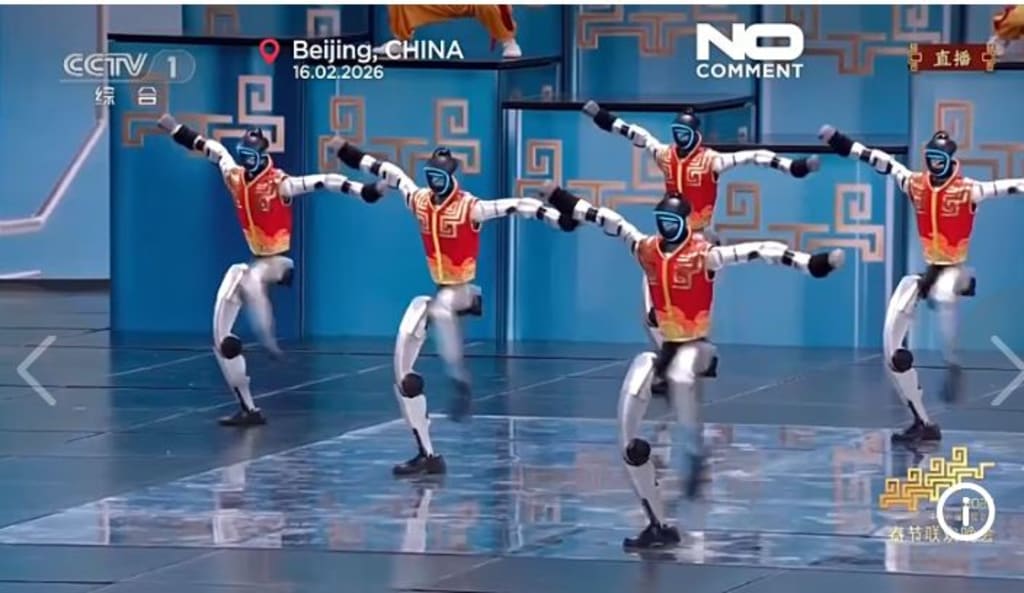
A futuristic spectacle recently captured global attention as humanoid robots performed martial-arts routines, flips, and synchronized choreography during a major televised celebration in China. The performance looked like something out of science fiction — machines moving with speed, balance, and coordination that once seemed uniquely human.
Beyond entertainment, the demonstration carried a deeper message. It highlighted rapid progress in humanoid robotics and raised strategic questions for policymakers, especially in Europe. As robotics becomes central to economic growth, security, and artificial intelligence, observers are asking: does this signal a shift in global technological power?
A Stage Built for Technological Messaging
The robots appeared during a massive New Year broadcast held in Beijing, watched by hundreds of millions of viewers. They performed kung fu movements, weapon choreography, and group routines that required precise coordination between hardware and AI systems.
The showcase blended culture with innovation. Martial arts — a symbol of discipline and tradition — became a metaphor for technological strength. Demonstrations like this are increasingly used to present national progress in robotics, AI, and manufacturing.
Many of the humanoids were developed by fast-growing firms such as Unitree Robotics, which has gained attention for producing agile quadruped and humanoid machines at comparatively low cost.
How Advanced Are These Humanoid Robots?
The performance revealed major improvements in balance, movement control, and multi-robot coordination. Modern humanoid robots rely on a combination of high-torque motors, advanced sensors, and AI models trained on motion data to mimic human movement.
However, experts emphasize an important distinction: demonstrations occur in controlled environments. Real-world settings — cluttered homes, construction sites, or emergency zones — are far more unpredictable.
Even so, progress is accelerating. Compared with earlier prototypes, today’s humanoids show:
Better stability while running or jumping
More precise hand and arm control
Improved coordination between multiple robots
Faster learning through AI simulation
These improvements suggest humanoid robots may move into practical roles sooner than previously expected.
The Global Robotics Race
Humanoid robotics is increasingly viewed as a strategic industry, similar to semiconductors and AI chips. Nations see it as a solution to labor shortages, aging populations, and productivity challenges.
China’s advantage lies in manufacturing scale and integrated supply chains. The country already installs more industrial robots than any other region, allowing new technologies to transition from prototype to production quickly.
Meanwhile, the United States leads in AI software and venture investment, while Europe remains strong in industrial automation and robotics research.
Rather than a single leader, analysts describe a three-way competition — each region specializing in different layers of the robotics ecosystem.
Why Martial Arts Matter Strategically
At first glance, kung fu robots may seem like a novelty. But the movements they demonstrate — balance, rapid response, object handling — are essential for real applications.
Humanoid robots could eventually:
Work in warehouses designed for humans
Assist elderly people at home
Perform maintenance in dangerous environments
Support disaster response teams
Help military logistics without redesigning infrastructure
Because the world is built for human bodies, robots shaped like humans could integrate more easily than wheeled machines.
This is why governments view humanoids as a long-term strategic technology rather than a gimmick.
Europe’s Position: Cautious but Capable
Europe is not absent from robotics innovation. The region leads in collaborative robots, safety standards, and ethical AI regulation. European universities and research labs remain influential in robotics theory and engineering.
However, commercialization at scale has been slower. Startups often face fragmented funding, regulatory complexity, and manufacturing challenges compared with competitors.
The robot showcase highlights a strategic question for Europe: should it compete directly in humanoid mass production, or focus on specialized robotics where it already excels?
Many experts argue the answer is both — coordinated investment alongside regulatory leadership.
Security and Ethical Concerns
As robots become more capable, concerns grow about misuse. Humanoid machines could be used for surveillance, policing, or military support. Their ability to operate in human environments raises questions about accountability and safety.
Key risks include:
Cybersecurity vulnerabilities
Autonomous decision-making errors
Labor displacement
Public trust and acceptance
Europe’s emphasis on regulation may become an advantage here, shaping global standards for safe deployment.
Innovation or Soft Power?
Large technology showcases often serve multiple purposes: attracting investors, inspiring public excitement, and projecting national strength.
The martial-arts robot display fits that pattern. It demonstrated genuine engineering progress while also reinforcing a narrative of rapid technological advancement.
Public reactions reflected both fascination and anxiety — admiration for innovation mixed with questions about automation’s societal impact.
This dual perception is common whenever transformative technologies emerge.
What Comes Next for Humanoid Robotics
The next decade will determine whether humanoid robots become widespread tools or remain niche machines. Key factors include cost, reliability, battery life, and software intelligence.
If these barriers fall, industries such as logistics, construction, healthcare, and home services could change dramatically.
The biggest shift may not be physical movement — which is improving quickly — but cognitive ability. Robots must understand complex environments, communicate naturally, and make safe decisions.
That challenge sits at the intersection of robotics and advanced AI.
Conclusion: Should Europe Be Worried?
The answer is nuanced.
China’s martial-arts robots signal momentum, strong investment, and growing manufacturing capability. They show that humanoid robotics is moving from research curiosity toward industrial priority.
But demonstrations do not equal dominance. Real-world deployment remains difficult, and global competition is intense.
For Europe, the takeaway is not panic — it is urgency. Strategic funding, collaboration, and clear regulation will determine whether the region leads, partners, or follows in the robotics era.
The kung fu performance may have looked like entertainment, but its message was serious: the future of AI will not exist only in software. It will walk, lift, assist — and perhaps even fight — in the physical world.
About the Creator
Modern Custom Software Development Strategies for Scaling Mid-Market Tech Companies
You know that point where your product is working, revenue is growing, but your tech stack feels like it’s held together with duct tape and late-night hotfixes? Users are increasing, features keep piling on, and every release feels riskier than the last. The codebase isn’t “bad,” but it definitely isn’t ready for the next 3x growth curve.
By Jessica Bennett4 days ago in Journal




Comments
There are no comments for this story
Be the first to respond and start the conversation.