
Black Friday Potatoes
Have we compromised our effort to think freely and rationally?

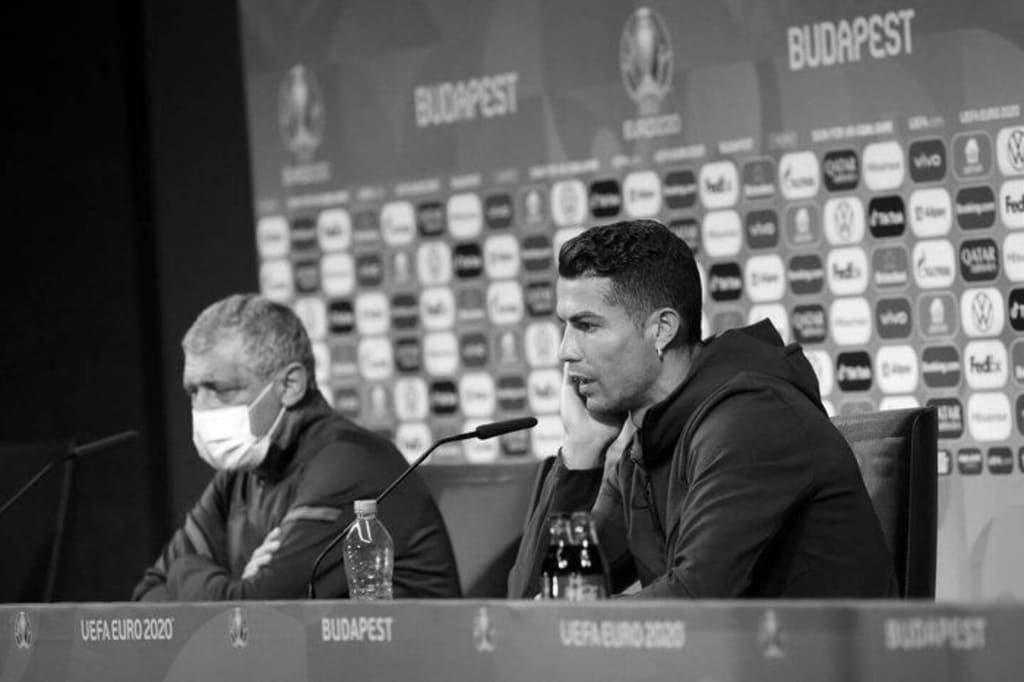
Everywhere around us advertising exists to attract our attention, determine what we do and how we do it. Portuguese football player, Cristiano Ronaldo, replaced two bottles of Coca Cola from a press conference with bottles of water - encouraging everyone to drink healthier.
Apart from the media and football associations' backlash saying 'how dare you move the money that finances this tournament', we realised that those coke bottles did not represent what the players were actually drinking and 'wait why was sugar drinks and professional sports even associated to begin with'.
Advertising, commercials and marketing play a huge role in our lives influencing our behaviour. In a consumerist world with Black Friday discounts and flashy billboard car displays we are constantly affected and to an extent even controlled by advertising.
But what would life look like without advertising?
Have we compromised our effort to think freely and rationally in order to afford a cheaper big screen TV?
I.
Satisfy the consumption needs and businesses would be out of business. At least that was Thorstein Veblen's theory. Increasing productivity lowered prices for simple products which was great for people, but bad for business. If our needs were fulfilled then why and what should we buy?
If we could extend the idea that our needs were not yet fulfilled, then we would always want to buy and do something in order to fill those needs.
Enters: Advertising.
Perpetuating scarcity became the crucial mechanism for extending consumer needs and creating artificially high prices. Advertising created perceived scarcity.
The gap between humans and the prospects of having needs fulfilled meant that our wishlist of things we wanted to buy could be controlled. Stretching needs for a product that seemed in high demand meant that prices could go up and having a scarce, rare and high-demand product was considered socially magical for you. Luxury and basic goods were now different and everyone was willing to chase an idea of reaching a higher need.
This need did not even have anything to do with our personal needs, but it was supposed to be better?
Whilst technology advancements made everything cheaper and easier to produce, advertising kept businesses running.
Think about potatoes. There was a time in history when potatoes were not a popular food. The French thought potatoes were connected with leprosy, the Germans thought they were nothing better than feed for livestock, and Russian peasants actually thought they were poisonous.
Then Catherine the Great came along and turned potatoes into gold. She had high fences installed to enclose her potato fields. Signs dotted the land warning the Russian citizens not to steal her potatoes. With the potatoes suddenly off-limits, they became popular. The idea of scarcity changed the need for potatoes.
"They call it the American Dream because you have to be asleep to believe it." 1
II.
Without advertising. How do we buy and sell? Would our needs be met?
The new intention economy. Our intent goes out to the marketplace, revealing only what is required to attract offers of a particular service or product at that time. In the new marketplace, freedom of choice remains the guiding light.
Browsing and scrolling without a single disruptive advertisement. The newspaper lies open brimming with articles line to line, devoid of the advertisements. No more discounts, no more coupons, just pure content and choice.
We are empowered to make our own choices without being influenced by unnecessary ads. Is that good? Can lack of advertisements trigger chaos and social disturbance since they serve as social navigation? Are we ready to accept ourselves and others in a world where businesses do not influence our social status and wellbeing? As such, the challenge is to imagine what all those empowered humans will do when they are free from ads.
Drink coke and watch football.
Sources to share:
- The Intention Economy
- Veblen's Critique of Advertising
- If advertising never dies
About the Creator
Human Dilemmas
Why do some ideas form our lives and others become nothing? Why do we take some ideas for granted and question others?
I'm Daniel, writer of Human Dilemmas. A weekly letter philosophising on life when we forget to live.
Keep reading
More stories from Human Dilemmas and writers in Journal and other communities.
The goals I did not achieve
Every writing goal I made for the year is a wash. It has been this way for a while, but I think it's important to be open about my failures and the reality of how life can get in the way. This is especially true considering the several times I have posted on Vocal about my writing goals, how I was changing my approach, and where I was hoping to be for the upcoming year. I will probably do that again in a couple months, but for now, it is time to acknowledge where I am today.
By Kay Husnick22 days ago in Journal
Inside Ratul Puri’s Vision: The Strategy Powering Hindustan Power’s Clean Energy Surge
India’s clean energy transition is entering a decisive phase, marked by large-scale investments, advanced technology adoption, and visionary leadership. At the center of this transformation stands Ratul Puri, Chairman of Hindustan Power, whose strategic direction is reshaping how renewable energy is developed, stored, and delivered across the country. Under his leadership, Hindustan Power has emerged as a significant force in solar and energy storage, aligning business growth with India’s long-term sustainability goals.
By Chinmaya Singh6 days ago in Journal


Comments
There are no comments for this story
Be the first to respond and start the conversation.