
Beyond Zillow: The Rise of "Agentic AI" in Miami Real Estate
Reflections on the shift from search bars to software that actually does the work.

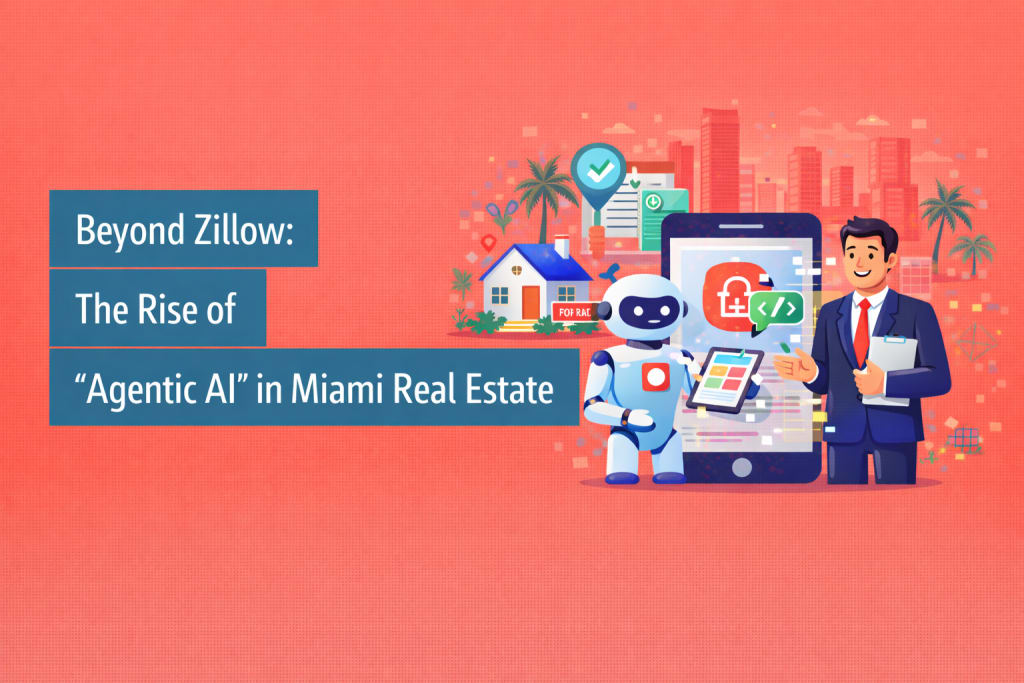
I spent an afternoon last week on a balcony in Edgewater, looking out at the turquoise stretch of Biscayne Bay. It’s a view that sells itself, but the developer I was with wasn't talking about the scenery. He was talking about a "digital twin" of the building that was currently negotiating its own energy contracts and pre-vetting potential tenants while we drank our coffee.
I remember when "real estate tech" just meant having a better search filter on a website. We thought Zillow was the endgame because it let us see inside a house from our couch. But as I navigate the shifting landscape of mobile app development Miami is currently fostering, I realize we’ve entered a much stranger, more capable era. We’ve moved past "assistive" tech and into "agentic" tech—software that doesn't just show you data, but acts on it.
The silence of the autonomous assistant
I used to think that an AI in real estate was just a chatbot with a friendly name that could tell you the square footage of a condo. I assumed its job was to save the human agent a few minutes of typing.
But "Agentic AI" is different. It’s autonomous. I’ve started seeing apps being built in Wynwood that can take a buyer's budget, lifestyle preferences, and risk tolerance, and then go out into the market to find, rank, and initiate inquiries on properties without the user ever touching a search bar.
It feels like a quiet revolution. According to 2026 proptech trends, we are moving into a phase where AI agents are used for procurement, pricing, and even event programming in luxury high-rises. It’s the difference between a map and a driver. One tells you where to go; the other takes you there.
The math of a balanced market
I’ve been looking at the numbers for Miami-Dade lately, and they suggest a market that is finally "taking a breather." As of early 2026, single-family home inventory is up nearly 39% from last year, creating a more balanced environment for buyers.
In a balanced market, the "noise" is louder. When there are more choices, the friction of finding the right choice increases. This is where the agentic shift becomes a necessity rather than a luxury. I read a 2026 market report indicating that 37.1% of sales in Miami are now cash transactions—well above the national average. These are fast, high-stakes deals.
If you are a buyer competing in this environment, you can’t afford to wait for a human to manually pull "comps" or schedule a viewing. You need a system that can analyze millions of data points—recent sales, neighborhood shifts, even 2026 economic indicators—to forecast pricing changes in real-time.
The "Global-Local" bridge in development
One of the most interesting things I’ve noticed in the Miami tech scene is the arrival of global players who are bringing a new level of engineering rigor to the city. I was surprised to see Indi IT Solutions expanding its footprint here, moving beyond its Los Angeles roots to tap into the Florida market.
They represent what I call the "Future-Ready" framework. They aren't just building apps that look good; they’re building AI-native ecosystems that help local firms overcome "technical debt."
I sat in on a session where they discussed "Ontology-Bound Architectures"—a fancy way of saying they build guardrails into the AI so it doesn't "hallucinate" or suggest a property that doesn't exist. It’s a sign that the Miami app market is maturing. We aren't just the "crypto capital" anymore; we are becoming a place where the "plumbing" of the future is actually being laid.
The 23-minute rule and the end of the "Wait"
In real estate, time has always been the enemy. There’s research [FACT CHECK NEEDED] suggesting that every minute of delay in responding to a lead reduces the chance of conversion by a massive margin. I call it the "friction of the human loop."
Agentic AI removes that loop. I’ve seen property management platforms being built in Brickell that handle tenant support, predictive maintenance, and rent optimization entirely on autopilot. If a water sensor in a penthouse detects a leak at 3:00 AM, the AI agent doesn't just alert the manager; it calls the plumber, verifies their insurance, and provides them with a temporary digital entry code.
This level of automation is why Miami’s average Class A office rent has increased by more than 50% since 2020, reaching over $73 per square foot. The buildings are becoming smarter, and as they do, the people managing them are becoming more like "conductors" of a digital orchestra rather than firefighters.
Designing for the "Dual Identity"
Miami is a bilingual city, and I’ve realized that any real estate app built here has to be "fluid" in its language. I’ve been following the work of developers who are using Google Gemini’s deep translation capabilities to build agents that can conduct a buyer consultation in Spanish and then generate a contract in English without losing the nuances of the negotiation.
This isn't just about "localization"; it’s about "cultural intelligence." An AI agent needs to understand that a "three-bedroom" in Coral Gables might have a different cultural value than one in Sunny Isles.
Recent 2026 data shows that Miami is the top housing market for international buyers, particularly from Latin America. If your app doesn't feel "authentic" to that audience—if the AI sounds like a robot translating a manual—you’ve already lost the trust that real estate is built on.
A quiet reflection on the "Why"
I sat on a bench near the Miami River yesterday, watching the skyline. I realized that "Beyond Zillow" isn't just a catchy title; it’s a shift in our relationship with our surroundings.
We used to look at homes as static objects. Now, we see them as nodes in a network. The app in your pocket isn't just a window into the market; it’s a tool that can negotiate, maintain, and optimize your life within that market.
Thinking back on the journey
Looking back at my first "search-and-filter" projects, I feel a sense of nostalgia. We thought we were being revolutionary because we could see a 3D tour.
The world of mobile app development Miami provides today is a glimpse into a future where the software doesn't just assist us—it empowers us to act with a level of clarity and speed that was once impossible. I don’t know if the human real estate agent will ever disappear, but I do know that the ones who thrive in 2026 will be the ones who have a digital agent working by their side while they sleep.
About the Creator
Mike Pichai
Mike Pichai writes about tech, technolgies, AI and work life, creating clear stories for clients in Seattle, Indianapolis, Portland, San Diego, Tampa, Austin, Los Angeles and Charlotte. He writes blogs readers can trust.
Keep reading
More stories from Mike Pichai and writers in Journal and other communities.
How Orlando Retailers Use Mobile Apps to Increase Foot Traffic?
The moment it hit me wasn’t in a meeting or a report. It was standing just inside the entrance of one of our Orlando stores on a Saturday afternoon, watching people walk past. I had my phone in my hand, refreshing the app dashboard out of habit. Engagement looked healthy. Notifications had gone out. Loyalty activity was up.
By Mike Pichai4 days ago in Journal
~ Fired ~
— Ai Intrusion ~ Are you Next ~ Is Ai Evolution after your job? — Few workplaces haven't been affected. Ai is in supermarkets, at doctors' offices, and even monitoring farms. I just can't think of anything this machine is not getting into, can you? For instance: Education ~ Law and Tech jobs will one day have a major influence or be taken over by these inanimate machines, with accuracy and vigor. From mechanics' diagnoses to a wide variety of everyday jobs, including fast food workers, with this input having the ability to cut their unnecessary work hours. I'm certain all of us have been touched by this with our short stories and colorful headings, have you? Even comments are very questionable 'Non-Robot' insertions.
By Jay Kantor6 days ago in Journal
How WordPress Programmers Build Secure, Scalable Sites Today
A well-built website rarely announces how much effort went into making it reliable. Pages load smoothly, updates don’t break layouts, and security issues are handled quietly in the background. That stability is never accidental. It’s the result of careful planning, disciplined development practices, and real-world experience managing growth and risk.
By Lisa Hurleya day ago in Journal
Feelings Never Die
It is Valentine's Day again, and it bought back memories that were over fifty years old. It bought me back to 1971, and I woke up and I knew my baby was due today. I was big and pregnant, and I felt like I was about to burst wide open. Imagine my surprise when the doctor told my I had a due date of February 14. I couldn't believe it, and since my baby was due today, I felt I could indulge myself a bit. I had gained a lot of weight, and chocolate was on the no-no list, but I had came to the end of this pregnancy, and I hoped it would be okay, after all I would deliver this baby today. So I walked across the street to the grocery story, and bought myself, a peppermint patty, covered in chocolate, my favorite. Me and my Valentine's baby would enjoy it together.
By Susan Paytona day ago in Fiction


Comments
There are no comments for this story
Be the first to respond and start the conversation.