
How Orlando Retailers Use Mobile Apps to Increase Foot Traffic?
How Orlando Retailers Use Mobile Apps to Increase Foot Traffic?

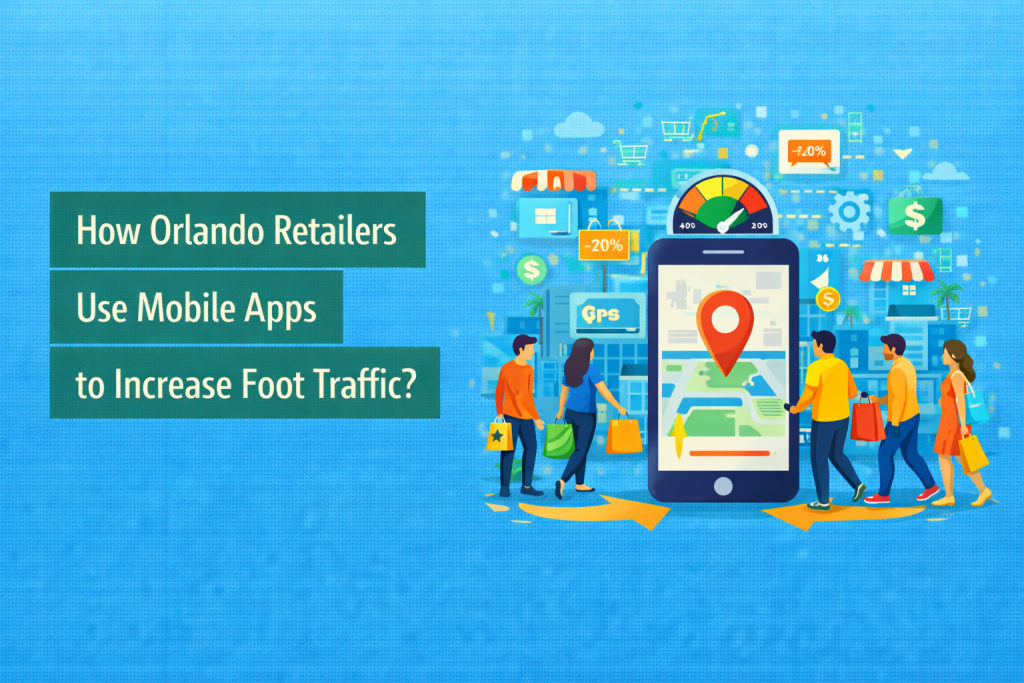
The moment it hit me wasn’t in a meeting or a report.
It was standing just inside the entrance of one of our Orlando stores on a Saturday afternoon, watching people walk past. I had my phone in my hand, refreshing the app dashboard out of habit. Engagement looked healthy. Notifications had gone out. Loyalty activity was up.
But the doors weren’t opening.
I remember feeling a strange disconnect—like I was watching two different businesses operate at once. One lived in analytics. The other lived on the sidewalk. And they weren’t speaking to each other.
Why we assumed an app would naturally drive visits
When we approved the app, the logic felt sound.
Retail was already mobile-first. Customers were glued to their phones. Competitors were investing heavily in digital loyalty and promotions. We believed an app would shorten the path between awareness and action.
In planning sessions, we talked about:
- Personalized offers
- Push notifications
- Loyalty rewards
- In-app browsing tied to in-store inventory
All of it made sense. None of it felt speculative.
At the time, mobile app development Orlando retailers were investing in followed similar playbooks. Apps were positioned as a bridge between digital engagement and physical presence.
What we didn’t fully question was how that bridge actually gets crossed.
The uncomfortable truth about engagement
The first few months post-launch looked encouraging.
Downloads climbed steadily. Push open rates were respectable. Users browsed products. Loyalty enrollments increased.
By digital standards, the app was performing.
By retail standards, something was missing.
When we overlaid app engagement with in-store traffic data, the correlation was weaker than expected. People interacted with the app—but often nowhere near a store. Engagement didn’t reliably translate into movement.
That was the first time I stopped treating engagement as a proxy for intent.
What foot traffic data quietly revealed
Once we started looking more closely, patterns emerged.
Users who engaged with the app at home behaved differently from those who engaged near a store. Timing mattered. Location mattered. Context mattered more than content.
Looking back at six months of data, we noticed:
- App activity spiked in the evenings, while foot traffic peaked midday
- Promotions sent outside a one-mile radius rarely led to visits
- Offers tied to immediacy outperformed generic discounts by 25–40%
- Users who opened the app within walking distance were 3× more likely to enter
The insight wasn’t that the app didn’t work.
It was that it worked only under very specific conditions.
Why “awareness” wasn’t enough
Retail apps often aim to stay top of mind.
But top of mind doesn’t always mean top of foot.
People can like a brand, browse products, and still choose convenience over commitment. Especially in Orlando, where traffic patterns, weather, and tourism influence movement daily.
We learned quickly that:
- Passive awareness rarely changes plans
- Incentives need urgency, not just value
- The app has to intervene, not just inform
That realization forced us to rethink how and when the app spoke to users.
The shift toward location-driven behavior
The biggest change came when we stopped treating the app as a broadcast channel and started treating it as a situational one.
Instead of asking, “What do we want to say?” we asked, “When does it make sense to interrupt?”
We began experimenting with:
- Geo-triggered notifications instead of scheduled blasts
- Store-specific messaging instead of brand-wide campaigns
- Time-bound offers that aligned with foot traffic patterns
- In-store prompts that reinforced app actions
The impact wasn’t immediate—but it was measurable.
Foot traffic lift didn’t show up as a spike. It showed up as consistency.
What surprised me about Orlando shoppers
One assumption I had to unlearn was that Orlando shoppers behaved like a single audience.
They don’t.
Local residents, tourists, and seasonal visitors interact with retail very differently. Their tolerance for travel, waiting, and exploration varies widely.
When we segmented behavior more honestly, we saw:
- Locals responded better to routine-based nudges
- Tourists reacted more to proximity and convenience
- Seasonal visitors showed higher impulse behavior but lower loyalty
That segmentation changed how we evaluated success.
A single campaign couldn’t serve all three effectively.
Why app features mattered less than timing
We spent a lot of time early on debating features.
In hindsight, most of those debates missed the point.
Features didn’t drive foot traffic. Moments did.
The most effective interactions were simple:
- “You’re nearby—here’s something useful now”
- “This offer expires today, not someday”
- “You’re already here—make this easier”
Complex flows underperformed. Immediate value won.
That was humbling for a team proud of what we’d built.
How in-store teams became part of the system
Another shift came when we involved store staff more directly.
Previously, the app lived in the digital team’s world. Stores were recipients, not participants.
Once we aligned:
- Staff could reinforce app-driven offers
- In-store signage mirrored app messaging
- Associates understood what users had already seen
Conversion improved—not because the app changed, but because the experience felt coherent.
Digital stopped feeling separate from physical.
What the numbers looked like after alignment
Six months after adjusting our approach, the metrics told a clearer story:
- Location-triggered campaigns drove 20–30% higher visit rates than scheduled pushes
- Users engaging within 500 meters converted to visits at nearly 4× the baseline
- App-driven foot traffic was more consistent, even without deep discounts
- Repeat visits increased among users who experienced in-store reinforcement
The app didn’t replace traditional drivers of traffic. It amplified them when used with intent.
The mistake I won’t repeat
I won’t confuse digital activity with physical outcome again.
- Downloads don’t open doors.
- Engagement doesn’t move feet.
- Dashboards don’t feel empty stores.
Only behavior does.
Once I accepted that, decisions became simpler—even when they were harder to execute.
Where I landed
Orlando retailers don’t use apps to increase foot traffic by shouting louder.
They do it by speaking at the right moment, in the right place, with the right restraint.
Mobile apps work best when they respect context—when they acknowledge that movement is a choice, not a click.
In mobile app development Orlando retail teams invest in today, the apps that succeed aren’t the most feature-rich.
They’re the most situationally aware.
I learned that not from a report—but from standing in a doorway, watching people walk past, and finally admitting that attention and action are not the same thing.
Once we built for that difference, the doors started opening more often.
About the Creator
Mike Pichai
Mike Pichai writes about tech, technolgies, AI and work life, creating clear stories for clients in Seattle, Indianapolis, Portland, San Diego, Tampa, Austin, Los Angeles and Charlotte. He writes blogs readers can trust.
Keep reading
More stories from Mike Pichai and writers in Journal and other communities.
~ Fired ~
— Ai Intrusion ~ Are you Next ~ Is Ai Evolution after your job? — Few workplaces haven't been affected. Ai is in supermarkets, at doctors' offices, and even monitoring farms. I just can't think of anything this machine is not getting into, can you? For instance: Education ~ Law and Tech jobs will one day have a major influence or be taken over by these inanimate machines, with accuracy and vigor. From mechanics' diagnoses to a wide variety of everyday jobs, including fast food workers, with this input having the ability to cut their unnecessary work hours. I'm certain all of us have been touched by this with our short stories and colorful headings, have you? Even comments are very questionable 'Non-Robot' insertions.
By Jay Kantor6 days ago in Journal
Russian Drone Attack on Bus Carrying Mine Workers in Ukraine Kills at Least 12
At least 12 people have reportedly been killed following a drone attack on a bus carrying mine workers in Ukraine, an incident that has intensified concerns about civilian safety amid the continuing conflict. The attack, attributed in early reports to Russian military drone activity, underscores the ongoing risks faced by civilians and industrial workers in regions affected by active hostilities.
By Aarif Lashari5 days ago in Journal



Comments
There are no comments for this story
Be the first to respond and start the conversation.