
Bayt al-Hikmah: Where Stars of Knowledge Once Shone
The Library of Baghdad That Changed the World"

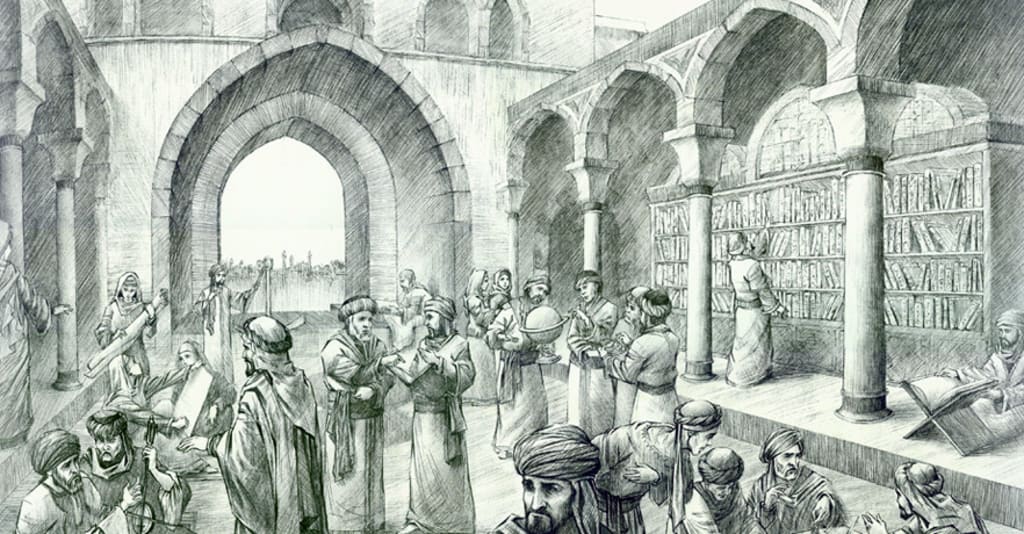
During the Abbasid Caliphate, Baghdad emerged as a center of intellectual and economic excellence. One of the most iconic examples of their support for scientific advancement was the famous library of Baghdad, Bayt al-Hikmah—known in English as the House of Wisdom. From around the 5th to at least the 9th century, its collection was considered the largest in the world. The halls of this institution were always abuzz with the presence of prominent scholars of the time.
Foundation and Development
The idea of Bayt al-Hikmah originated during the establishment of Baghdad. The second Abbasid Caliph, Al-Mansur, moved the capital there with the aim of completely removing the influence of the Damascus-based Umayyads. Islamic power replaced the Sassanids in the region, but Sassanid influence lingered in the Abbasid court. Many customs of the old empire persisted. The Sassanid nobility used to build rooms called ganj to store books. In Arabic, this became khizānah (library). Al-Mansur aspired to create a similar collection in Baghdad. He was also inspired by the Library of Alexandria and envisioned a grand repository called Khizanat al-Hikmah (Library of Wisdom). He died in 775, but his dream was realized by Caliph Harun al-Rashid. Shortly after assuming power in 786, he opened part of the royal library to the public. His vizier, Yahya Al Barmaki, was tasked with building a large-scale library. Initially, the library housed literary and scientific works collected by the caliph's father and grandfather. Persian folktales and Sassanid astronomical writings were translated into Arabic. Translators and bookbinders were hired for the purpose. At this early stage, only texts in ancient Persian were translated into Arabic.
Under Harun al-Rashid's son, Caliph Al-Ma'mun, the library reached its peak. He ruled from 813 to 833 and expanded the main building into an academy named Bayt al-Hikmah. In 829, he also established an observatory there. The library thrived with the presence of scientists and philosophers. He took several measures to expand the collection. One famous tale recounts how Al-Ma'mun brought the entire royal library of Sicily to Baghdad. The Sicilian king reportedly agreed to send the books, saying they hadn’t benefited his ancestors anyway. It is said that it took 400 camels to transport the entire collection.
Contribution to Science and Knowledge
Many philosophers and scientists were associated with Bayt al-Hikmah. One of the most notable was Muhammad ibn Musa al-Khwarizmi, a Persian scholar known as the father of algebra. He wrote several valuable books on geography, mathematics, and astronomy. In 820, he was appointed head of the library. Other regular scholars included the Banu Musa brothers—Muhammad, Ahmad, and Hasan—who made notable contributions in mathematics, astronomy, and mechanics. One major function of Bayt al-Hikmah was the translation of scientific texts from Greek, Sanskrit, and Latin into Arabic. To encourage this, Caliph Al-Ma'mun is said to have offered the translator an amount of gold equal to the weight of the translated manuscript.
Many Greek philosophers' works were translated: Pythagoras, Plato, Aristotle, Hippocrates, Galen, Socrates, and Euclid. Al-Kindi was involved in translating Aristotle, while Hunayn ibn Ishaq translated Hippocrates. Other renowned translators included Yahya Ibn al-Batriq, Hajjaj Ibn Mater, Qosta Ibn Luqa al-Bulabakki, and Thabit Ibn Qurrah. Bayt al-Hikmah also played a significant role in translating Indian scientific texts from Sanskrit. This enabled Arab mathematicians to explore the concept of zero and develop the Arabic numeral system.
At Bayt al-Hikmah, Al-Jahiz described various animals in his famous work The Book of Animals. Al-Malik developed precise measurements later used by astronomers to determine the Earth's circumference. It is said that within the library’s walls, one could hear conversations in Arabic, Persian, Hebrew, Greek, and Latin. The library was open to all, regardless of gender, religion, race, caste, or language. For example, Hunayn ibn Ishaq, a Christian physician, was welcomed and allowed to thrive. He contributed to many branches of knowledge, including logic and history, and translated the Greek Old Testament (Septuagint) into Arabic, although that version was later lost.
Destruction
After Al-Ma'mun’s death, Bayt al-Hikmah began to decline. During the rule of Caliph Al-Mu'tasim, many administrative functions were moved to the secondary capital, Samarra. Although later caliphs maintained the library, they did not take significant steps to improve it. Nevertheless, translation work continued through private efforts.
The final destruction came in the 13th century. In 1258, the Mongols invaded Iraq and devastated Baghdad. The Tigris River reportedly ran red with blood from mass killings. They burned down the once-glorious city, and Bayt al-Hikmah was lost forever. However, the astronomer Nasir al-Din al-Tusi managed to save some books by transferring them in advance to the library of the Maragheh observatory in Iran.
Impact
There is some debate about Bayt al-Hikmah’s exact influence. Some argue that many translations attributed to it were actually done elsewhere. However, it undeniably inspired a culture of library-building. Wealthy individuals began establishing local libraries. Other states began patronizing science and knowledge in the style of Baghdad. Large libraries were built to attract renowned Islamic scholars. In the 10th century, Caliph Al-Hakam II established such a library in Cordoba. Following this, 12th-century Toledo in Andalusia became a major center for science and knowledge, where scholars from all religions and ethnicities gathered. Arabic works began to be translated into European languages. In 1005, the Fatimid Caliph Al-Hakim founded Dar al-Hikma in Cairo, which was mentioned alongside Bayt al-Hikmah for nearly 165 years. Similar knowledge centers called Dar al-‘Ilm were established in other Muslim regions.
References
• Bayt al-Hikmah. Encyclopedia Britannica.
• Chandio, A. R. (2021). The house of wisdom (Bait Al-Hikmah): A sign of glorious period of Abbasids caliphate and development of science. International Journal of Engineering and Information Systems (IJEAIS); 5 (3).
• Lyons, J. (2010). The House of Wisdom: How the Arabs Transformed Western Civilization. Bloomsbury Publishing; Illustrated edition.
About the Creator
Riham Rahman
Writer, History analyzer, South Asian geo-politics analyst, Bengali culture researcher
Aspiring writer and student with a deep curiosity for history, science, and South Asian geopolitics and Bengali culture.
Asp
Keep reading
More stories from Riham Rahman and writers in Journal and other communities.
The Untold Aspects of The Lord of the Rings Trilogy Pt.2
Last part 8. Avatar (2009) drew significant inspiration from The Lord of the Rings trilogy. How? Let’s explain. In 1994, James Cameron had already completed about 80% of the conceptual work for Avatar. However, due to the limitations of visual effects at the time, he didn’t feel confident enough to begin production. Lacking advanced CGI and VFX, he decided to wait patiently for technological advancements. In 2002, after witnessing the CGI and motion capture used for Gollum in The Two Towers, Cameron was blown away. He realized the time had finally come to bring his dream project to life. And so, he jumped in headfirst to make it happen.
By Riham Rahman 9 months ago in Journal
The goals I did not achieve
Every writing goal I made for the year is a wash. It has been this way for a while, but I think it's important to be open about my failures and the reality of how life can get in the way. This is especially true considering the several times I have posted on Vocal about my writing goals, how I was changing my approach, and where I was hoping to be for the upcoming year. I will probably do that again in a couple months, but for now, it is time to acknowledge where I am today.
By Kay Husnick22 days ago in Journal




Comments
There are no comments for this story
Be the first to respond and start the conversation.