
Barcode Registration Demystified: Insights for Entrepreneurs and Manufacturers
Barcode Registration

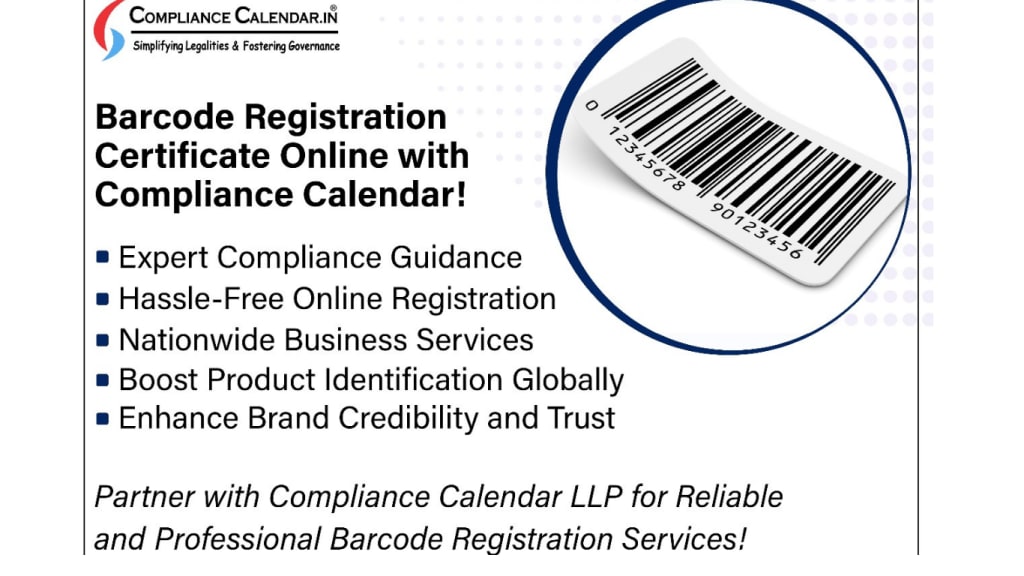
In the current competitive market, effective product identification is essential for both entrepreneurs and producers. Barcodes act as a universal language, simplifying inventory management, sales tracking, and enabling smooth transactions across different platforms. This guide seeks to clarify the process of Barcode Registration, offering detailed insights designed for business owners and producers.
Understanding Barcodes
Barcodes are visual representations of data that scanners can read to retrieve information about a product. The most common types include:
• UPC (Universal Product Code): Predominantly used in North America, UPCs are 12-digit codes essential for retail products.
• EAN (European Article Number): A 13-digit code widely adopted outside North America, suitable for international retail.
• ISBN (International Standard Book Number): Specifically assigned to books, facilitating their unique identification.
The Importance of Barcode Registration
Barcode Registration, guarantee that every product can be uniquely identified, thereby averting conflicts within the global supply chain. It improves the precision of inventory management, accelerates the checkout process, and is frequently necessary for selling products via major retailers and online marketplaces.
Steps to Register a Barcode
1. Determine Your Barcode Needs
Evaluate the quantity of products and variations (like size, color, or style) you intend to offer. Every distinct product variant needs a separate barcode. A t-shirt that comes in three sizes and three colors, for example, would require nine different barcodes.
2. Obtain a GS1 Company Prefix
The GS1 Company Prefix is a unique identifier assigned to your business, forming the foundation of your product barcodes. To acquire this prefix:
o Contact Your Local GS1 Member Organization: GS1 operates through member organizations in over 100 countries. Reach out to the one corresponding to your location.
o Provide Necessary Business Information: This typically includes your company name, address, and contact details.
o Pay the Associated Fees: Fees vary based on your region and the number of products you intend to barcode.
3. Assign Unique Product Numbers
You can now allocate a unique number to each product variant using your GS1 Company Prefix. Along with your prefix and a computed check digit, this number constitutes the Global Trade Item Number (GTIN) that is embedded in the barcode.
4. Generate Barcode Images
Utilize GS1's tools or certified software to create barcode images corresponding to your GTINs. Guarantee these images meet size and quality standards to guarantee scannability.
5. Integrate Barcodes into Product Packaging
Incorporate the generated barcode images into your product packaging design. It's important to place them in a location that's easily accessible for scanning and to maintain print quality to prevent scanning issues.
6. Test Barcode Scannability
Before mass production, test the barcodes to confirm they scan correctly across various devices. This step helps identify potential issues that could disrupt the supply chain or point-of-sale systems.
Cost Considerations
The cost of barcode registration varies based on factors such as your business location, the number of products, and the chosen barcode type. Typically, expenses include:
• Initial Registration Fee: A one-time fee for obtaining the GS1 Company Prefix.
• Annual Renewal Fee: An ongoing fee to maintain your prefix and barcodes.
• Per-Barcode Fee: Some organizations charge per barcode issued.
For example, in the United States, licensing a GS1 Company Prefix starts at $250, with an annual renewal fee of $50. Alternatively, single GTINs can be purchased for $30 without renewal fees.
Common Pitfalls to Avoid
• Using Unofficial Barcodes: Purchasing barcodes from unauthorized sources can lead to duplication issues and non-compliance with retailers.
• Incorrect Barcode Placement: Improper placement on packaging can hinder scanning efficiency.
• Neglecting Barcode Maintenance: Failing to renew your barcode licenses can result in deactivation, causing disruptions in product distribution.
Conclusion
For entrepreneurs and manufacturers seeking to optimize operations and guarantee product traceability, barcode registration is a necessary step. Businesses can improve efficiency, meet retail demands, and prepare for success in the global market by following the specified steps and complying with GS1 standards.
About the Creator
Keep reading
More stories from Rahul Saini and writers in Journal and other communities.
From TM to ®: Directing the Trademark Registration Maze
The transition from ™ to ® marks a brand's development from common law rights to the strong protections afforded by federal Trademark Registration. By means of this transformation, your brand’s personality will be strengthened and so will its legal position in the market. Let’s make our way through this complex labyrinth step by step, guaranteeing a smooth transition to a registered trademark.
By Rahul Sainiabout a year ago in Education
~ Fired ~
— Ai Intrusion ~ Are you Next ~ Is Ai Evolution after your job? — Few workplaces haven't been affected. Ai is in supermarkets, at doctors' offices, and even monitoring farms. I just can't think of anything this machine is not getting into, can you? For instance: Education ~ Law and Tech jobs will one day have a major influence or be taken over by these inanimate machines, with accuracy and vigor. From mechanics' diagnoses to a wide variety of everyday jobs, including fast food workers, with this input having the ability to cut their unnecessary work hours. I'm certain all of us have been touched by this with our short stories and colorful headings, have you? Even comments are very questionable 'Non-Robot' insertions.
By Jay Kantor6 days ago in Journal
KFC Delivering Near You in Warszawa on Pyszne.pl
Fast food delivery has become an essential part of modern city life, and Warsaw is no exception. With busy schedules, long commutes, and growing demand for convenience, more residents are turning to food delivery apps. One of the most popular combinations in the Polish capital today is KFC delivery through Pyszne.pl, giving customers quick access to their favourite fried chicken meals without leaving home.
By Aarif Lashari6 days ago in Journal



Comments
There are no comments for this story
Be the first to respond and start the conversation.