
Automated vs Manual Data Cleansing: Which is Right For You?
Know the difference between automated and manual data cleansing services for your business. Identify the key factors to select the best data cleansing method.
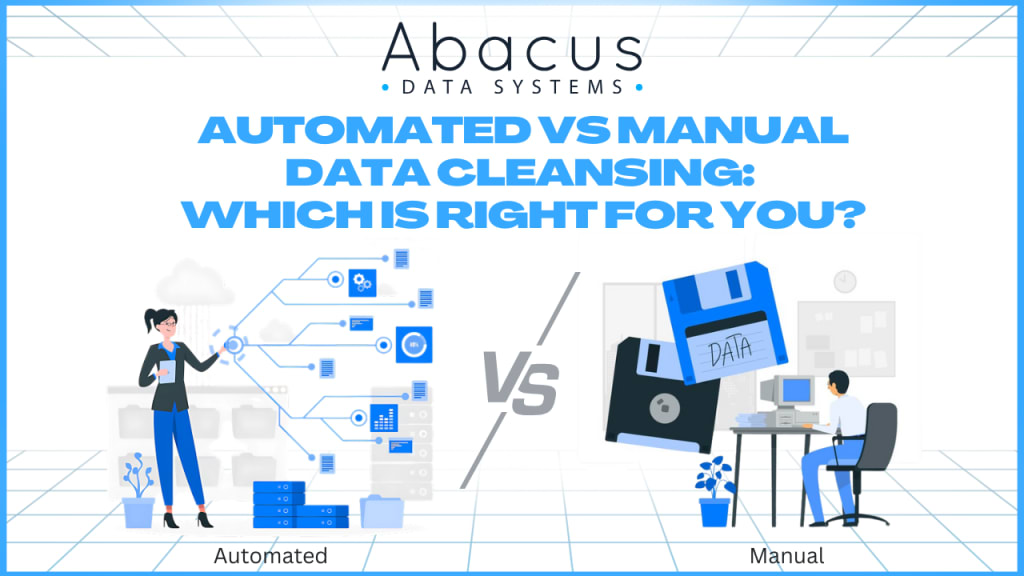
The rapid adoption of advanced digital transformation and the increasing use of cutting-edge technology by businesses to accumulate vast data volumes from various sources for better-informed decisions. However, the data from multiple sources is in raw format and needs to be cleaned of errors and redundancies.
Data cleansing is the backbone for modern data management practices, ensuring that firms have relevant information to make informed business decisions. Whether managing a small data set or struggling with the large volume of databases, the process of detecting and resolving duplicate entries is necessary. Traditionally, many businesses have used manual techniques to clean and validate data. However, the rise of automated tools provides a compelling alternative that promises speed, scalability, and real-time monitoring.
However, each approach has its pros and drawbacks, and selecting the perfect method suits the nature of your information, the unique resources are available, and your tolerance for remarkable time investments or potential oversight of subtle errors and redundancies. This blog discusses both sides of data cleansing services, examines pros and cons, and helps you decide which approach best fits your organization’s unique needs.
Understanding Manual Data Cleansing Process: A Hands-On Approach
Manual data cleansing is a hands-on approach where skilled and expert analysts individually review specific data entries. This method rely on complete domain knowledge and intuition to identify and correct mistakes, including data redundancies, formatting errors, duplicate entries, and misspellings.
Primary Characteristics Include:
- Ideal for handling complex data where variations matter: Automation may overlook the necessary context when validating highly specialized fields, such as medical codes or legal identifiers.
- Require human oversight to interpret context: Only trained professionals can identify that “NYC” and New York City refer to the same geographic location.
- High Accuracy on Small Scales: Manual review frequently yields near-perfect quality for smaller datasets, as human reviewers can identify anomalies that escape rule-based checks.
- Time-Consuming Nature: Examining thousands of rows for clean data results often consumes a remarkable amount of time and expands project timelines.
Why Manual Cleansing Makes Sense?
These traditional manual approaches for data cleaning are practically applicable in various scenarios, such as:
Highly Specialized or Contextual Data
In industries such as legal services or healthcare, terminology, and codes can have subtle differences that require human judgment to restore.
Small or Medium-Sized Data Sets
For a specific data repository containing a few thousand records, selecting analysts or professionals to validate entries manually can yield near-perfect accuracy.
Ad-Hoc Projects
Manual review may be the simplest option when you need to prepare one official report or clean an outdated legacy system before migration.
Primary Advantages of Using Manual Methods For Data Cleansing
Deep Context Awareness
One of the primary benefits of data cleansing for businesses using manual methods is the unique ability to generate awareness of the detailed text. Humans gain excellent skills at interpreting ambiguous entries, such as identifying that “J. Steves” and “J. Steves, Jr.” refer to the same individual.
Flexibility
If an unexpected error pattern emerges, reviewers can adjust on the go without reprogramming rules.
Precision for Edge Cases
Manual cleansing catches edge-case errors and anomalies that rule-based engines might avoid. These processes include duplicate entries, missing values, incorrect formats, and data type mismatches.
Limitations Of the Manual Cleansing Approach
Manual Methods Are Effective But Time-Consuming
Continuously examining thousands of rows is time-consuming, often consuming a remarkable amount of time and delaying necessary downstream processes.
The Scalability Restrictions
Manual review becomes impractical and expensive for the organization when your data footprint grows into larger datasets.
Inconsistency Risk With Human Error
Severe fatigue or differing reviewer interpretations can introduce variability, leading to new errors and inconsistencies during the manual data cleaning process.
Automated Data Cleansing Explained: The Smarter Way To Clean Data
Automated data cleansing uses software solutions powered by machine learning, accurate pattern recognition, advanced algorithms, and rule-based engines to scan your data set, detecting and correcting issues without constant human intervention.
These sophisticated tools can be configured to apply formatting standards, identify duplicates, validate against reference datasets, and perform additional tasks. When organizations need better results and higher efficiency with accurate, clean data, they utilize data cleansing outsourcing that uses advanced technologies to identify and correct errors.
Primary Characteristics Of Automated Method Include:
- Cleaning Process at Scale: Automated solutions excel when handling large datasets, processing thousands or even millions of records within minutes.
- Rule-Driven Accuracy: Define parameters to determine what constitutes a valid entry. For example, email addresses should match a regular expression pattern, and phone numbers should follow a country code format.
- Integration Capabilities: The system connects directly to the databases and data warehouses to align the cleansing pipeline.
- Continuous Monitoring: Many platforms offer real-time data validation, identifying data quality issues as they arise during data entry.
When Automated Methods Deliver Maximum Value?
Well-Defined Error Patterns
Formatting issues, such as phone numbers, data strings, missing values, and duplicates, follow predictable rules that automated tools can handle effectively.
High-Volume or Continuous Data Streams
Data flows in real-time in numerous industries, including e-commerce, IoT, and financial services. Automated solutions can reinforce quality inspections on the go, avoiding poor information from entering your entire system.
Cost Savings While Scaling:
Once the system is set up, the automated rule-based engines process millions of records within minutes. This process reduces human labor costs related with precise cleanup and data entry validation.
Top Advantages Of Automated Tools
- Optimal Speed and Efficiency: Automated engines rapidly transform and validate bulk data, saving days or hours of your project timelines.
- Continuous Monitoring: Many platforms combine with your system pipelines to detect real-time data quality issues, allowing for immediate remediation.
- Consistency: Every record is positioned to the same standards, preventing reviewer bias and fatigue.
Drawbacks Of the Automated Review Method
- Contextual Gaps: Algorithms may struggle with nuanced cases such as industry-specific jargon or special codes that lack clear code-related rules.
- Managing the Maintenance of Automated Tools: As data sources evolve, the cleansing rules must be updated, and algorithms must be retrained to handle new error patterns.
- Initial Setup Overhead Costs: Defining cleansing rules and training models can be labor-intensive, especially when dealing with complex data.
The Detailed Comparison Between Manual vs Automated Data Cleansing Method
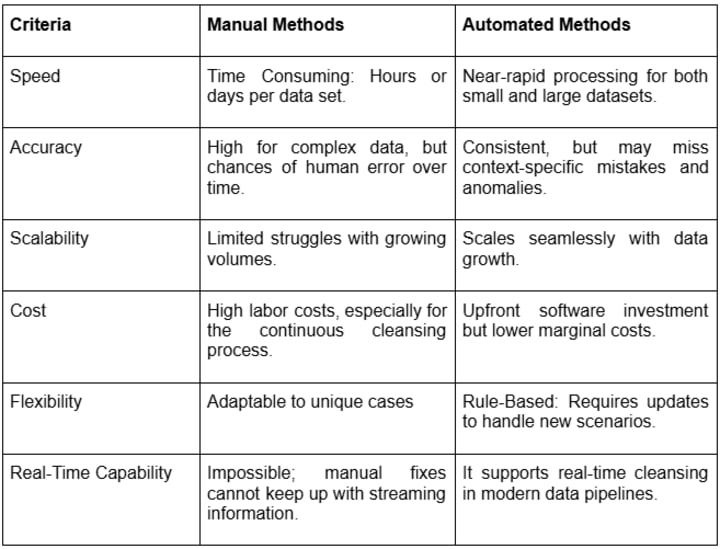
Essential Considerations When Selecting a Data Cleansing Strategy
Several factors must be considered while choosing the appropriate approach for your business needs.
Volumes and Velocity Of Data
The manual method may be suitable for static or batch uploads of moderate size. However, if you take thousands of entries per hour or manage streaming sensitive sensor data in real-time, automated tools become necessary.
Nature Of Errors
Are you dealing with formatting inconsistencies, such as varying formats and dates? Or do you need to restore disparate naming conventions? The automated tools are advanced and well-suited for rules-based engines; but manual approach need human intervention.
The Overall Budget And Expertise
Small teams with limited budgets may choose manual processes or open-source scripts, while larger enterprises can invest in commercial platforms that offer comprehensive rule libraries, machine learning modules, and dedicated support.
Risk Tolerance
Mission-critical applications such as clinical trial data or regulatory reporting demand the highest standards. A hybrid workflow combining automated pre-cleansing with human audit can optimize speed and accuracy.
Long-Term Maintenance
The automation process reduces ongoing labor costs but introduces a need for technical maintenance: rule updates, model retraining, and integration conservation. In contrast, while labor-intensive, manual methods may have lower technical debt.
Get Accurate Data For Making Informed Decisions With Manual vs Automated Data Cleansing Services
In the debate between manual and automated data cleansing, no single solution perfectly suits all business needs. The manual approach produces the desired results when complex data requires a complete contextual understanding and flexibility. In contrast, automated tools offer unparalleled speed and consistency for large datasets and continuous data flows.
You can develop a robust strategy that suits your basic data needs by detecting your firm's data characteristics, and resource limitations.
Whether you take an automated, manual, or hybrid cleansing approach, this process ensures that your accurate data initiatives deliver maximum value.
For many firms and enterprises, data cleansing outsourcing provides a strategic advantage, offering specialized expertise and cost efficiency, particularly when internal resources are limited.
Investing in data cleaning practices is an investment in your data insights, the efficiency of your robust operations, and the trust your stakeholders place in your data management capabilities.
About the Creator
Keep reading
More stories from abacusdatasystems and writers in Journal and other communities.
How To Recognize and Avoid Fraudulent Data Entry Companies
The increased adoption of digital tools enables businesses to generate large amounts of data, providing valuable insights and facilitating smooth business operations. For instance, data entry companies play a crucial role in helping businesses efficiently process, manage, and organize large volumes of information.
By abacusdatasystems9 months ago in Journal
How to Grow a Psychology Business After Purchase
Introduction Purchasing a psychology business is only the first step toward long-term success. Sustainable growth requires strategic planning, operational refinement, and thoughtful leadership. New owners must balance continuity with improvement, ensuring that quality of care remains high while expanding services and revenue. A structured growth strategy helps stabilize the practice post-acquisition and creates a foundation for scalability, profitability, and clinical excellence.
By Abdul Mueed4 days ago in Journal
Miss Persephone's Manual to a Seemingly Ordinary Life
Miss Persephone was found at the dining table, her blue eyes swollen, her tears arriving and retreating like the tides of the ocean. Earlier that day, her family had visited her in the retirement home where she had lived for eight years. It was her eightieth birthday.
By Imola Tóth3 days ago in Fiction




Comments
There are no comments for this story
Be the first to respond and start the conversation.