
Autologous Stem Cell Therapies: Pioneering Personalized Regenerative Medicine
A New Era of Healing: The Rise of Autologous Stem Cell Therapies”
Introduction
The field of regenerative medicine is undergoing a paradigm shift, with autologous stem cell therapies emerging as one of the most promising frontiers in modern healthcare. Unlike traditional treatments that focus on managing symptoms, these therapies harness the patient’s own biological material to repair, regenerate, and rejuvenate damaged tissues — offering hope for chronic, degenerative, and otherwise untreatable conditions.
What Are Autologous Stem Cell Therapies?
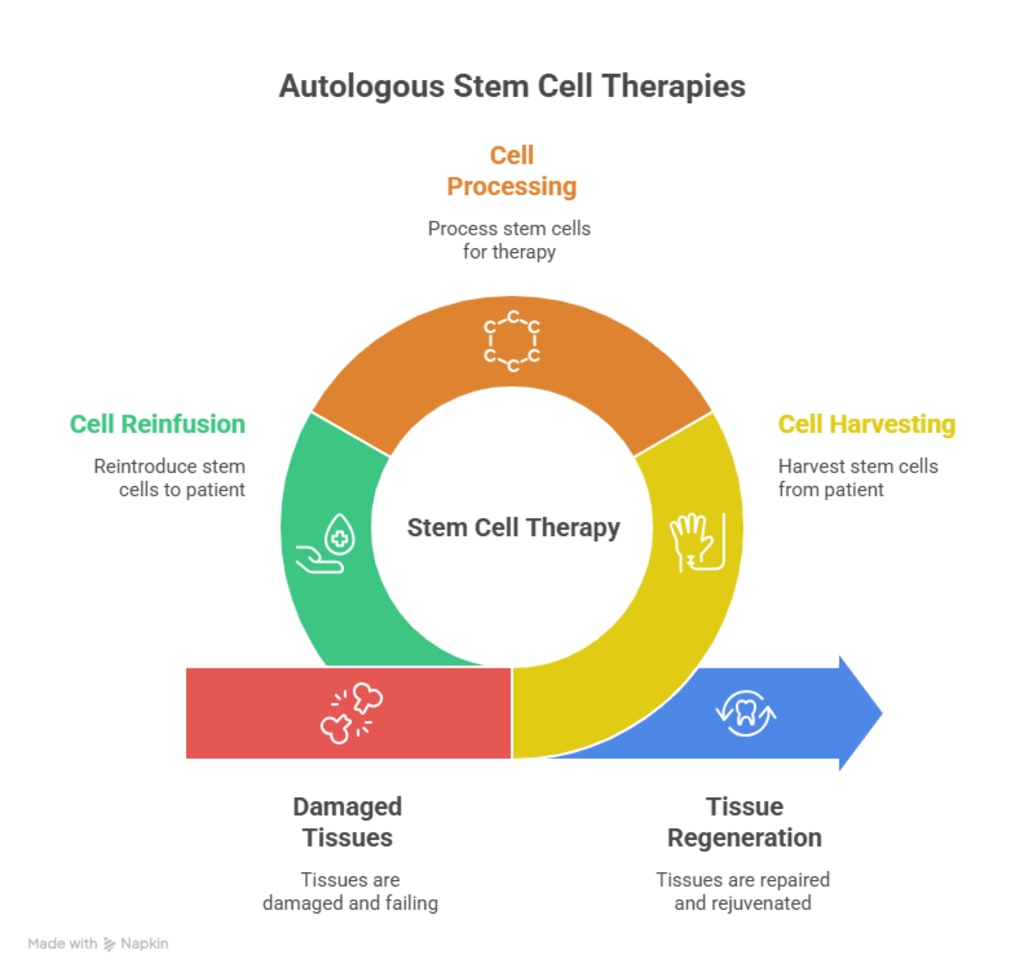
Autologous stem cell therapy involves harvesting stem cells from a patient’s own body — typically from bone marrow, adipose (fat) tissue, or peripheral blood — and reintroducing them after processing to promote healing or regeneration.
Because the cells come from the same individual, the risk of immune rejection, graft-versus-host disease (GVHD), or ethical complications is minimized.
Key types of autologous stem cells include:
• Hematopoietic stem cells (HSCs): Used primarily in blood and immune system disorders.
• Mesenchymal stem cells (MSCs): Known for their ability to regenerate bone, cartilage, muscle, and connective tissues.
Clinical Applications
Autologous stem cell therapies have demonstrated significant promise across several therapeutic areas:
🧠 Neurology:
Used in clinical trials for conditions such as multiple sclerosis, Parkinson’s disease, and spinal cord injuries.
❤️ Cardiology:
Stem cells can help repair damaged cardiac tissue after myocardial infarction, improving heart function.
🦵 Orthopedics:
Applications include the treatment of osteoarthritis, tendon injuries, and non-healing fractures.
🩸 Hematology and Oncology:
Autologous stem cell transplants are already a standard of care in treating certain cancers like lymphoma and multiple myeloma.
Market Outlook
According to industry analysis, the global autologous stem cell therapy market is experiencing rapid expansion, driven by:
• Rising prevalence of chronic and degenerative diseases
• Growing investment in cell-based research
• Increasing patient demand for personalized and minimally invasive treatments
📈 The market is projected to grow at a CAGR of over 10% from 2023 to 2030, reaching several billion dollars in valuation by the end of the decade.
Leading players in the space include:
• Vericel Corporation (US)
• BrainStorm Cell Therapeutics (US)
• CO.DON AG (Germany)
• Holostem Terapie Avanzate S.r.l. (Italy)
• Anterogen Co., Ltd. (South Korea)
Advantages of Autologous Therapies
✅ Reduced Risk of Rejection: No immune mismatch as cells originate from the same patient.
✅ Ethically Acceptable: Avoids the controversies linked to embryonic stem cells.
✅ Personalized Medicine: Tailored to the individual’s biology, ensuring a better safety profile.
✅ Faster Recovery: Accelerates tissue healing and reduces inflammation.
Challenges and Limitations
Despite their promise, several challenges remain:
• High cost of cell isolation, processing, and reinfusion.
• Limited scalability due to patient-specific nature.
• Regulatory complexities across regions (FDA, EMA, etc.).
• Variability in outcomes, depending on age, health, and cell source.
Ongoing advances in automation, cryopreservation, and cell expansion technologies aim to make these therapies more cost-effective and widely accessible.
The Future of Autologous Stem Cell Therapy
The integration of AI-driven cell analytics, 3D bioprinting, and gene editing (CRISPR) is expected to accelerate progress in this domain. Future autologous therapies may not only restore function but also prevent disease progression — marking a shift toward truly regenerative healthcare.
Conclusion
Autologous stem cell therapies represent the next evolution in personalized medicine, merging biology, technology, and innovation to redefine healing. As research matures and regulatory pathways streamline, these treatments are poised to become a mainstay in clinical practice, offering new hope to millions worldwide.
About the Creator
Keep reading
More stories from Rachel Paul and writers in Journal and other communities.
United States Medical Humidifier Market Witnesses Significant Growth Driven by Increasing Adoption of Respiratory Care Devices and Home Healthcare Solutions
The United States Medical Humidifier Market is experiencing notable expansion, primarily fueled by the rising prevalence of chronic respiratory diseases, the increasing use of mechanical ventilation and continuous positive airway pressure (CPAP) devices, and growing awareness of the benefits of humidified air in patient care. Medical humidifiers—devices designed to add moisture to inhaled gases—play an essential role in ensuring patient comfort, preventing airway damage, and improving the efficacy of respiratory therapies.
By Rachel Paul3 months ago in Journal
The world order likes to introduce itself as a set of principles.
From 2010 to 2025, that tension between military dominance and national interest did not fade. It became the soundtrack. Every headline felt like a reminder that power still matters, but power now travels in new forms: data, supply chains, energy routes, sanctions, alliances, debt, and the quiet leverage of who controls the platforms where money and information move.
By Sayed Zewayedabout 2 hours ago in Journal
The CEO of Everything
They say "jack of all trades, master of none," but they forgot to mention the part where the jack of all trades is also the camera woman, the makeup artist, and the person currently yelling at a tangled Wii microphone cable in a her own bathroom while recording herself singing and trying to make it look realistic and professional. (As professional as you can make it with nothing but a cell phone camera and a mic that doesn't work)
By Sara Wilson7 days ago in Humans




Comments
There are no comments for this story
Be the first to respond and start the conversation.