
Australia Waste to Energy Market to Surge to USD 2,152.6 Million by 2033
With 9.80% CAGR Growth, Landfill Crisis, Kwinana Facility Launch, and National Circular Economy Push Transform Australia's Renewable Energy and Waste Management Landscape

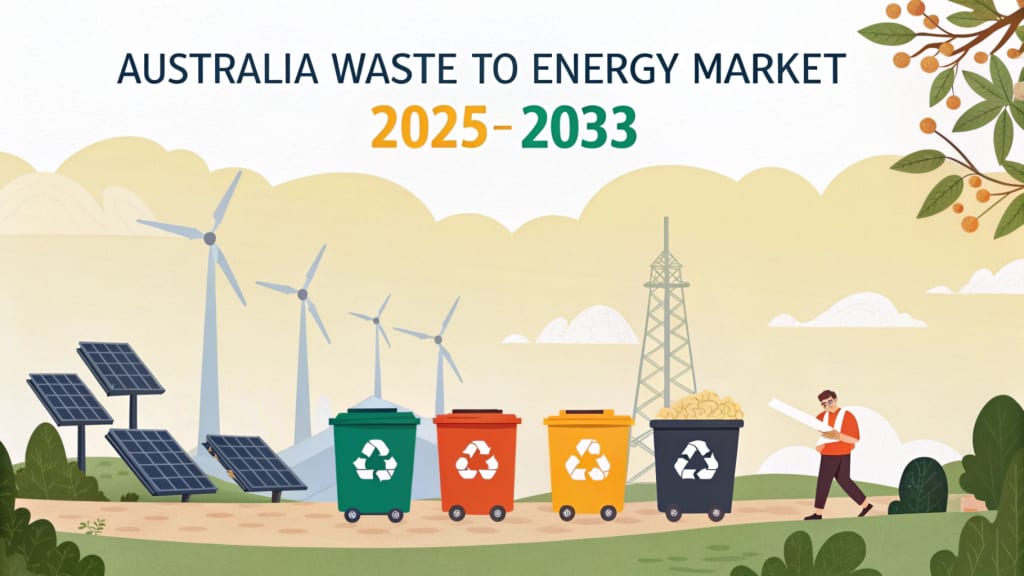
Australia Waste to Energy Market Overview
Market Size in 2024: USD 928.0 Million
Market Size in 2033: USD 2,152.6 Million
Market Growth Rate 2025-2033: 9.80%
According to IMARC Group's latest research publication, "Australia Waste to Energy Market Size, Share, Trends and Forecast by Technology, Waste Type, and Region, 2025-2033", The Australia waste to energy market size was valued at USD 928.0 Million in 2024. Looking forward, IMARC Group estimates the market to reach USD 2,152.6 Million by 2033, exhibiting a CAGR of 9.80% during 2025-2033.
How AI is Reshaping the Future of Australia Waste to Energy Market
• Optimizing Combustion Efficiency: AI-powered process control systems monitor real-time combustion parameters in thermal facilities like the Kwinana Energy Recovery plant, adjusting fuel feed rates, air intake, and temperature profiles to maximize energy output while minimizing emissions and maintaining compliance with stringent EPA standards.
• Predicting Waste Composition: Machine learning algorithms analyze municipal solid waste streams—from Australia's 75.8 million tons of annual waste generation—to forecast waste composition, heating values, and seasonal variations, enabling operators to optimize processing schedules and energy recovery rates across diverse waste types.
• Enhancing Emissions Monitoring: Artificial intelligence processes continuous emissions monitoring system (CEMS) data to detect anomalies, predict maintenance needs for acid gas scrubbers and electrostatic precipitators, and ensure facilities achieve up to 99% fine particle capture efficiency required by environmental protection licenses.
• Streamlining Energy Grid Integration: AI-driven demand forecasting optimizes baseload power delivery from WtE plants to electricity grids, balancing output with renewable energy variability from wind and solar installations while supporting Australia's decarbonization goals and providing reliable power to metropolitan populations.
• Accelerating Project Planning: Machine learning models evaluate site suitability, community impact assessments, and regulatory compliance requirements for proposed facilities like the AUD 1.5 billion Parkes Energy Recovery project, reducing development timelines and improving stakeholder engagement through data-driven decision-making and risk assessment.
Grab a sample PDF of this report: https://www.imarcgroup.com/australia-waste-to-energy-market/requestsample
Australia Waste to Energy Market Trends & Drivers:
Australia's waste to energy market is experiencing explosive growth driven by critical landfill capacity constraints and escalating environmental pressures confronting major metropolitan areas. The nation generates approximately 75.8 million tons of waste annually—averaging 2.95 tons per capita—with this figure increasing year-over-year as population growth and urbanization accelerate. Major cities including Sydney and Melbourne are rapidly approaching landfill capacity limits, forcing state governments to implement aggressive landfill diversion requirements and substantially increase landfill levies, particularly in Victoria and New South Wales where regulatory pressures make traditional waste disposal increasingly uneconomical. Environmental hazards associated with landfilling—including methane emissions contributing to climate change, groundwater contamination threatening water supplies, and biodiversity loss from land degradation—are prompting environmental authorities to mandate alternatives prioritizing resource recovery over burial. The 2024 National Waste Policy Action Plan, developed in accordance with the 2018 National Waste Policy framework, explicitly positions waste-to-energy technology as a critical component of Australia's transition toward a circular economy where resources are continually cycled rather than discarded. This policy alignment, combined with finite landfill space and mounting disposal costs, creates powerful economic and regulatory incentives driving investment in WtE infrastructure capable of diverting waste while generating valuable energy outputs.
Comprehensive government policy support and substantial infrastructure funding represent the second major growth catalyst transforming Australia's waste-to-energy landscape. State and federal governments are implementing coordinated frameworks favoring advanced thermal treatment technologies through financial incentives, streamlined permitting procedures, and integration with renewable energy targets aligned with national decarbonization commitments. The Recycling Modernisation Fund and Clean Energy Finance Corporation (CEFC) provide crucial capital access for WtE developers, offsetting high upfront costs and making innovative conversion technologies—including gasification, pyrolysis, and anaerobic digestion—financially viable for both public and private sector investors. Grant programs tie funding to measurable environmental and operational goals, ensuring supported projects deliver genuine sustainability outcomes while meeting strict regulatory standards. Growing public-private partnerships (PPPs) combine government backing with private sector expertise and capital, sharing financial risk and accelerating project delivery timelines for large-scale facilities requiring significant long-term operational commitments. Victoria's 2025 consultation on increasing the waste-to-energy processing cap from current limits to 2.5 million tons annually exemplifies regulatory evolution supporting sector expansion. These coordinated efforts reduce financial barriers, foster investor confidence, and create predictable regulatory environments essential for deploying capital-intensive WtE infrastructure across Australia's diverse geographic regions.
Rising electricity demand amid Australia's coal phase-out and renewable energy transition positions waste-to-energy as an increasingly vital baseload power solution addressing grid stability challenges. As coal-fired power plants retire and variable renewable sources like wind and solar create intermittency concerns, WtE facilities offer consistent, dispatchable energy generation complementing Australia's clean energy mix. The Kwinana Energy Recovery facility in Western Australia—which received its first waste delivery in July 2024 and processes 460,000 tons annually—exemplifies WtE's dual value proposition: diverting waste from landfills while generating reliable electricity for local communities and industrial operations. The proposed AUD 1.5 billion Parkes Energy Recovery project in New South Wales would become Australia's largest, processing 600,000 tons of waste yearly to generate 60 megawatts of electricity sufficient for 80,000 homes. Additional facilities under construction at East Rockingham (Western Australia) and Maryvale (Victoria) demonstrate accelerating deployment across multiple states. Municipalities and energy utilities increasingly partner on projects converting municipal solid waste, agricultural residues, and industrial refuse into electricity or heat, supporting grid stability while advancing national environmental objectives. In regional areas with less robust grid infrastructure, localized WtE plants provide reliable energy while simultaneously managing local waste, creating community-level resilience and economic benefits that strengthen political and social support for continued sector expansion through 2033.
Australia Waste to Energy Industry Segmentation:
The report has segmented the market into the following categories:
Technology Insights:
• Thermal
o Incineration
o Pyrolysis
o Gasification
• Biochemical
• Others
Waste Type Insights:
• Municipal Waste
• Process Waste
• Agriculture Waste
• Medical Waste
• Others
Breakup by Region:
• Australian Capital Territory & New South Wales
• Victoria & Tasmania
• Queensland
• Northern Territory & Southern Australia
• Western Australia
Recent News and Developments in Australia Waste to Energy Market
• May 2025: The AUD 1.5 billion Parkes Energy Recovery project in New South Wales announced plans to process 600,000 tons of waste annually, generating 60 megawatts of electricity for 80,000 homes, though community consultation addresses health and environmental concerns through stringent EPA standards.
• March 2025: Victoria's government initiated consultation on increasing the waste-to-energy processing cap to 2.5 million tons per annum, signaling regulatory support for sector expansion as Australia's resource recovery rate reaches 66% with 26 million tons still requiring alternative disposal solutions.
• July 2024: The Kwinana Energy Recovery facility in Western Australia received its first waste delivery, marking a milestone for Australia's first large-scale WtE plant capable of processing 460,000 tons annually and generating baseload renewable power for metropolitan Perth and industrial operations.
Competitive Landscape:
The competitive landscape of the industry has also been examined along with the profiles of the key players.
Note: If you require specific details, data, or insights that are not currently included in the scope of this report, we are happy to accommodate your request. As part of our customization service, we will gather and provide the additional information you need, tailored to your specific requirements. Please let us know your exact needs, and we will ensure the report is updated accordingly to meet your expectations.
About Us:
IMARC Group is a global management consulting firm that helps the world's most ambitious changemakers to create a lasting impact. The company provide a comprehensive suite of market entry and expansion services. IMARC offerings include thorough market assessment, feasibility studies, company incorporation assistance, factory setup support, regulatory approvals and licensing navigation, branding, marketing and sales strategies, competitive landscape and benchmarking analyses, pricing and cost research, and procurement research.
Contact Us:
IMARC Group
134 N 4th St. Brooklyn, NY 11249, USA
Email: [email protected]
Tel No:(D) +91 120 433 0800
United States: +1 201-971-6302
About the Creator
Amyra Singh
Market research analyst who loves spotting patterns, digging into data, and turning insights into strategies that help brands grow and stay ahead of the curve.
Keep reading
More stories from Amyra Singh and writers in Journal and other communities.
DIY Cowboy Hat Business: Costs and Supply Chain
Last week, a U.S. client reached out to us, looking for help sourcing pure wool felt cowboy hats and all kinds of hat accessories. At first, it didn’t seem unusual, but as we talked more, we realized her main business is actually running a few bars. And she plans to sell these hats in the bars. Surprisingly, this has now turned into a fast-growing, high-ticket, social DIY experience that’s really blowing up in her country.
By Jingsourcing.com 6 days ago in Journal


Comments
There are no comments for this story
Be the first to respond and start the conversation.