
Australia Solar Power Market: Growth, Trends & Local Manufacturing Revival
With the solar power market expected to grow from USD 8.3 billion in 2024 to USD 12.9 billion by 2033, Australia is building momentum via rooftop rollouts, storage integration, and policy reforms to accelerate its clean energy transition.

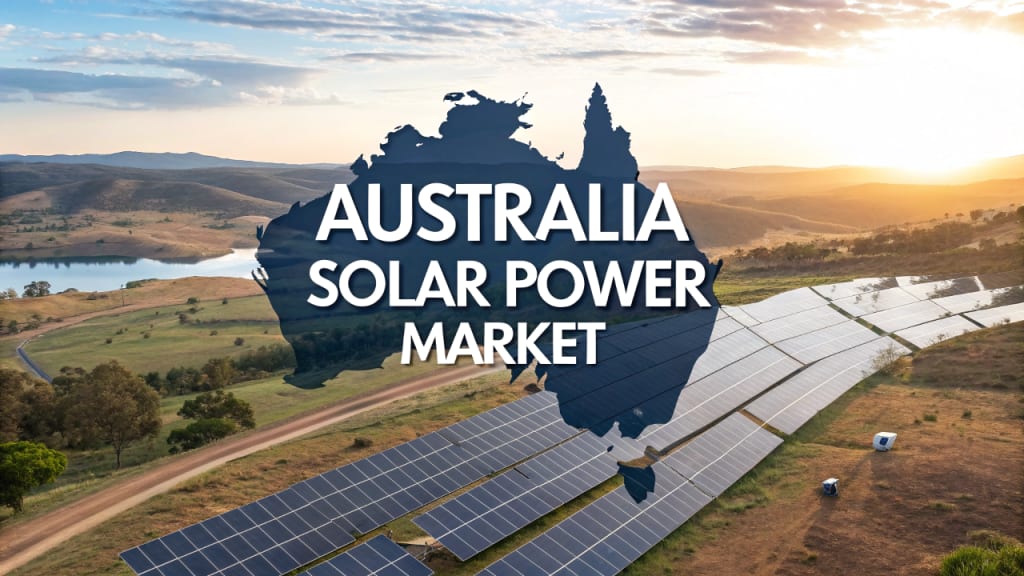
Market Overview
- The Australia solar power market was valued at USD 8.3 billion in 2024. From 2025 to 2033, it is forecast to grow at a CAGR of ~15.87% to reach about USD 12.9 billion.
- Key segments include deployment by type (Solar Photovoltaic (PV) vs Concentrated Solar Power (CSP)), by utility vs non-utility (residential, commercial, industrial), and by region.
- The equipment market alone (solar modules, inverters, and associated components) is sizeable—rising demand driven by rising electricity costs and policy incentives.
Key Trends & Market Drivers
1. Rooftop Solar Installations Surge
Demand for rooftop solar in homes and businesses is rising sharply. Falling costs of solar panels + government rebates, incentives, and feed-in tariffs make adopting solar more affordable. Rooftop solar isn’t just a niche—it’s increasingly seen as mainstream energy infrastructure.
2. Energy Storage Integration
Solar alone has intermittency. To capture more value and stabilize energy supply (especially during evening demand or low-sunlight periods), battery storage (behind-the-meter or utility scale) is being paired with PV systems. Storage helps smooth output, provide backup, and reduce grid strain.
3. Declining Technology & Equipment Costs
Solar panels, inverters, and balance-of-system components are getting more efficient and less expensive. Innovations (e.g. high-efficiency PV modules) and local manufacturing promises are helping reduce dependencies on imports and logistics costs.
4. Policy & Incentive Support
Federal and state programs (rebates, feed-in tariffs, underwriting schemes, investment grants) are pushing solar and renewables forward. The government’s clean energy targets, renewable underwriting capacity schemes, and expanded funding are central to enabling large projects and speed of deployment.
5. Domestic Manufacturing & Local Supply Chain Reboot
Projects for local manufacturing of key solar components (panels, ingots, wafers) are gaining traction. Australia aims to reduce reliance on imported modules, improve job creation, and strengthen resilience in supply chains.
6. Rooftop Solar Output & Household Penetration
Output from rooftop solar has seen significant growth. One recent statistic: rooftop solar output jumped ~20% from one summer to the next (Dec-Feb periods), with states like NSW, Victoria, SA leading the rise. Household adoption is now such that many households are generating their own electricity.
Get a PDF Request for a Free Sample Report: https://www.imarcgroup.com/australia-solar-power-market/requestsample
Opportunities in the Australian Solar Power Market
Scaling Utility-Scale & Large Solar Farms
Large solar farms remain critical to hitting national renewable generation targets. Investment in land, grid interconnection, and multi-GW scale projects offers strong opportunities, especially under supportive policy and offtake agreements.
Local Manufacturing Plants
The planned Stellar PV Project in Townsville (2 GW worth of ingot & wafer manufacturing) is an example of what local manufacturing can deliver—in output, jobs, and supply resilience. Encouraging similar projects could yield major industrial hubs.
Enhanced Grid & Storage Infrastructure
With more solar feeding into the grid, storage and grid flexibility (demand response, smart inverters, distributed energy resource management) will be essential to handling supply fluctuations and maintaining reliability.
Rooftop Solar in Apartments & Multi-Tenant Buildings
Shared rooftop or communal solar systems in apartment complexes are under-served. Policy programs that subsidize or encourage such systems could unlock large capacity in more densely populated areas.
Solar Panel Recycling & Circular Economy
As installations age (many rooftop PV systems have 20-25 year life spans), recycling becomes important. Recovering glass, silicon, metals and enforcing responsible end-of-life management will become more expensive and also more regulated. Opportunity arises for businesses specializing in solar panel recycling. (IMARC expects growth in panel recycling segment)
Innovative Solar-Plus Technologies
Floating solar installations, agrivoltaics (dual land use with farming), solar-powered hydrogen production, or integration with electric vehicle charging can deliver higher utilization and novel revenue streams.
Business Models & Financing Structures
Power Purchase Agreements (PPAs), solar leasing, third-party ownership, or community solar are pathways to reduce upfront costs for end users. Also financing or incentives that reduce payback periods help widen adoption.
Recent News & Developments in the Australia Solar Power Market
Renewables Underwriting Scheme Expansion (July 2025)
To accelerate clean energy deployment and hit the target of 82% renewable electricity by 2030, Australia expanded its Capacity Investment Scheme by 25%. This extension underwrites solar, wind, and storage projects—helping boost investor confidence in large-scale solar projects.
Rooftop Solar Output Surges
In summer 2024-25, rooftop solar generation jumped ~20% compared to previous summer period. States across the board (NSW, Victoria, SA) saw strong growth. The total number of solar panels installed is now in millions, with large increases in households installing solar across Queensland, NSW & Victoria.
Stellar PV Project in Townsville
A planned 2 GW solar ingot and wafer manufacturing facility is underway near Townsville, in partnership with ARENA under the Solar SunShot program. If approved and built, this will strengthen Australia’s solar supply chain and reduce dependency on imports.
Cost-of-Living Squeeze Impacts Residential Uptake
Despite panel price declines, economic pressures (household bills, upfront costs) are affecting some residential solar system adoption. Some months have seen a drop in installations as households defer non-essential spending.
Government Targets & Clean Energy Policy Intensified
The push for 82% renewable electricity by 2030 is driving policy changes, subsidy programs, tenders, and regulatory support. More grid capacity, interconnection, and permitting reforms are being discussed to reduce bottlenecks.
Browse Full Report with TOC & List of Figures: https://www.imarcgroup.com/australia-solar-power-market
For Homeowners and Businesses: Adopting solar plus storage is becoming a way to reduce electricity costs, gain energy independence, and hedge against rising energy prices. Even with economic pressures, the lifetime savings and environmental benefits are becoming hard to ignore.
For Investors and Developers: Utility-scale solar farms, community scale projects, and manufacturing plants (eg for modules, wafers) offer strong returns—especially under supportive policy or underwriting schemes. Risk is lower as solar technology matures and costs decline.
For Policymakers: Meeting Australia’s renewable energy targets depends not only on favorable funding and subsidies but on ensuring grid infrastructure, permitting, and regulation keep up. Local manufacturing and recycling policies will boost resilience.
For the Environment & Grid Security: Solar penetration helps reduce reliance on fossil fuels, lowers emissions, aids in decarbonization efforts. But high solar without storage or grid flexibility can lead to instability—so energy storage, smart grid, demand response become central.
For Communities & Jobs: Local solar manufacturing and large-scale installs spur job growth in manufacturing, construction, installation, maintenance. There’s opportunity in regional areas where sunlight and land are abundant but industrial infrastructure might lag.
About the Creator
Kevin Cooper
Hi, I'm Kavin Cooper — a tech enthusiast who loves exploring the latest innovations, gadgets, and trends. Passionate about technology and always curious to learn and share insights with the world!
Keep reading
More stories from Kevin Cooper and writers in Journal and other communities.
Australia MedTech Market: Innovation, Regulation & Digital Care Transforming Healthcare
Market Overview In 2024, Australia’s MedTech market was valued at approximately USD 8.48 billion. It is forecast to reach USD 13.90 billion by 2033, growing at a compound annual growth rate (CAGR) of 5.10% between 2025 and 2033.
By Kevin Cooper3 months ago in Journal
A Dart at Dusk
Seconds ago, the sullen sun set on the two of us… my exuberant furry companion and me. A fresh breeze embraces us, delivering welcome relief from the day’s oppressive heat. His typical stumbling and staggering along — apace with a sloth — has turned into trip-trapping, high-stepping, almost skipping along.
By Angie the Archivist 📚🪶5 days ago in Petlife




Comments
There are no comments for this story
Be the first to respond and start the conversation.