
Australia Rooftop Solar Market: Growth, Trends, Demand & Drivers
From USD 1,436.36 million in 2024 to a forecast USD 2,508.25 million by 2033 (CAGR ~6.39%), rooftop solar is no longer fringe—it’s central to Australia’s energy transition, backyard by backyard.

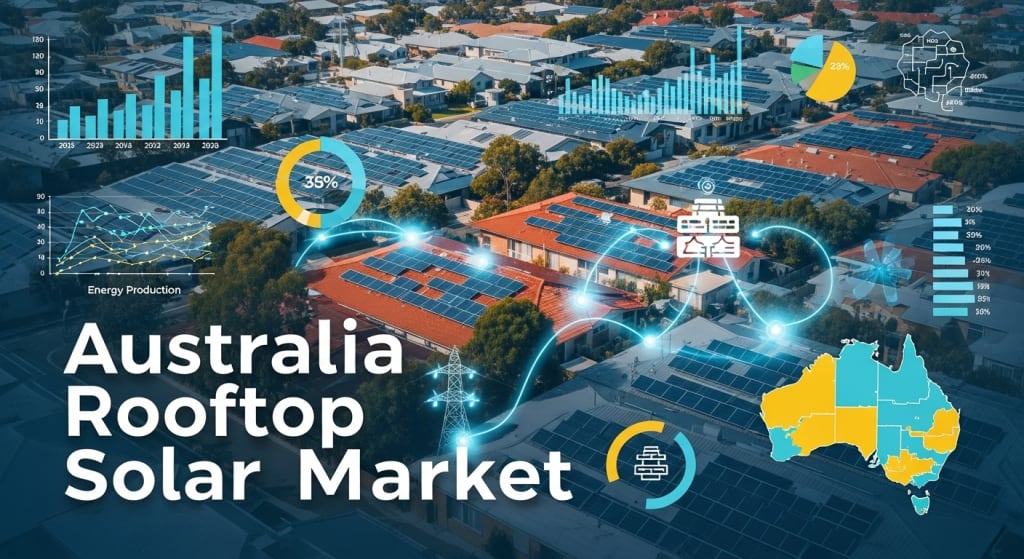
Market Overview
- The Australian rooftop solar market was valued at USD 1,436.36 million in 2024. It is expected to grow to USD 2,508.25 million by 2033, growing at a CAGR of about 6.39% for the period 2025-2033.
- Drivers include strong government incentives (rebates, subsidies, certificate schemes), rising electricity costs, growing concern over grid reliability, especially in remote areas, and increasing interest in energy independence.
- The market spans residential households, small business rooftops, shared systems (e.g. apartments), and is influenced by regional differences in solar irradiance, policy, electricity price differentials, and grid constraints.
Key Trends & Market Drivers
1. Explosive Growth & Progress Toward Targets
By mid-2025, around 4.2 million Australian homes and small businesses had installed around 26.8 GW of solar across the country. This figure is 75 percent of the Australian Energy Market Operator (AEMO)'s 36 GW 2030 rooftop solar target in its latest Integrated System Plan..
2. Policy & Incentive Support
The Australian Government provides these subsidies upfront. They do so under the Small-scale Renewable Energy Scheme (SRES) and the Small-scale Technology Certificates (STCs). Another program, Cheaper Home Batteries Program, in place from 1 July 2025, provided further subsidy for solar + storage systems.
3. Battery Uptake Rising Sharply
In addition to rooftop solar installations, home batteries are being adopted at a rapid rate. Year-on-year growth in the first half of 2025 was helped by rebates and programs such as the Cheaper Home Batteries program. The purpose is to smooth intermittent generation, enable self-consumption, reduce peak-grid demand, and to stabilize the grid against instability.
4. Volatility & Monthly Install Fluctuations
However, short-term variation exists. As an example, only about 225 MW of rooftop solar got installed in April 2025. This was down from previous months because of factors such as public holidays, election periods, and wait times for subsidy programs. Nonetheless, the long-term trend continues to strongly adopt. Also, in August 2025, installations dropped down to ~206 MW, continuing a year-on-year soft patch in some areas.
5. Grid Constraints & Decentralised Energy Needs
As more PV is added, some grid issues can arise (local network voltage, dispatch or export limits, line losses, etc.). Rooftop solar can also reduce the need for transmission capacity, which is meaningful in many places.
Get a PDF, Request for a Free Sample Report: https://www.imarcgroup.com/australia-rooftop-solar-market/requestsample
Opportunities in the Australia Rooftop Solar Market
Solar + Storage Combinations
With battery costs coming down and government subsidies supporting combined systems, households can capture more value, reduce grid reliance, and limit bill shocks. Programs that bundle solar and storage are likely to get more uptake.
Apartment & Multi-Unit dwellings Shared Solar
Already, governments are supporting initiatives (e.g. a “Solar for Apartment Residents” program in NSW covering up to 50% of installation costs) to enable shared rooftop installations for residents who can’t install panels individually.
Technological Innovation & Panel Efficiency
New high-efficiency panels (for example, n-type all-back-contact cell technologies) are entering the market, improving power output, durability, and performance under non-ideal conditions. The Aiko Neostar 2P panels (480 W) launched in early 2025 are an example.
Regulation & Grid Integration
Better regulations for distributed energy resources (DERs), feed-in tariffs, export regimes, and inverter standards will be increasingly important. Improvements in grid management tools (DER management systems, virtual power plants) offer opportunities for smoother integration.
Cost Savings & Energy Security for Households
With rising electricity prices, many households see rooftop solar (with batteries) as a hedge. The fiscal benefits (lower bills, sometimes dividends via feed-in tariffs) are becoming more clear. Programs that reduce upfront cost or soften financing will continue to drive adoption.
Recent News & Developments (2024-2025)
Record Installations & Capacity Milestones
Australia installed ~3.2 GW of new rooftop solar capacity in 2024, a record, with 2025 tracking closely.
Rooftop Solar Generating >12% of National Electricity
In the first half of 2025, rooftop solar contributed around 12.8% of Australia’s electricity generation—up from ~11.5% a year earlier.
Cheaper Home Batteries Program Launch
As of 1 July 2025, a new government program provides a ~30% discount for battery installations in homes in conjunction with rooftop solar, via expansions to the SRES. This is accelerating battery uptake strongly.
Government Loan to Commercial Solar + Storage
The government loaned AUD $100 million via the Clean Energy Finance Corporation (CEFC) to places like Bunnings and Officeworks for installing solar panels, storage, and EV chargers in their stores. This helps commercial rooftop uptake in sectors slower to adopt solar.
Browse Full Report with TOC & List of Figures: https://www.imarcgroup.com/australia-rooftop-solar-market
For Homeowners & Small Businesses: Rooftop solar (particularly with battery storage) now saves energy costs the best, reduces dependence on centralized grids through hedges against inflation. Growth slowed in months. The greatly longer term trend reveals real savings and value during that time.
For Installers, Panels & Storage Providers: A growing market but also a growing set of expectations regarding efficiency, longevity, storage integration, good after-sales, and compliance with global, national or local targets.
For Policymakers & Regulators: Adequate stable incentives and transparent tariff/export regime policies, appropriate grid integration (voltage, export limits, inverter standards), and support for shared solar/apartment programs prevent grid stability issues or cost shifting that could drive consumers to resist further integration.
For the Environment & Energy Transition: Rooftop solar is energy generation at the edge of the distribution network, close to the consumer. It reduces losses associated with transmission, it reduces peak demand and it reduces greenhouse emissions. Rooftops will be among the most flexible, responsive tools we have as we move towards net-zero and higher renewables.
About the Creator
Kevin Cooper
Hi, I'm Kavin Cooper — a tech enthusiast who loves exploring the latest innovations, gadgets, and trends. Passionate about technology and always curious to learn and share insights with the world!
Keep reading
More stories from Kevin Cooper and writers in Journal and other communities.
Australia Real Estate Market: Growth, Trends & Investment Opportunity
Market Overview Size & Forecast: In 2024, the Australia real estate market was valued at USD 206.8 billion. It’s projected to reach USD 305.8 billion by 2033, growing at about 3.99% annually during 2025-2033. Segments & Channels: The IMARC report covers multiple property types (residential, commercial, industrial, land); business mode (sales vs rental); transaction channels (online vs offline); and region. Drivers include population growth, economic stability, favorable interest rates, infrastructure upgrades, and a rising preference for sustainable buildings. Residential vs Commercial: The residential real estate portion is notably large—with IMARC reporting in 2024 a residential market value of USD 6.2 trillion, expected to rise to USD 7.9 trillion by 2033 (CAGR ~2.59%). Housing supply is under strain, especially in high-demand metro areas. Meanwhile, commercial real estate is shifting in usage (retail, industrial, mixed-use, etc.), with green building and tenant preferences playing a growing role.
By Kevin Cooper3 months ago in Journal
The goals I did not achieve
Every writing goal I made for the year is a wash. It has been this way for a while, but I think it's important to be open about my failures and the reality of how life can get in the way. This is especially true considering the several times I have posted on Vocal about my writing goals, how I was changing my approach, and where I was hoping to be for the upcoming year. I will probably do that again in a couple months, but for now, it is time to acknowledge where I am today.
By Kay Husnick23 days ago in Journal
Why SEO Became the Quiet Salesperson Every Car Dealership Needs
I still remember the day our showroom was spotless, the cars were polished, and the sales team was ready—but hardly anyone walked in. It didn’t make sense at first. We had competitive pricing, trusted brands, and years of experience. Yet the phone barely rang. That moment forced me to confront a truth many car dealers avoid: buyers no longer start their journey on the lot. They start online.
By Anthony Rodgers3 days ago in Journal



Comments
There are no comments for this story
Be the first to respond and start the conversation.