
Australia Offshore Wind Power Market: Share, Growth, Trends & Renewable Energy
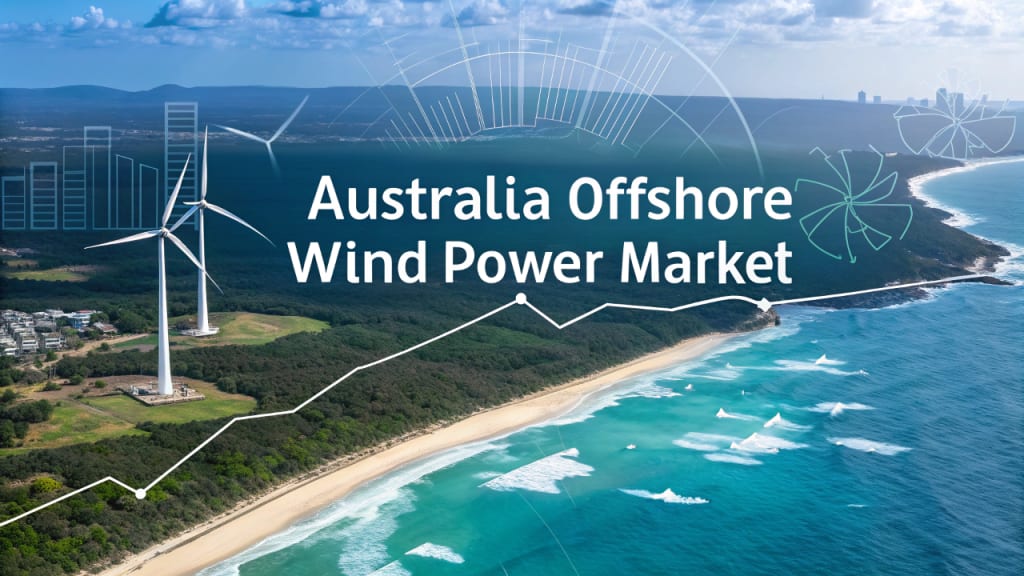
With the market set to grow from USD 950.88 million in 2024 to an expected USD 5.69 billion by 2033 (CAGR ~19.6%), offshore wind is becoming central to Australia’s renewable energy roadmap.

Market Overview
- In 2024, the Australia offshore wind power market was valued at USD 950.88 million.
- It is forecast to reach approximately USD 5,694.26 million by 2033, rising at a compound annual growth rate (CAGR) of ~19.60% over 2025-2033. IMARC Group
Important segments of the market are:
- Installation type: Fixed structures vs Floating structures.
- Water depth: Up to 30m vs Above 30m.
- Capacity classes: Up to 3MW, 3–5MW, Above 5MW.
- Regions: NSW & ACT, Victoria & Tasmania, Queensland, Northern Territory & South Australia, Western Australia.
- Key growth drivers include supportive government policies, technological advances (both fixed and floating wind), large coastline with strong wind resources, increasing demand for clean energy, and the potential for offshore wind to power green hydrogen and support export-oriented clean energy.
Key Trends & Market Drivers
1. Policy & Feasibility Licences Moving Forward
The federal government has begun issuing offshore wind feasibility licences: in early-2024, six projects off the Gippsland coast (Victoria) received licences, potentially totalling ~12 GW, with further stages expected.
2. Floating vs Fixed Foundation Debate
Much of Australia’s nearshore coast is shallow, enabling fixed-bottom turbines where feasible. But in deeper waters, floating structures become essential. Floating projects tend to be more costly and take longer to develop; still, technology progress is pushing interest.
3. Abundant Resources, Strategic Zones Declared
Regions such as Gippsland in Victoria are emerging as front-runners. They are the first declared offshore wind zones, benefiting from favourable bathymetry, wind conditions, and proximity to existing grid infrastructure.
4. Rising Investment, International Players Involved
Major international and domestic developers are participating: utilities, global wind companies, renewables financiers. Partnerships and feasibility work are attracting attention (and capital) but global cost pressures (materials, labour, interest rates) are also being felt.
5. Regulatory & Environmental Challenges
While licences and zones are opening, environmental approvals, community consultation (including First Nations involvement), marine ecology, seabed use, coastal impacts, and transmission infrastructure remain complex challenges. Also, costs of floating installations remain significantly higher.
Get a PDF, Request for a Free Sample Report: https://www.imarcgroup.com/australia-offshore-wind-power-market/requestsample
Opportunities in the Australian Offshore Wind Power Market
Large-scale Projects in Declared Zones
Projects with feasibility licensing in Gippsland and other zones offer strong potential. Early movers in zones with clearer regulatory environments stand to gain first-mover advantages.
Floating Offshore Wind
As fixed-bottom options reach their geographical limits (water depth, seabed conditions), floating offshore wind becomes crucial. Businesses that can reduce cost and enhance reliability in floating platforms will be well placed.
Green Hydrogen Integration
Co-locating offshore wind with hydrogen production (electrolysis) for domestic use or export is a major opportunity. High energy output offshore can provide power for energy-intensive electrolysers.
Local Supply Chain & Port Infrastructure Development
To lower cost, reduce time-to-market, and increase local economic benefits, Australia needs port upgrades, ship fabrication, turbine component manufacture, vessel availability, and skilled labour.
Regulatory Streamlining & Community Engagement
Projects that navigate environmental approvals, marine use, Indigenous consultation, and community acceptance will be more resilient. Clarity in leasing, permitting, and regulations will reduce risk for investors.
Risk Mitigation Against Rising Costs
Inflation, labour shortages, material cost, and interest rates are relevant globally. Mitigation strategies (bulk procurement, long-term contracts, local sourcing) and government incentive / financial support can help.
Recent News & Developments in the Australia Offshore Wind Power Market
Issuance of Gippsland Feasibility Licences (May 2024)
Six offshore wind feasibility licences were issued for projects off Gippsland, Victoria, potentially adding ~12GW of capacity. Additional capacity is expected in future rounds.
Industry Caution & Scaling Back by Some Developers (Mid-2025)
Companies like BlueFloat Energy and Equinor have scaled back or reconsidered investments in certain projects (e.g. Illawarra, Gippsland Dawn) amid rising global costs, funding pressures, and investment uncertainty.
Approval of Offshore Zones Such as Illawarra
The Illawarra coast zone (south of Sydney) has been formally approved as an offshore wind zone (approximately 1,022 sq km), though with reductions and constraints (distance from shore, environmental protections). It’s expected to deliver several gigawatts of capacity and power over a million homes.
Global Headwinds Impact Australia’s Offshore Wind Sector
Inflation, rising capital costs, supply chain disruptions, and rising interest rates are making project economics more challenging. Public and private investors are assessing these risks.
Infrastructure & Planning Advances
There is growing emphasis on transmission capacity, port readiness, and clarity in permitting/licensing. Regulatory frameworks are being refined, feasibility studies supported, and zones declared to reduce lead times.
Browse Full Report with TOC & List of Figures: https://www.imarcgroup.com/australia-offshore-wind-power-market
- For energy planners & policymakers, offshore wind represents one of the few scalable and steady renewable sources that can help meet Australia’s ambitious renewable targets and reduce reliance on fossil fuels. But success depends on policy clarity, environmental safeguards, and infrastructure readiness.
- For investors, the forecast ~19.6% CAGR and multi-billion dollar growth suggest offshore wind offers high upside—but also carries elevated early-stage risk. Projects with strong regulatory alignment, local value chains, and solid cost management are better positioned.
- For communities & environment, offshore wind means potential job creation (ports, construction, maintenance), regional economic benefits, and cleaner air—but also requires careful balance with marine ecosystems, first-nations interests, coastal landscapes, and biodiversity.
- For technology & manufacturing sectors, demand for floating platforms, deep water solutions, turbine innovation, installation vessels, subsea cabling, and supporting infrastructure will stimulate growth and opportunity.
- For Australia’s broader climate goals, offshore wind may be essential part of a diversified clean energy mix along with solar, onshore wind, storage, hydro, and hydrogen. Delays or setbacks could worsen energy price risks, emissions trajectories, and reliability challenges.
About the Creator
Kevin Cooper
Hi, I'm Kavin Cooper — a tech enthusiast who loves exploring the latest innovations, gadgets, and trends. Passionate about technology and always curious to learn and share insights with the world!
Keep reading
More stories from Kevin Cooper and writers in Journal and other communities.
Australia Meat Market: High Demand, Growth, Trends & Emerging Alternatives
Market Overview In 2024, the Australia meat market was valued at approximately USD 28.6 billion. It is projected to grow to USD 34.0 billion by 2033, with a CAGR of about 1.93% from 2025-2033. The Australia meat and poultry market (by tonnage) reached 3.35 million tons in 2024, and is expected to climb to 4.85 million tons by 2033, growing at ~3.80% annually. Key drivers include strong domestic protein demand, export growth (especially in red meats like beef, lamb, mutton), rising interest in premium and grassfed certifications, evolving consumer preferences around health, traceability, and ethics, and trade agreements that support exports.
By Kevin Cooper3 months ago in Journal
Why Aircraft Availability Is a Systems Problem, Not a Fleet Size Problem
Why Aircraft Availability Is a Systems Problem, Not a Fleet Size Problem In aviation, aircraft availability is often misinterpreted as a function of fleet size. Airlines report the number of aircraft owned, leased, or ordered, and this number is frequently used as a proxy for operational capacity. However, fleet size alone does not determine how many aircraft can be operated at any given moment. Availability is a systems outcome shaped by maintenance capacity such as: Cherry Aerospace, component supply, regulatory compliance, and operational decision-making.
By Beckett Dowhan3 days ago in Journal



Comments
There are no comments for this story
Be the first to respond and start the conversation.