
Australia Mobility as a Service Market to Reach USD 1.14 Billion by 2033
The Australia mobility as a service market size reached USD 144.00 Million in 2024. Looking forward, the market is projected to reach USD 1,144.44 Million by 2033, exhibiting a growth rate (CAGR) of 25.90% during 2025-2033.

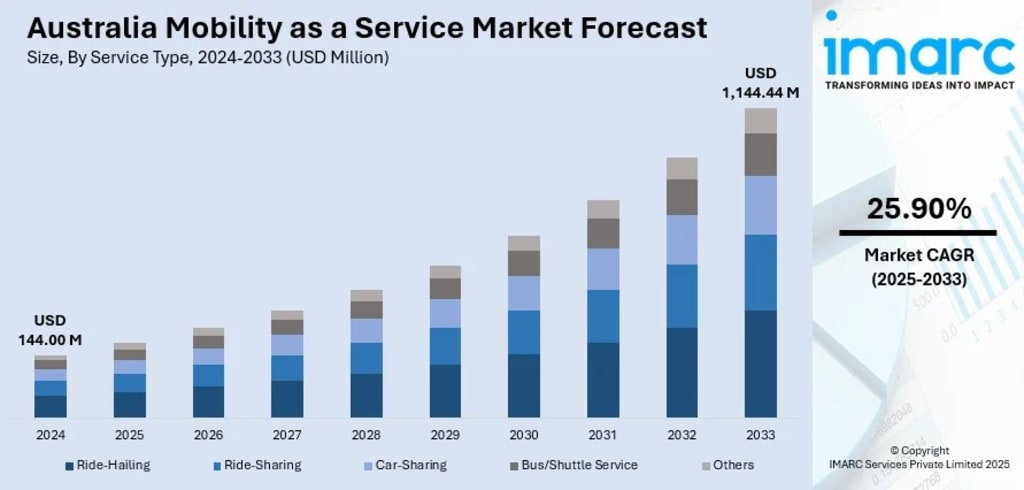
The latest report by IMARC Group, titled "Australia Mobility as a Service Market Report by Service Type (Ride-Hailing, Ride-Sharing, Car-Sharing, Bus/Shuttle Service, Others), Transportation Type (Private, Public), Application Platform (Android, iOS, Others), Propulsion Type (Electric Vehicle, Internal Combustion Engine, Others), and Region 2025-2033," offers a comprehensive analysis of the Australia mobility as a service market growth. The report includes competitor and regional analysis, along with a detailed breakdown of the market segmentation. The Australia mobility as a service market size reached USD 144.00 Million in 2024. Looking forward, IMARC Group expects the market to reach USD 1,144.44 Million by 2033, exhibiting a CAGR of 25.90% during 2025–2033.
Base Year: 2024
Forecast Years: 2025–2033
Historical Years: 2019–2024
Market Size in 2024: USD 144.00 Million
Market Forecast in 2033: USD 1,144.44 Million
Market Growth Rate (2025–2033): 25.90%
Australia Mobility as a Service Market Overview
The Australia mobility as a service market is experiencing exceptional growth driven by implementation of government initiatives promoting sustainable transport, growing demand for integrated mobility solutions, continual advancements in digital platforms, and shift toward subscription-based transport models addressing increasing urban mobility needs. The market expansion is supported by rapid urbanization creating demand for efficient transportation solutions, environmental sustainability focus aligning with national climate targets, and rising costs of vehicle ownership steering consumers toward flexible mobility alternatives. Enhanced multi-modal integration, government support for smart mobility initiatives, and corporate mobility solution demands are positioning Australia's MaaS market for transformative growth and widespread adoption.
Australia's mobility as a service foundation demonstrates robust urbanization fundamentals with urban population reaching 86.62% of total population in 2023, creating substantial pressure on existing transport infrastructure. The country maintains ambitious climate targets including 43% emission reduction from 2005 levels by 2030 and Net Zero by 2050, driving demand for sustainable transport solutions. The proliferation of electric vehicle adoption with 85,319 units sold by September 2024, digital platform advancement, and multi-modal transport integration is creating favorable market conditions, requiring substantial investments in smart mobility infrastructure and integrated transport systems. Australia's strategic focus on sustainable urban development, combined with government policy support and corporate ESG requirements, makes it an increasingly attractive market for innovative MaaS platform development and deployment.
Request For Sample Report:
https://www.imarcgroup.com/australia-mobility-as-a-service-market/requestsample
Australia Mobility as a Service Market Trends
• Urbanization impact acceleration: Rapid urban growth in major cities including Sydney, Melbourne, Brisbane, and Perth creating escalating demand for efficient, scalable transportation solutions alleviating congestion and enhancing mobility.
• Sustainable transport integration: Environmental sustainability emphasis integrating eco-friendly options including electric buses, e-bikes, and shared electric vehicles aligning with national climate targets and low-emission mobility goals.
• Multi-modal platform development: Seamless connections among different transport modes including public transport, ride-hailing, car-sharing, and micro-mobility solutions through unified digital platforms eliminating multiple app requirements.
• Government smart mobility support: Active policy development promoting sustainable transportation networks, digital infrastructure investment, and regulatory frameworks encouraging innovation while maintaining safety and accessibility standards.
• Subscription-based model adoption: Rising adoption of subscription-based travel packages providing cost-effective alternatives to private car ownership with pay-per-use flexibility and integrated expense management capabilities.
• AI-driven personalization expansion: Growing use of artificial intelligence for personalized route optimization, carbon footprint calculation, and user preference-based recommendations enhancing overall mobility experience and sustainability awareness.
Market Drivers
• Urban population growth: Australia's urban population reaching 86.62% creating immense pressure on existing transport infrastructure and prompting adoption of integrated MaaS platforms for effective urban transit management.
• Climate target compliance: National commitment to 43% emission reduction by 2030 and Net Zero by 2050 driving integration of low-emission transport options and sustainable mobility solutions supporting environmental goals.
• Vehicle ownership cost escalation: Rising expenses for fuel, insurance, parking, and maintenance making private vehicle ownership less financially viable, particularly in urban environments, favoring flexible MaaS alternatives.
• Electric vehicle adoption: Accelerating EV sales with 85,319 units sold by September 2024 supporting National Electric Vehicle Strategy and infrastructure development creating opportunities for electric mobility integration.
• Digital platform advancement: Continual technological improvements in mobile applications, real-time tracking, unified payment systems, and intelligent ticketing enhancing user experience and platform accessibility.
• Corporate sustainability requirements: Growing demand for corporate mobility solutions helping companies meet ESG standards, reduce travel expenses, and support employee convenience through integrated transport packages.
Challenges and Opportunities
Challenges:
• Regulatory and policy barriers across different states and territories creating complex compliance requirements, divergent data sharing policies, and operational approval processes hindering cohesive nationwide MaaS deployment
• High infrastructure costs for digital foundations including real-time tracking systems, unified payment solutions, charging stations, and transport hubs requiring substantial capital investment and ongoing maintenance
• Integration complexity challenges coordinating various transport modes, operators, technologies, and business models within single user interfaces while ensuring real-time accuracy and reliability
• Revenue sharing disputes and competitive concerns among transport operators creating reluctance to share vital operational data and collaborate on unified platform development
• Consumer behavior adaptation requirements for transitioning from traditional transport methods to integrated digital mobility platforms requiring education and trust-building initiatives
Opportunities:
• Regional and suburban expansion addressing mobility gaps in smaller towns and rural areas through integrated solutions combining buses, ride-sharing, and micro-mobility alternatives improving accessibility
• Corporate mobility market growth providing tailored packages for business travel, commuting solutions, and integrated expense management appealing to companies seeking cost-effective employee transport options
• Public transport operator partnerships creating cohesive travel ecosystems through unified ticketing, real-time journey planning, and resource optimization reducing service redundancies and improving user experience
• Smart city integration opportunities aligning MaaS platforms with urban development plans, traffic management systems, and sustainability initiatives creating comprehensive mobility solutions
• Electric vehicle ecosystem expansion leveraging growing EV adoption and charging infrastructure development to provide sustainable, integrated mobility options supporting climate targets and environmental consciousness
Australia Mobility as a Service Market Segmentation
By Service Type:
• Ride-Hailing
• Ride-Sharing
• Car-Sharing
• Bus/Shuttle Service
• Others
By Transportation Type:
• Private
• Public
By Application Platform:
• Android
• iOS
• Others
By Propulsion Type:
• Electric Vehicle
• Internal Combustion Engine
• Others
By Region:
• Australia Capital Territory & New South Wales
• Victoria & Tasmania
• Queensland
• Northern Territory & Southern Australia
• Western Australia
Australia Mobility as a Service Market News (2024–2025)
• 2024: Australia's urban population reached 86.62% of total population creating substantial demand for efficient, integrated transportation solutions addressing congestion and mobility challenges in major cities.
• September 2024: Electric vehicle sales reached 85,319 units by end of September supporting National Electric Vehicle Strategy and creating opportunities for sustainable mobility integration within MaaS platforms.
• 2024: Government climate targets emphasized 43% emission reduction from 2005 levels by 2030 and Net Zero by 2050, driving integration of eco-friendly transport options within mobility service platforms.
• 2024: Corporate partnerships with MaaS providers expanded as companies aimed to meet Environmental, Social, and Governance standards through employee mobility programs and sustainable transport initiatives.
• 2024: Multi-modal integration advanced through seamless connections among public transport, ride-hailing services, car-sharing, and micro-mobility solutions eliminating need for multiple applications and tickets.
Key Highlights of the Report
• Market Performance (2019–2024)
• Market Outlook (2025–2033)
• Industry Catalysts and Challenges
• Segment-wise historical and future forecasts
• Competitive Landscape and Key Player Analysis
• Service Type, Transportation Type, Application Platform, and Propulsion Type Analysis
Ask analyst for your customized sample:
https://www.imarcgroup.com/request?type=report&id=33380&flag=F
Q&A Section
Q1: What drives growth in the Australia mobility as a service market?
A1: Market growth is driven by urban population growth reaching 86.62% creating transport infrastructure pressure, climate target compliance requiring 43% emission reduction by 2030, vehicle ownership cost escalation making private cars less viable, electric vehicle adoption with 85,319 units sold by September 2024, digital platform advancement enhancing user experience, and corporate sustainability requirements for ESG compliance and employee transport solutions.
Q2: What are the latest trends in this market?
A2: Key trends include urbanization impact acceleration in major cities requiring efficient transport solutions, sustainable transport integration with electric buses and shared vehicles, multi-modal platform development through unified digital systems, government smart mobility support through policy and infrastructure investment, subscription-based model adoption providing flexible alternatives, and AI-driven personalization for route optimization and user preferences.
Q3: What challenges do companies face?
A3: Major challenges include regulatory and policy barriers across states creating compliance complexity, high infrastructure costs for digital foundations and charging networks, integration complexity coordinating multiple transport modes and operators, revenue sharing disputes among transport providers, and consumer behavior adaptation requirements for transitioning to integrated digital mobility platforms.
Q4: What opportunities are emerging?
A4: Emerging opportunities include regional and suburban expansion addressing mobility gaps in underserved areas, corporate mobility market growth providing tailored business travel solutions, public transport operator partnerships creating unified travel ecosystems, smart city integration aligning with urban development initiatives, and electric vehicle ecosystem expansion leveraging growing EV adoption and charging infrastructure.
About Us
IMARC Group is a leading market research company that offers management strategy and market research worldwide. We partner with clients in all sectors and regions to identify their highest-value opportunities, address their most critical challenges, and transform their businesses. IMARC's information products include major market, scientific, economic and technological developments for business leaders in pharmaceutical, industrial, and high technology organizations. Market forecasts and industry analysis for biotechnology, advanced materials, pharmaceuticals, food and beverage, travel and tourism, nanotechnology and novel processing methods are at the top of the company's expertise.
Contact Us
IMARC Group
134 N 4th St. Brooklyn, NY 11249, USA
Email: [email protected]
Tel No: (D) +91-120-433-0800
United States: +1-201-971-6302
About the Creator
Rashi Sharma
I am a market researcher.
Keep reading
More stories from Rashi Sharma and writers in Journal and other communities.
Australia Fraud Detection and Prevention Market Projected to Reach USD 9.1 Billion by 2033
The latest report by IMARC Group, titled "Australia Fraud Detection and Prevention Market Size, 2033," offers a comprehensive analysis of the Australia fraud detection and prevention market growth. The report includes competitor and regional analysis, along with a detailed breakdown of the market segmentation. The Australia fraud detection and prevention market size reached USD 1.2 billion in 2024. Looking forward, IMARC Group expects the market to reach USD 9.1 billion by 2033, exhibiting a CAGR of 22.52% during 2025–2033.
By Rashi Sharma4 months ago in Journal
Comparing Requirements for Ambulatory Care Facilities
Introduction Ambulatory care facilities (ACFs) provide medical services to patients who do not require overnight hospitalization. These facilities include outpatient clinics, urgent care centers, surgical centers, and specialized treatment sites. While they share a common focus on outpatient care, requirements for operation, staffing, compliance, and safety vary significantly based on facility type and scope of services. Understanding these differences is essential for healthcare administrators, clinical leaders, and investors. Comparing requirements ensures compliance, patient safety, and operational efficiency, while guiding planning, budgeting, and resource allocation.
By Abdul Mueed2 days ago in Journal
Miss Persephone's Manual to a Seemingly Ordinary Life
Miss Persephone was found at the dining table, her blue eyes swollen, her tears arriving and retreating like the tides of the ocean. Earlier that day, her family had visited her in the retirement home where she had lived for eight years. It was her eightieth birthday.
By Imola Tóth3 days ago in Fiction



Comments
There are no comments for this story
Be the first to respond and start the conversation.