
Australia Healthcare Services Market: Doubles to $382B by 2033
The Australia healthcare services market size reached USD 201.8 Billion in 2024. Looking forward, the market is projected to reach USD 382.3 Billion by 2033, exhibiting a growth rate (CAGR) of 6.8% during 2025-2033.


Australia Healthcare Services Market Overview
Market Size in 2024: USD 201.8 Billion
Market Size in 2033: USD 382.3 Billion
Market Growth Rate 2025-2033: 6.8%
According to IMARC Group's latest research publication, "Australia Healthcare Services Market: Industry Trends, Share, Size, Growth, Opportunity and Forecast 2025-2033", The Australia healthcare services market size was valued at USD 201.8 Billion in 2024. Looking forward, IMARC Group estimates the market to reach USD 382.3 Billion by 2033, exhibiting a CAGR of 6.8% during 2025-2033.
How AI is Reshaping the Future of Australia Healthcare Services Market
• $5 Billion Annual Productivity Revolution: The 2024 Productivity Commission estimated that adopting smart health services could save over $5 billion annually while easing pressure on Australia's healthcare system. AI-powered diagnostic imaging, genetic analysis, and treatment optimization are transforming medical practices from Alzheimer's disease research to real-time patient care across hospitals and clinics nationwide.
• Government-Backed AI Healthcare Investment: The Albanese Government committed nearly $30 million to research new artificial intelligence applications that improve healthcare access and maintain world-class service standards. This investment supports development of AI-driven diagnostic tools, personalized treatment systems, and automated administrative processes that enhance efficiency across Australia's healthcare ecosystem.
• Telehealth Transformation and Digital Adoption: Mobile health app downloads in Australia surged 150% between 2022 and 2024, reflecting widespread consumer acceptance of digital health solutions and self-monitoring technologies. Regional healthcare delivery has been particularly transformed, with telehealth services reducing physical, distance, and time barriers while enabling remote consultations and continuous patient monitoring through wearable devices.
• AI-Enhanced Diagnostic Precision: CSIRO's March 2024 report highlighted healthcare's "extraordinary era" of artificial intelligence, with AI systems revolutionizing diagnostic imaging, genetic analysis, and disease detection. These technologies enable earlier interventions, personalized treatment plans, and improved patient outcomes while reducing diagnostic errors and accelerating medical research breakthroughs.
• Integrated Electronic Health Records: Australia is establishing a digitally enabled healthcare system that fosters innovation and strengthens data capabilities through comprehensive electronic health records implementation. EHRs facilitate seamless information sharing between healthcare providers, improving care coordination, reducing medical errors, and enabling AI-powered analytics that optimize treatment decisions and resource allocation.
Grab a sample PDF of this report: https://www.imarcgroup.com/australia-healthcare-services-market/requestsample
Australia Healthcare Services Market Trends & Drivers:
Australia's healthcare services market is experiencing transformative growth driven by the rapidly aging population, with 4.2 million Australians aged 65 and over representing 16% of the total population as of June 30, 2020. The Australian Bureau of Statistics projects this proportion will increase from 21% to 23% by 2066, creating escalating demand for age-related health services, chronic disease management, long-term care facilities, and specialized healthcare technologies. Government policies including the National Disability Insurance Scheme and aged care reforms are supporting this demographic shift.
The rising prevalence of chronic diseases represents a critical market driver, with Australian Bureau of Statistics data showing 47.3% of Australians had one or more chronic conditions in 2017-18, up from 42.2% in 2007-08. Diabetes, cardiovascular diseases, and cancer require continuous long-term management and medical care, driving demand for diagnostics, treatment, rehabilitation, and preventive healthcare programs. Lifestyle-related disease factors including poor diet, physical inactivity, and obesity are intensifying pressure on healthcare systems, prompting significant investments in preventive care, early diagnosis, patient education, and specialized facilities.
Digital health adoption is revolutionizing service delivery across Australia, with telemedicine, electronic health records, and AI-powered diagnostics becoming integral to modern healthcare provision. Telemedicine facilitates remote consultations that bridge geographical limitations, particularly benefiting regional and rural populations with limited healthcare access. The 150% surge in mobile health app downloads between 2022 and 2024 demonstrates widespread consumer acceptance, while wearable devices enable continuous health monitoring and personalized care approaches that reduce hospital visits and improve patient outcomes.
Australia Healthcare Services Industry Segmentation:
The report has segmented the market into the following categories:
Type Insights:
• Hospitals and Clinics
• Pharmaceutical Companies
• Dental Services
• Nursing Care
• Medical and Diagnostic Laboratory Services
• Others
Expenditure Insights:
• Public
• Private
Breakup by Region:
• Australia Capital Territory & New South Wales
• Victoria & Tasmania
• Queensland
• Northern Territory & Southern Australia
• Western Australia
Recent News and Developments in Australia Healthcare Services Market
• June 2024: The Albanese Government announced nearly $30 million investment in artificial intelligence research to improve healthcare access and maintain world-class service standards, supporting development of AI-driven diagnostic tools, personalized treatment systems, and automated processes across Australia's healthcare ecosystem.
• 2024: The Productivity Commission estimated smart health services adoption could save over $5 billion annually while easing healthcare system pressure, with AI-powered diagnostic imaging, genetic analysis, and treatment optimization transforming medical practices nationwide.
• March 2024: CSIRO released comprehensive "AI Trends for Healthcare" report highlighting the "extraordinary era" of artificial intelligence in medical applications, from diagnostic imaging breakthroughs to genetic research unlocking Alzheimer's disease secrets.
• 2024: Mobile health app downloads in Australia surged 150% between 2022 and 2024, demonstrating widespread consumer acceptance of digital health solutions, self-monitoring technologies, and telehealth services that transform regional healthcare delivery across areas like Gippsland.
Competitive Landscape:
The competitive landscape of the industry has also been examined along with the profiles of the key players.
Note: If you require specific details, data, or insights that are not currently included in the scope of this report, we are happy to accommodate your request. As part of our customization service, we will gather and provide the additional information you need, tailored to your specific requirements. Please let us know your exact needs, and we will ensure the report is updated accordingly to meet your expectations.
About Us:
IMARC Group is a global management consulting firm that helps the world's most ambitious changemakers to create a lasting impact. The company provide a comprehensive suite of market entry and expansion services. IMARC offerings include thorough market assessment, feasibility studies, company incorporation assistance, factory setup support, regulatory approvals and licensing navigation, branding, marketing and sales strategies, competitive landscape and benchmarking analyses, pricing and cost research, and procurement research.
Contact Us:
IMARC Group
134 N 4th St. Brooklyn, NY 11249, USA
Email: [email protected]
Tel No:(D) +91 120 433 0800
United States: +1-201971-6302
About the Creator
Rashi Sharma
I am a market researcher.
Keep reading
More stories from Rashi Sharma and writers in Journal and other communities.
Australia Electric Truck Market Projected to Reach USD 133.0 Million by 2033
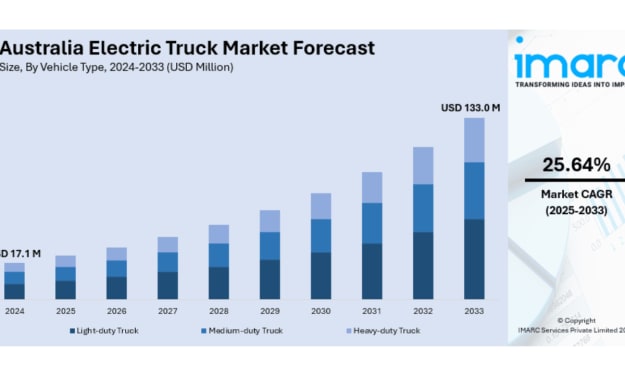
The latest report by IMARC Group, titled "Australia Electric Truck Market Report by Vehicle Type (Light-duty Truck, Medium-duty Truck, Heavy-duty Truck), Propulsion (Battery Electric Truck, Hybrid Electric Truck, Plug-in Hybrid Electric Truck, Fuel Cell Electric Truck), Range (0-150 Miles, 151-300 Miles, Above 300 Miles), Application (Logistics, Municipal, Construction, Mining, Others), and Region 2025-2033," offers a comprehensive analysis of the Australia electric truck market growth. The report includes competitor and regional analysis, along with a detailed breakdown of the market segmentation. The Australia electric truck market size reached USD 17.1 Million in 2024. Looking forward, IMARC Group expects the market to reach USD 133.0 Million by 2033, exhibiting a CAGR of 25.64% during 2025–2033.
By Rashi Sharma4 months ago in Journal
The goals I did not achieve
Every writing goal I made for the year is a wash. It has been this way for a while, but I think it's important to be open about my failures and the reality of how life can get in the way. This is especially true considering the several times I have posted on Vocal about my writing goals, how I was changing my approach, and where I was hoping to be for the upcoming year. I will probably do that again in a couple months, but for now, it is time to acknowledge where I am today.
By Kay Husnick24 days ago in Journal
Stanislav Kondrashov: How Social Media Is Quietly Changing the Way We Experience Travel Photography
Travel photography has always been about more than images. At its best, it captures atmosphere, emotion, and the subtle details that define a place beyond landmarks and guidebooks. Yet the way these stories are created and shared has changed dramatically in recent years. Social media platforms have not simply introduced new tools; they have reshaped the language of travel photography itself.
By Stanislav Kondrashov 3 days ago in Journal


Comments
There are no comments for this story
Be the first to respond and start the conversation.