
Australia Fuel Cell Market Soars to $1.1B by 2033: Hydrogen Revolution Powered by AI
The Australia fuel cell market size was valued at USD 184.8 Million in 2024. Looking forward, IMARC Group estimates the market to reach USD 1,116.0 Million by 2033, exhibiting a CAGR of 19.7% during 2025-2033.

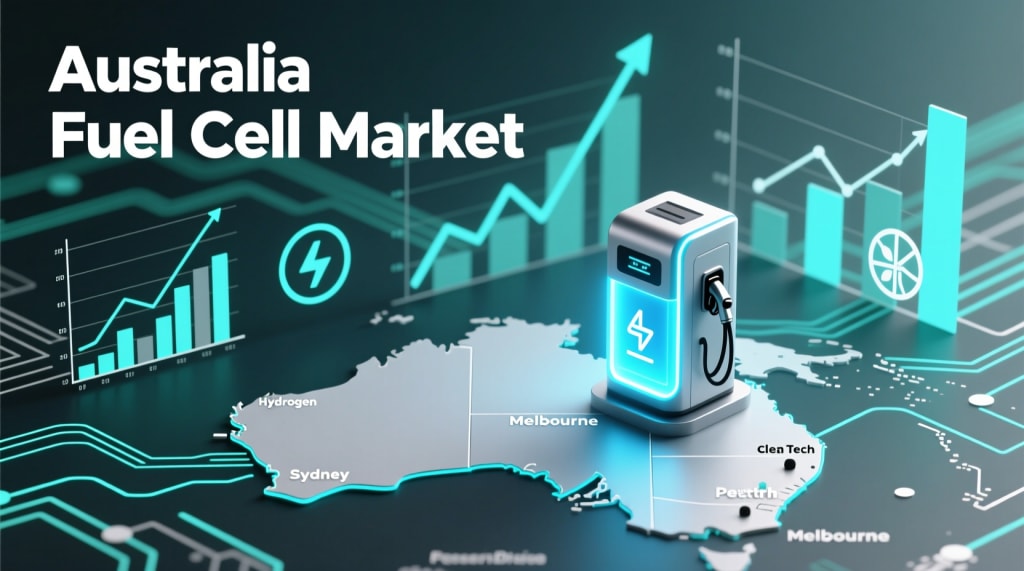
Australia Fuel Cell Market Overview
Market Size in 2024: USD 184.8 Million
Market Size in 2033: USD 1,116.0 Million
Market Growth Rate 2025-2033: 19.7%
According to IMARC Group's latest research publication, "Australia Fuel Cell Market: Industry Trends, Share, Size, Growth, Opportunity and Forecast 2025-2033", The Australia fuel cell market size was valued at USD 184.8 Million in 2024. Looking forward, IMARC Group estimates the market to reach USD 1,116.0 Million by 2033, exhibiting a CAGR of 19.7% during 2025-2033.
How AI is Reshaping the Future of Australia Fuel Cell Market
• AI-Optimized Fuel Cell Performance: Artificial intelligence algorithms are revolutionizing fuel cell system efficiency by continuously monitoring and optimizing hydrogen flow rates, temperature control, and power output. Machine learning models analyze operational data from PEMFC and SOFC systems to predict performance degradation, optimize maintenance schedules, and extend fuel cell lifespan across stationary and transportation applications.
• Smart Grid Integration and Energy Management: AI-powered energy management systems are enabling seamless integration of fuel cell technologies with Australia's renewable energy infrastructure. These intelligent platforms balance hydrogen production, storage, and fuel cell power generation in real-time, optimizing energy distribution across off-grid communities, remote mining operations, and critical infrastructure backup systems.
• Predictive Maintenance for Hydrogen Infrastructure: Machine learning algorithms deployed across Australia's developing hydrogen refueling station network provide predictive maintenance capabilities that reduce downtime and operational costs. These AI systems analyze sensor data from the 12 operational and under-construction refueling stations to identify potential equipment failures before they occur, ensuring consistent fuel cell vehicle support.
• Autonomous Fuel Cell Vehicle Operations: AI-enhanced fuel cell electric vehicles (FCEVs) are being piloted in Queensland and Victoria fleet trials, combining hydrogen powertrains with autonomous driving capabilities. These intelligent systems optimize hydrogen consumption based on route conditions, traffic patterns, and load requirements, demonstrating the future of zero-emission heavy-duty transport across Australian logistics networks.
• Hydrogen Production Optimization: Advanced AI models are optimizing green hydrogen production through renewable energy-powered electrolysis, analyzing weather patterns, grid demand, and energy pricing to maximize production efficiency. These systems support the Hydrogen Energy Supply Chain (HESC) project and ARENA initiatives by reducing production costs and enhancing the economic viability of Australia's hydrogen economy.
Grab a sample PDF of this report: https://www.imarcgroup.com/australia-fuel-cell-market/requestsample
Australia Fuel Cell Market Trends & Drivers:
Australia's fuel cell market is experiencing explosive growth driven by comprehensive government policy support through the National Hydrogen Strategy implementation, with substantial funding allocated through the Hydrogen Energy Supply Chain (HESC) project and Australian Renewable Energy Agency (ARENA) initiatives. Federal and state-level programs across New South Wales, Victoria, and Queensland are advancing hydrogen mobility and industrial applications, while the Clean Energy Finance Corporation provides financial backing for clean hydrogen initiatives aligned with emissions reduction commitments.
The commercialization of hydrogen fuel cell vehicles is gaining momentum, particularly in fleet and heavy-duty transport segments, with automotive manufacturers introducing FCEVs targeting government fleets and corporate entities. Queensland and Victoria trials demonstrate growing interest in low-emission transport strategies, while approximately 12 hydrogen refueling stations are either operational or under construction across Australia, marking the early stage of infrastructure development crucial for widespread FCEV deployment.
Stationary fuel cell applications are expanding rapidly for off-grid power supply, remote community electrification, and critical infrastructure backup, offering compelling alternatives to diesel generators through cleaner, quieter, and more efficient power generation. Companies are piloting PEM and SOFC systems for telecommunications, rural health centers, and isolated mining operations. With average Australian household electricity expenses exceeding $300 quarterly, the financial burden is encouraging interest in alternative energy systems offering cost stability and energy independence.
Australia Fuel Cell Industry Segmentation:
Type Insights:
• Proton Exchange Membrane Fuel Cells (PEMFC)
• Solid Oxide Fuel Cells (SOFC)
• Molten Carbonate Fuel Cells (MCFC)
• Direct Methanol Fuel Cells (DMFC)
• Phosphoric Acid Fuel Cells (PAFC)
• Others
Application Insights:
• Stationary
• Transportation
• Portable
Breakup by Region:
• Australia Capital Territory & New South Wales
• Victoria & Tasmania
• Queensland
• Northern Territory & Southern Australia
• Western Australia
Recent News and Developments in Australia Fuel Cell Market
• 2024: Government implemented National Hydrogen Strategy with substantial HESC project funding and ARENA initiatives supporting domestic fuel cell technology development, infrastructure investment, and subsidies for private sector hydrogen research, production, and deployment across Australia.
• 2024: Approximately 12 hydrogen refueling stations became operational or entered construction phase across Australia through coordinated state government efforts, private sector collaborations, and federal funding schemes, establishing foundation for FCEV commercialization in fleet and heavy-duty transport segments.
• 2024: Stationary fuel cell deployment expanded for off-grid power supply, with PEM and SOFC systems piloted in telecommunications, rural health centers, and isolated mining operations, offering cleaner alternatives to diesel generators as household electricity costs exceeded $300 quarterly.
• 2025: Queensland and Victoria advanced hydrogen vehicle trials targeting government fleets and corporate entities, demonstrating low-emission transport strategies while automotive manufacturers introduced fuel cell electric vehicles designed for Australian market conditions and infrastructure capabilities.
Competitive Landscape:
The competitive landscape of the industry has also been examined along with the profiles of the key players.
Note: If you require specific details, data, or insights that are not currently included in the scope of this report, we are happy to accommodate your request. As part of our customization service, we will gather and provide the additional information you need, tailored to your specific requirements. Please let us know your exact needs, and we will ensure the report is updated accordingly to meet your expectations.
About Us:
IMARC Group is a global management consulting firm that helps the world's most ambitious changemakers to create a lasting impact. The company provide a comprehensive suite of market entry and expansion services. IMARC offerings include thorough market assessment, feasibility studies, company incorporation assistance, factory setup support, regulatory approvals and licensing navigation, branding, marketing and sales strategies, competitive landscape and benchmarking analyses, pricing and cost research, and procurement research.
Contact Us:
IMARC Group
134 N 4th St. Brooklyn, NY 11249, USA
Email: [email protected]
Tel No:(D) +91 120 433 0800
United States: +1-201971-6302
About the Creator
Rashi Sharma
I am a market researcher.
Keep reading
More stories from Rashi Sharma and writers in Journal and other communities.
How MAGA Rhetoric Went Viral in Europe
Imagine scrolling your social feed and seeing political debates about France’s elections, Germany’s nationalist rise, or far-right gains in Italy and Poland — all tied, at least in part, to the influence of America’s Make America Great Again (MAGA) movement. What started as an American slogan transformed into a global conversation about nationalism, identity, and political strategy, generating massive public interest, academic analysis, and viral news cycles across the United States and Europe.
By Omasanjuwa Ogharandukun3 days ago in Journal


Comments
There are no comments for this story
Be the first to respond and start the conversation.