
Australia Fertilizer Market: Ai Revolution, Trend & Growth Drivers by 2033
The Australia fertilizer market size was valued at USD 2.7 Billion in 2024. Looking forward, IMARC Group estimates the market to reach USD 3.8 Billion by 2033, exhibiting a CAGR of 3.5% during 2025-2033.

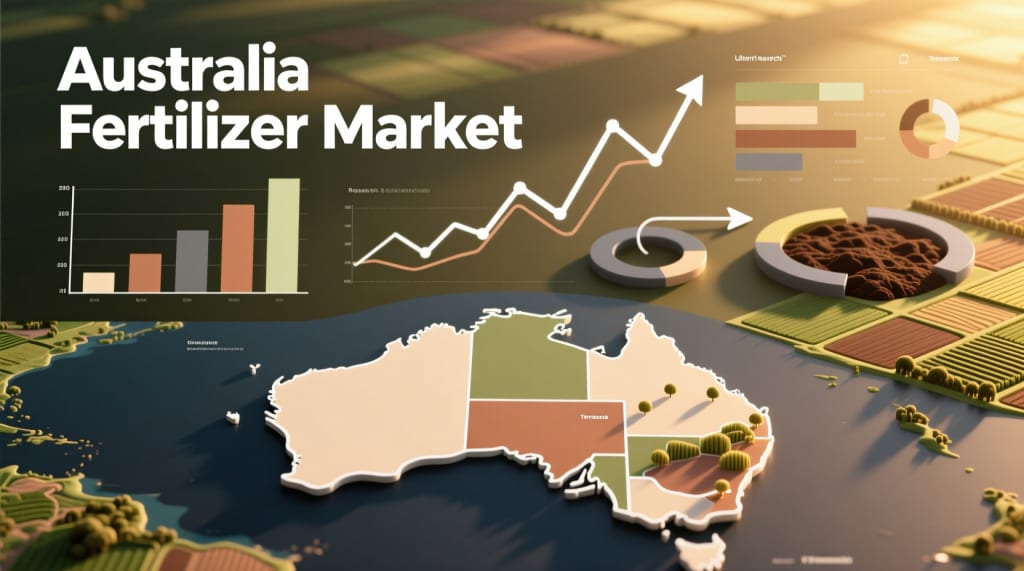
Australia Fertilizer Market Overview
Market Size in 2024: USD 2.7 Billion
Market Size in 2033: USD 3.8 Billion
Market Growth Rate 2025-2033: 3.5%
According to IMARC Group's latest research publication, "Australia Fertilizer Market: Industry Trends, Share, Size, Growth, Opportunity and Forecast 2025-2033", The Australia fertilizer market size was valued at USD 2.7 Billion in 2024. Looking forward, IMARC Group estimates the market to reach USD 3.8 Billion by 2033, exhibiting a CAGR of 3.5% during 2025-2033.
How AI is Reshaping the Future of Australia Fertilizer Market
• $254.37 Million Organic Fertilizer Revolution: Australia's organic fertilizers market is projected to surge from USD 134.92 million in 2023 to USD 254.37 million by 2032 at 7.30% CAGR, reflecting accelerating farmer preferences toward organic products promoting soil health and minimizing ecological impact. This dramatic growth demonstrates fundamental market shift toward sustainable agriculture, regenerative farming practices, and bio-based nutrient solutions derived from composting, microbial inoculants, and plant-based amendments supporting long-term soil fertility, microbial function, and environmental stewardship aligned with consumer demand for sustainably produced agricultural products.
• 3.2% Liquid Fertilizer Expansion Leadership: Liquid fertilizers segment is experiencing accelerated growth at 3.2% CAGR from 2024 to 2032, driven by superior absorption rates, efficient nutrient delivery, and operational advantages including easy application through irrigation systems or spraying that reduces labor costs and improves efficiency. Water-soluble and liquid formulations enable precise nutrient delivery minimizing waste while optimizing resource utilization, particularly valuable across Murray-Darling Basin irrigation systems and Western Australian broadacre operations where precision agriculture technologies facilitate targeted application based on real-time soil and crop requirements.
• Government Rural Development Corporation Investment: Rural Research and Development Corporations funding supports fertilizer research and field testing across grains, cotton, and horticulture sectors, promoting development of controlled-release fertilizers, biofertilizers, and specialty products adapted to Australian climates and diverse soil conditions. Federal and state governments provide rural development grants, soil improvement initiatives, and agricultural extension programs encouraging appropriate fertilizer utilization maximizing farm productivity while supporting environmental sustainability objectives through subsidies on precision agriculture equipment, soil testing services, and new product trials.
• Great Barrier Reef Catchment Protection Initiative: Department of Agriculture, Water and the Environment initiatives focus on minimizing nutrient runoff and leaching in ecologically sensitive areas including Great Barrier Reef catchment regions, driving adoption of best management practices, controlled-release formulations, and precision application technologies. Government-sponsored campaigns promote balanced fertilization, micronutrient importance, and alternatives including organic and bio-based fertilizers through extension programs and workshops providing on-ground training connecting environmental stewardship with long-term farm productivity objectives.
• Precision Agriculture Digital Integration: Farmers across regions including Murray-Darling Basin and Western Australia adopt soil-mapping technology, drone-based field monitoring, and yield data analysis maximizing fertilizer application efficiency. Online platforms facilitate site-specific fertilizer recommendations based on soil fertility, moisture levels, and yield performance history, resonating with sustainable farming objectives while attracting large-scale grain, cotton, and horticulture producers prioritizing cost-effectiveness and environmental responsibility through data-driven nutrient management transforming traditional fertilization into optimized, technology-enabled precision agriculture operations.
Grab a sample PDF of this report: https://www.imarcgroup.com/australia-fertilizer-market/requestsample
Australia Fertilizer Market Trends & Drivers:
Australia's fertilizer market is experiencing transformative growth driven by expanding agricultural production across diverse cropping systems spanning broadacre grain and pulse farming in Western Australia and New South Wales to high-value horticulture in Victoria and Queensland. The nation's extensive export-oriented production including wheat, barley, canola, and cotton pushes producers to invest in fertilizers sustaining quantity and quality standards demanded by international consumers. Emerging crops including avocados and almonds in South Australia and Murray-Darling Basin introduce specialized nutrient management requirements, fueling demand for products promoting root development, flowering, and fruit growth supporting agricultural diversification and productivity enhancement.
Soil health challenges and nutrient deficiency represent critical market drivers, with Australian soils particularly in Western Australia and Northern Territory inherently deficient in essential nutrients including nitrogen, phosphorus, and potassium. Years of intensive farming without balanced replenishment render fertilizer application necessary for maintaining soil fertility, with growers increasingly utilizing soil testing and agronomic recommendations identifying optimal products and application rates. Sandy and acidic soils prevalent throughout southern and coastal Australia require specialized nutrient programs counteracting leaching and low retention, creating demand for traditional NPK fertilizers supplemented with micronutrients including zinc, boron, and manganese supporting long-term soil health improvement.
Government support and climate resilience strategies accelerate market expansion through rural development grants, soil improvement initiatives, and agricultural extension programs encouraging appropriate fertilizer utilization maximizing productivity and environmental sustainability. Federal and state governments promote precision agriculture, conservation tillage, and best fertilization practices counteracting soil erosion, salinity, and drought challenges widespread throughout Australia's diverse climate regions. Climate change driving irregular rainfall and weather extremes increases importance of efficient fertilizer utilization enhancing water-use efficiency, plant stress tolerance, and nutrient acquisition under changing environmental conditions, stimulating new-age fertilizer development and collaborative innovation among manufacturers, agronomists, and government agencies.
Australia Fertilizer Market Industry Segmentation:
The report has segmented the market into the following categories:
Product Type Insights:
• Chemical Fertilizer
• Biofertilizers
Product Insights:
• Straight Fertilizers
o Nitrogenous Fertilizers (Urea, Calcium Ammonium Nitrate, Ammonium Nitrate, Ammonium Sulfate, Anhydrous Ammonia, Others)
o Phosphatic Fertilizers (Mono-Ammonium Phosphate (MAP), Di-Ammonium Phosphate (DAP), Single Super Phosphate (SSP), Triple Super Phosphate (TSP), Others)
o Potash Fertilizers (Muriate of Potash (MoP), Sulfate of Potash (SoP))
o Secondary Macronutrient Fertilizers (Calcium Fertilizers, Magnesium Fertilizers, Sulfur Fertilizers)
o Micronutrient Fertilizers (Zinc, Manganese, Copper, Iron, Boron, Molybdenum, Others)
• Complex Fertilizers
Product Form Insights:
• Dry
• Liquid
Crop Type Insights:
• Grains and Cereals
• Pulses and Oilseeds
• Fruits and Vegetables
• Flowers and Ornamentals
• Others
Breakup by Region:
• Australia Capital Territory & New South Wales
• Victoria & Tasmania
• Queensland
• Northern Territory & Southern Australia
• Western Australia
Recent News and Developments in Australia Fertilizer Market
• 2024-2032: Australia organic fertilizers market projected to surge from USD 134.92 million in 2023 to USD 254.37 million by 2032 at 7.30% CAGR, reflecting accelerating transition toward sustainable agriculture practices. Growing consumer demand for organically produced food, regenerative farming adoption, and environmental stewardship priorities drive organic fertilizer segment expansion across New South Wales, Victoria, South Australian wine regions, and Tasmanian specialty crop operations.
• 2024-2032: Liquid fertilizers segment experiencing accelerated growth at 3.2% CAGR driven by superior absorption rates, efficient nutrient delivery, and operational advantages including irrigation system compatibility and spraying applications reducing labor costs. Water-soluble formulations enable precise nutrient management minimizing waste while supporting precision agriculture adoption across diverse cropping systems requiring optimized resource utilization and environmental responsibility.
• 2024-2025: Precision agriculture technologies including soil-mapping, drone-based field monitoring, and yield data analysis gain widespread adoption across Murray-Darling Basin and Western Australian farming regions. Digital platforms provide site-specific fertilizer recommendations based on soil fertility, moisture levels, and historical performance, promoting data-driven nutrient management that reduces wastage, minimizes environmental losses, and enhances productivity across large-scale grain, cotton, and horticulture operations.
• 2024-2033: Government initiatives through Department of Agriculture, Water and the Environment focus on minimizing nutrient runoff in Great Barrier Reef catchment regions, promoting balanced fertilization practices, controlled-release formulations, and organic alternatives. Rural Research and Development Corporations funding supports fertilizer technology innovation including biofertilizers and specialty products adapted to Australian soil conditions, climate variability, and sustainability objectives.
Competitive Landscape:
The competitive landscape of the industry has also been examined along with the profiles of the key players being Incitec Pivot Limited, Yara International ASA, Nufarm Limited, K+S Aktiengesellschaft, The Mosaic Company, CF Industries Holdings Inc., Nutrien Ltd., ICL Group, EuroChem Group, BASF SE, Haifa Group, and regional fertilizer distributors providing comprehensive nutrient solutions across chemical fertilizers, biofertilizers, specialty products, and precision agriculture technologies serving Australia's diverse agricultural sectors.
Note: If you require specific details, data, or insights that are not currently included in the scope of this report, we are happy to accommodate your request. As part of our customization service, we will gather and provide the additional information you need, tailored to your specific requirements. Please let us know your exact needs, and we will ensure the report is updated accordingly to meet your expectations.
About Us:
IMARC Group is a global management consulting firm that helps the world's most ambitious changemakers to create a lasting impact. The company provide a comprehensive suite of market entry and expansion services. IMARC offerings include thorough market assessment, feasibility studies, company incorporation assistance, factory setup support, regulatory approvals and licensing navigation, branding, marketing and sales strategies, competitive landscape and benchmarking analyses, pricing and cost research, and procurement research.
Contact Us:
IMARC Group
134 N 4th St. Brooklyn, NY 11249, USA
Email: [email protected]
Tel No:(D) +91 120 433 0800
United States: +1-201971-6302
About the Creator
Rashi Sharma
I am a market researcher.
Keep reading
More stories from Rashi Sharma and writers in Journal and other communities.
The goals I did not achieve
Every writing goal I made for the year is a wash. It has been this way for a while, but I think it's important to be open about my failures and the reality of how life can get in the way. This is especially true considering the several times I have posted on Vocal about my writing goals, how I was changing my approach, and where I was hoping to be for the upcoming year. I will probably do that again in a couple months, but for now, it is time to acknowledge where I am today.
By Kay Husnick23 days ago in Journal
Business Valuation Services in Los Angeles: A Guide to Accurate Appraisals in Southern California
In the competitive landscape of Southern California, a generic appraisal simply isn’t enough to secure a deal or satisfy a regulator. Whether you are navigating a high-stakes merger in Hollywood or a tech exit in Silicon Beach, understanding the true worth of your enterprise requires a localized, sector-specific lens.
By CEO A&S Developers5 days ago in Journal
So You Decided To Become a Nurse Practitioner:
So you decided to become an "Advanced Practice" nurse. Congratulations!... is what I would say if this was a good idea. Grad school? In this economy? What were you thinking? Likely it was something along the lines of either 1) “I've seen these other chucklefucks do it— Why can't I?” or even 2) “I've got a nice career, I should shake it up. I miss feeling like I have no clue what I'm doing.”
By Sandor Szabo2 days ago in Fiction


Comments
There are no comments for this story
Be the first to respond and start the conversation.