
Australia Battery Recycling Market: Turning Power Waste into Value
With EVs, energy storage, and sustainability policies ramping up, Australia’s battery recycling sector is on an upward trajectory.

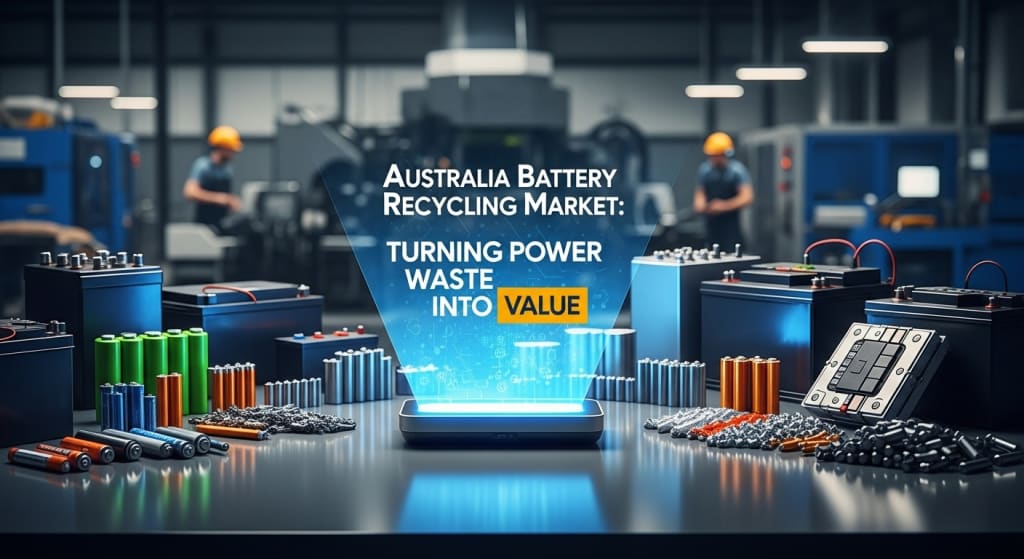
The Australia battery recycling market was valued at about USD 336 million in 2024. Projections suggest it will grow to roughly USD 612.55 million by 2033, expanding at a compound annual growth rate (CAGR) of 6.9% from 2025 through 2033.
Market Drivers:
Growing Battery Waste from EVs and Energy Storage
Electric vehicle (EV) adoption is accelerating, and the deployment of grid‐scale battery storage is growing rapidly. As the number of EVs and stationary storage installations rise, so does the volume of end‐of‐life lithium-ion batteries that require recycling. These waste streams provide the raw input needed to make recycling economically viable.
Policy Support & Circular Economy Initiatives
Federal and state governments in Australia are introducing funding, regulation, and incentives aimed at building recycling infrastructure and reducing environmental harm. The National Battery Strategy, for example, provides funding to boost domestic recycling capacity, R&D, and the material recovery ecosystem. Mandates for recycled content and producer responsibility are being explored.
Technological Advances in Recovery Processes
Newer technologies—hydrometallurgical recovery, mechanical shredding, and chemical separation—are improving yields for critical metals like lithium, cobalt, nickel, and others. Innovations also aim to reduce processing costs and improve environmental safety. Several emerging firms are scaling such methods to handle large‐format batteries efficiently.
Strong Private-Public Partnerships
Industry players are partnering with battery OEMs, battery manufacturers, and government bodies to secure supply chains and ensure that end‐of‐life batteries are routed to recycling instead of waste streams. Companies like Lithium Australia and Envirostream are playing key roles in establishing collection infrastructure and processing capacity.
Download Request Sample of Report: https://www.imarcgroup.com/australia-battery-recycling-market/requestsample
Real-World Signals & Examples
- Lithium Australia saw a strong increase in collections of large‐format lithium-ion batteries—used in EVs and energy storage—with its facility in Melbourne expanding its capacity and installing improved shredding equipment.
- Renewable Metals is developing an alkali-based recycling technology that claims to recover over 95% of critical materials from lithium batteries and works across different battery chemistries including lithium iron phosphate (LFP).
- Public awareness is growing about battery disposal hazards, including safety risks from improper discarding (for example, fires) and environmental risks from toxic leakage. This is driving demand for more drop-off points, educational campaigns, and regulation on battery waste management.
Key Challenges
Collection and Logistics Gaps
A major hurdle is the fragmented and inefficient battery collection infrastructure, particularly for small‐format batteries (like those in electronics) and in rural or remote areas. Many households lack access to suitable drop-off or take-back programs. Transport of hazardous battery waste from collection points to processing centres adds cost and regulatory complexity.
Low Recycling Rates for Lithium-Ion Waste
Despite large volumes of lithium-ion battery waste, only a small fraction is recycled effectively. Lithium-ion batteries are more difficult and costly to process than older lead-acid types. Technical challenges plus economies of scale are still catching up, meaning a lot of material risk ending up in landfills or unsafe disposal channels.
Financial Viability and Cost Pressure
Recycling plants require significant capital investment in specialized equipment and safety systems. Operating costs are high. The revenue from recovered metals fluctuates with global commodity prices, which can make it hard to plan long term. Smaller operators especially are under pressure unless they can scale.
Regulatory & Safety Risks
Battery fires in waste streams are an increasing concern. Misdisposed lithium batteries pose risks to collection agents, recycling facilities, and local government waste operations. Clear regulations around handling, transport, labelling, and safety protocols are needed to manage risks.
Trends & Opportunities Going Forward
Improved Collection Schemes & Producer Responsibility
Nationwide product stewardship or extended producer responsibility (EPR) programs are likely to be introduced or strengthened. These will push manufacturers and importers toward ensuring batteries are collected and recycled. More accessible drop-off locations and incentive schemes can boost recycling rates.
Scaling Domestic Recycling Infrastructure
More facilities capable of handling large-format EV and grid battery packs will be built. Facilities that integrate mechanical and chemical recovery, maybe even newer separation technologies, will help capture more material locally—less reliance on exporting waste or raw inputs.
Innovation and R&D in Recycling Processes
Organic improvements in yield, cost reduction, and environmental impact will come from innovation (for example, alkali-based recovery, improved material separation, reuse of components beyond metals) to better match battery chemistries and reduce waste.
Safety & Environmental Regulations Tighten
Stricter safety standards for handling and storage of spent batteries; regulations to reduce fire risks; rules around labelling and disposal; oversight of informal collection and transport will be important. Also, environmental standards for disposal of electrolytes or toxic by-products will become stricter.
Growing Role in Critical Minerals Supply Chain
Recycled lithium, cobalt, nickel etc. can help with supply constraints, reduce reliance on imports, and support Australia’s ambitions in clean energy, EVs, domestic battery manufacturing, and renewable energy storage. This makes battery recycling more than a waste management issue—it becomes a strategic industrial opportunity.
Ask An Analyst: https://www.imarcgroup.com/request?type=report&id=37023&flag=C
Australia’s battery recycling market is at a pivotal moment. With EV adoption accelerating, grid-scale battery deployment rising, and policy environments putting more emphasis on clean energy and circular economy values, handling battery waste well is not optional—it’s essential. Proper recycling helps avoid environmental damage, reduces fire risk, secures critical minerals supply, and unlocks economic value.
Because projections show the market nearly doubling by 2033, stakeholders—including governments, makers of batteries, recyclers, and technology developers—have a chance to build robust systems that are safe, efficient, and locally grounded.
About IMARC Group
IMARC Group delivers detailed market research and strategic foresight across high-growth industries. Their Australia Battery Recycling Market report includes rigorous segmentation by battery type (lithium-ion, lead-acid etc.), source (EV vs consumer electronics vs grid storage), material, end-use, regional breakdowns, and competitive landscape—helping companies and policymakers chart out reliable strategies.
About the Creator
Kevin Cooper
Hi, I'm Kavin Cooper — a tech enthusiast who loves exploring the latest innovations, gadgets, and trends. Passionate about technology and always curious to learn and share insights with the world!
Keep reading
More stories from Kevin Cooper and writers in Journal and other communities.
AI Agents Explained: The Future of Work, Business, and Daily Life
AI agents—software programs powered by artificial intelligence that understand, act, or act on behalf of users—are transforming how we live and work. Fueled by breakthroughs in machine learning, natural language processing, and automation, AI agents now power everything from smart home systems and customer support bots to autonomous financial advisors and self-driving vehicles.
By Kevin Cooper7 months ago in Journal
Author’s Advice
If you would’ve asked me 20 years ago did I know I’d become a writer and an author, I would’ve said “nope, ain’t happening”. As fate would have it I did become an author and I can honestly say I’m loving it so far. It really does feel good to be a writer. I’ve learned a lot on this journey and I feel like with even me being as new to this world as I am, there’s some wisdom I need to share with every other aspiring author.
By Joe Patterson2 days ago in Journal
The Hyaluronic Acid Market Is Quietly Changing the Way We Think About Skincare
There is a moment most of us know well. Standing in the skincare aisle, bottle in hand, squinting at the ingredient list. Somewhere near the top, almost always, you will find it: hyaluronic acid.
By Harvey Specterabout 12 hours ago in Journal




Comments
There are no comments for this story
Be the first to respond and start the conversation.