
Australia Agricultural Machinery Market Projected to Reach USD 6.4 Billion by 2033
The Australia agricultural machinery market size reached USD 4.0 Billion in 2024. Looking forward, IMARC Group expects the market to reach USD 6.4 Billion by 2033, exhibiting a growth rate (CAGR) of 5.18% during 2025-2033.

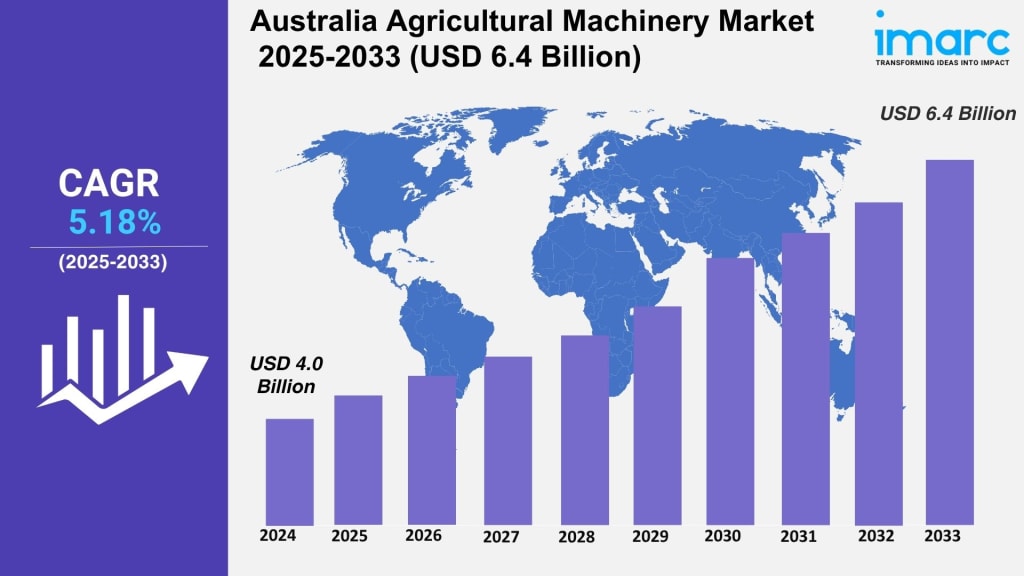
The latest report by IMARC Group, titled "Australia Agricultural Machinery Market Report by Product Type (Tractors, Ploughing and Cultivating Machinery (Ploughs, Harrows, Cultivators and Tillers, Others), Planting Machinery (Seed Drills, Planters, Spreaders, Others), Harvesting Machinery (Mowers, Balers, Others), Haying Machinery, Irrigation Machinery), and Region 2025-2033," offers a comprehensive analysis of the Australia agricultural machinery market growth. The report includes competitor and regional analysis, along with a detailed breakdown of the market segmentation. The Australia agricultural machinery market size reached USD 4.0 Billion in 2024. Looking forward, IMARC Group expects the market to reach USD 6.4 Billion by 2033, exhibiting a CAGR of 5.18% during 2025–2033.
Base Year: 2024
Forecast Years: 2025–2033
Historical Years: 2019–2024
Market Size in 2024: USD 4.0 Billion
Market Forecast in 2033: USD 6.4 Billion
Market Growth Rate (2025–2033): 5.18%
Australia Agricultural Machinery Market Overview
The Australia agricultural machinery market is experiencing steady growth driven by increasing food demand, sustainable farming practices adoption, government support programs, and technological advancement integration across farming operations. The market expansion is supported by modernization initiatives, precision agriculture implementation, smart technology deployment, and enhanced productivity requirements addressing Australia's growing agricultural export demands. Advanced agricultural machinery solutions are transforming Australia's farming landscape through automated systems, GPS-guided equipment, variable rate technologies, and data-driven farming practices positioning the country as a leader in agricultural innovation and operational efficiency.
Australia's agricultural machinery foundation demonstrates robust farming capabilities across diverse agricultural sectors including broadacre cropping, livestock production, horticulture, viticulture, and intensive farming operations. The country's extensive agricultural land base, favorable climate conditions, and export-oriented agricultural economy create substantial demand for sophisticated machinery solutions capable of maximizing productivity, reducing labor costs, and enhancing operational efficiency. The proliferation of large-scale farming enterprises, technology-driven agriculture, sustainable farming practices, and precision agriculture methods is creating favorable market conditions, requiring significant investments in modern equipment, smart farming technologies, and automated systems. Australia's agricultural sector competitiveness, combined with government incentives and environmental sustainability goals, makes it an increasingly attractive market for innovative agricultural machinery development and deployment.
Request For Sample Report:
https://www.imarcgroup.com/australia-agricultural-machinery-market/requestsample
Australia Agricultural Machinery Market Trends
• Precision agriculture adoption: Growing implementation of GPS-guided tractors, variable rate application systems, and data-driven farming technologies enabling optimized resource utilization, reduced input costs, and enhanced crop yields across Australian agricultural operations.
• Autonomous machinery integration: Increasing deployment of driverless tractors, robotic harvesters, and automated planting systems providing 24/7 operational capability, reduced labor dependency, and improved operational precision in farming activities.
• Smart farming technologies: Rising adoption of IoT-enabled equipment, sensor-based monitoring systems, and cloud-connected machinery providing real-time data analytics, predictive maintenance capabilities, and enhanced decision-making support for farmers.
• Sustainable equipment focus: Growing demand for machinery supporting conservation tillage, reduced chemical application, cover crop management, and sustainable farming practices addressing environmental concerns and regulatory compliance requirements.
• Digital integration expansion: Increasing utilization of farm management software, equipment telematics, and integrated technology platforms enabling comprehensive farm operation monitoring, optimization, and performance analysis.
• Multi-functional equipment development: Rising preference for versatile machinery capable of performing multiple operations, reducing equipment investment costs, and maximizing utilization efficiency across diverse farming activities and seasonal requirements.
Market Drivers
• Food demand growth: Increasing global food requirements and Australia's significant agricultural export role driving demand for machinery capable of enhancing productivity, improving efficiency, and meeting international quality standards and supply commitments.
• Government policy support: Comprehensive incentive programs, subsidies, tax benefits, and financial assistance schemes encouraging farmers to invest in modern machinery, upgrade equipment, and adopt advanced agricultural technologies.
• Labor shortage challenges: Growing scarcity of skilled agricultural workers and seasonal labor availability creating demand for mechanized solutions, automated systems, and labor-saving technologies reducing dependency on manual operations.
• Farm consolidation trends: Increasing farm size, scale expansion, and corporate farming operations requiring high-capacity machinery, efficient equipment, and advanced technology solutions supporting large-scale agricultural production.
• Export market demands: Strong international demand for Australian agricultural products requiring machinery that ensures consistent quality, meets export standards, and supports competitive pricing through operational efficiency improvements.
• Climate adaptation requirements: Changing weather patterns, extreme weather events, and climate variability driving adoption of resilient machinery, efficient irrigation systems, and adaptive farming equipment supporting productivity under challenging conditions.
Challenges and Opportunities
Challenges:
• High capital investment costs for advanced agricultural machinery creating financial barriers particularly for small and medium-sized farmers with limited access to capital and extended equipment payback periods
• Technical complexity and maintenance requirements for modern equipment demanding specialized knowledge, training programs, and ongoing technical support creating adoption challenges for traditional farming operations
• Rapid technology evolution and equipment obsolescence concerns requiring frequent upgrades, software updates, and compatibility assessments complicating long-term investment planning and equipment utilization strategies
• Parts availability and service support challenges particularly in remote agricultural regions requiring extensive service networks, inventory management, and technical expertise for equipment maintenance and repairs
• Skills gap challenges requiring farmer training, technical education, and workforce development programs to effectively operate, maintain, and optimize sophisticated agricultural machinery and technology systems
Opportunities:
• Smart agriculture leadership through precision farming technologies, data analytics integration, and IoT-enabled equipment creating competitive advantages and positioning Australian farmers as global technology adopters
• Export market potential for Australian agricultural machinery expertise serving international markets with similar farming conditions, climate challenges, and large-scale agricultural operations
• Sustainable farming differentiation through eco-friendly equipment, conservation technologies, and environmentally conscious farming practices addressing sustainability requirements and consumer preferences
• Service sector expansion including equipment leasing, maintenance contracts, training programs, and technology support services providing recurring revenue streams and enhanced customer relationships
• Research collaboration opportunities between manufacturers, universities, and farming organizations advancing agricultural technology development, optimizing equipment performance, and creating innovative farming solutions
Australia Agricultural Machinery Market Segmentation
By Product Type:
• Tractors
o Compact Tractors (Below 40 HP)
o Mid-Range Tractors (40-100 HP)
o High-Power Tractors (Above 100 HP)
o Specialty Tractors
• Ploughing and Cultivating Machinery
o Ploughs
Moldboard Ploughs
Disc Ploughs
Chisel Ploughs
o Harrows
Disc Harrows
Tine Harrows
Chain Harrows
o Cultivators and Tillers
Field Cultivators
Rotary Tillers
Subsoilers
o Others
Rippers
Seedbed Preparers
• Planting Machinery
o Seed Drills
No-Till Drills
Conventional Drills
Air Drills
o Planters
Row Crop Planters
Precision Planters
Vegetable Planters
o Spreaders
Fertilizer Spreaders
Lime Spreaders
Manure Spreaders
o Others
Transplanters
Broadcast Seeders
• Harvesting Machinery
o Mowers
Rotary Mowers
Flail Mowers
Disc Mowers
o Balers
Round Balers
Square Balers
Large Square Balers
o Others
Combine Harvesters
Forage Harvesters
Potato Harvesters
• Haying Machinery
o Hay Rakes
o Hay Tedders
o Hay Conditioners
o Hay Wrappers
• Irrigation Machinery
o Center Pivot Systems
o Sprinkler Systems
o Drip Irrigation Systems
o Traveling Gun Systems
By Region:
• Australia Capital Territory & New South Wales
• Victoria & Tasmania
• Queensland
• Northern Territory & Southern Australia
• Western Australia
Australia Agricultural Machinery Market News (2024–2025)
• 2024: Australian Department of Agriculture reported significant adoption of sustainable farming practices with 85% of broadacre farms maintaining stubble, 68% practicing minimal tillage, and 61% implementing rotational grazing management systems.
• 2024: Government agricultural support programs expanded with enhanced subsidies, grants, and tax incentives encouraging farmers to invest in modern machinery and adopt precision agriculture technologies across all farming sectors.
• 2024: Food production and export demand continued growing with annual increases in agricultural output, household consumption, and net food exports driving machinery investment for enhanced productivity and efficiency.
• 2024: Smart farming technology integration accelerated with increased adoption of GPS guidance systems, variable rate application equipment, and IoT-enabled machinery supporting data-driven farming decisions.
• 2024: Conservation agriculture practices gained momentum with farmers increasingly adopting machinery supporting reduced tillage, precision input application, and sustainable farming methods addressing environmental concerns.
• 2024: Agricultural machinery modernization initiatives expanded across rural regions with improved financing options, dealer networks, and technical support services enhancing equipment accessibility and adoption rates.
Key Highlights of the Report
• Market Performance (2019–2024)
• Market Outlook (2025–2033)
• Industry Catalysts and Challenges
• Segment-wise historical and future forecasts
• Competitive Landscape and Key Player Analysis
• Product Type and Regional Analysis
Ask analyst for your customized sample:
https://www.imarcgroup.com/request?type=report&id=24658&flag=F
Q&A Section
Q1: What drives growth in the Australia agricultural machinery market?
A1: Market growth is driven by food demand growth requiring enhanced productivity and export capacity, government policy support through incentives and financial assistance programs, labor shortage challenges creating demand for mechanized solutions, farm consolidation trends requiring high-capacity equipment, export market demands ensuring competitive agricultural production, and climate adaptation requirements supporting resilient farming practices under changing environmental conditions.
Q2: What are the latest trends in this market?
A2: Key trends include precision agriculture adoption with GPS-guided and data-driven farming technologies, autonomous machinery integration providing driverless and robotic farming solutions, smart farming technologies enabling IoT connectivity and real-time monitoring, sustainable equipment focus supporting conservation practices and environmental compliance, digital integration expansion through farm management platforms, and multi-functional equipment development maximizing versatility and cost-effectiveness.
Q3: What challenges do companies face?
A3: Major challenges include high capital investment costs creating financial barriers for smaller farming operations, technical complexity and maintenance requirements demanding specialized knowledge and support, rapid technology evolution causing equipment obsolescence concerns, parts availability and service support challenges particularly in remote regions, and skills gap challenges requiring comprehensive training and workforce development programs.
Q4: What opportunities are emerging?
A4: Emerging opportunities include smart agriculture leadership through precision farming and IoT-enabled equipment technologies, export market potential leveraging Australian expertise for international agricultural markets, sustainable farming differentiation through eco-friendly and conservation technologies, service sector expansion with leasing and maintenance programs, and research collaboration opportunities advancing agricultural technology development and innovative farming solutions.
About Us
IMARC Group is a leading market research company that offers management strategy and market research worldwide. We partner with clients in all sectors and regions to identify their highest-value opportunities, address their most critical challenges, and transform their businesses. IMARC's information products include major market, scientific, economic and technological developments for business leaders in pharmaceutical, industrial, and high technology organizations. Market forecasts and industry analysis for biotechnology, advanced materials, pharmaceuticals, food and beverage, travel and tourism, nanotechnology and novel processing methods are at the top of the company's expertise.
Contact Us
IMARC Group
134 N 4th St. Brooklyn, NY 11249, USA
Email: [email protected]
Tel No: (D) +91-120-433-0800
United States: +1-201-971-6302
About the Creator
Rashi Sharma
I am a market researcher.
Keep reading
More stories from Rashi Sharma and writers in Journal and other communities.
Australia Biotechnology Market to Reach USD 23.8 Billion by 2033
The latest report by IMARC Group, titled "Australia Biotechnology Market Report by Product Type (Instruments, Reagents, Software and Services), Technology (Nanobiotechnology, Tissue Engineering and Regeneration, DNA Sequencing, Cell-Based Assays, Fermentation, PCR Technology, Chromatography, Others), Application (Healthcare, Food and Agriculture, Natural Resources and Environment, Industrial Processing, Bioinformatics, Others), and Region 2025-2033," offers a comprehensive analysis of the Australia biotechnology market growth. The report includes competitor and regional analysis, along with a detailed breakdown of the market segmentation. The Australia biotechnology market size reached USD 12.5 Billion in 2024. Looking forward, IMARC Group expects the market to reach USD 23.8 Billion by 2033, exhibiting a CAGR of 7.39% during 2025–2033.
By Rashi Sharma4 months ago in Journal
The goals I did not achieve
Every writing goal I made for the year is a wash. It has been this way for a while, but I think it's important to be open about my failures and the reality of how life can get in the way. This is especially true considering the several times I have posted on Vocal about my writing goals, how I was changing my approach, and where I was hoping to be for the upcoming year. I will probably do that again in a couple months, but for now, it is time to acknowledge where I am today.
By Kay Husnick24 days ago in Journal
Learning to Surrender Control to God
Surrender is one of the most misunderstood ideas in the Christian life. For many people, the word itself triggers resistance. It sounds passive, frightening, or even irresponsible. We are taught to plan carefully, protect ourselves, and stay in control. Faith, however, introduces a different way of living, one that asks us to loosen our grip and trust Someone beyond ourselves.
By Sound and Spirit2 days ago in Journal
How, Too
Many people wonder how, too. You are not alone, and I am an expert. I will teach you how, too! First, you need to remit a small application fee and fill out an application describing the nature of your financial situation and how often payments will be made, as this will have great bearing on how well I teach you how, too.
By Harper Lewis3 days ago in Fiction



Comments
There are no comments for this story
Be the first to respond and start the conversation.