

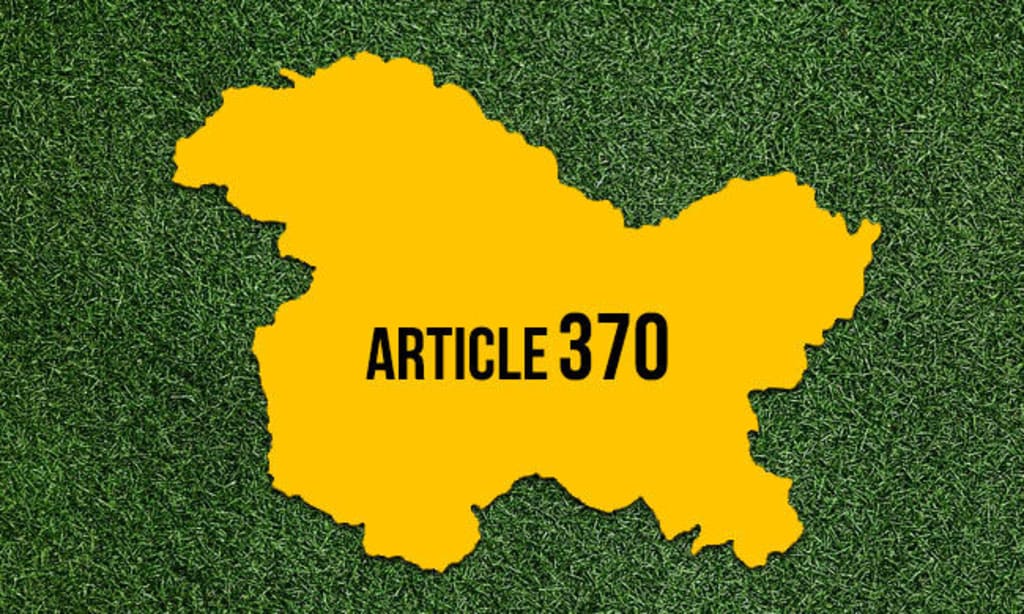
Article 370 of the indian constitution was a provision that granted special autonomous status to the state of jammu and kashmir. The article was incorporated into the indian constitution on 26th january 1950, shortly after india's independence from british rule. It was initially supposed to be a temporary provision that would allow the state to adopt the indian constitution and become part of the indian union. However, it remained in force for more than six decades and was finally abolished on 5th august 2019.
Under article 370, jammu and kashmir had its own constitution, flag, and the power to make laws on all matters except for defense, foreign affairs, finance, and communications. The article also prohibited non-residents from buying land or property in the state. These provisions were put in place to preserve the unique cultural identity of the state and to give its people a sense of autonomy.
However, over the years, the article came under criticism for a number of reasons. Some argued that it had led to the isolation of jammu and kashmir from the rest of india and had hindered its economic and social development. Others argued that it had created a separate set of laws and regulations for the state, which had led to a lack of accountability and transparency in governance.
In addition, article 370 had been used by some political parties in the state to further their own interests, rather than the interests of the people. Some had used it as a tool to stoke regional and religious tensions, which had led to violence and unrest in the state.
In 2019, the indian government led by prime minister narendra modi, decided to abrogate article 370 and integrate jammu and kashmir fully into the indian union. The decision was met with mixed reactions, with some welcoming it as a long-overdue move that would bring the state into the mainstream and improve its economic and social prospects. Others, however, saw it as a violation of the special status granted to the state and an infringement of its autonomy.
The move to abrogate article 370 was accompanied by a number of other measures, including the bifurcation of the state into two union territories, jammu and kashmir and ladakh. The indian government argued that these measures were necessary to bring peace and stability to the region and to address the issues of terrorism and separatism that had plagued the state for decades.
The abrogation of article 370 has had significant political, social, and economic implications for jammu and kashmir. On the one hand, it has led to an increase in investment and development in the region, with new infrastructure projects and industries being established. On the other hand, it has led to a sense of disenfranchisement among some sections of the population, who feel that their cultural identity and political rights have been undermined.
The indian government has also faced criticism for its handling of the situation in jammu and kashmir since the abrogation of article 370. The state was placed under a strict lockdown, with restrictions on movement and communication, and the detention of political leaders and activists. This has led to accusations of human rights abuses and a lack of transparency in governance.
In conclusion, the abrogation of article 370 has been a controversial and divisive issue in india. While some see it as a necessary step towards greater integration and development, others see it as a violation of the unique cultural identity and autonomy of jammu and kashmir. It remains to be seen how the situation in the region will evolve in the coming years, and whether the indian government's measures will lead to lasting peace and prosperity or further unrest and conflict.Start writing...
About the Creator
THE RIP Review: Does Joe Carnahan’s New Heist Thriller Deliver or Fall Apart Under Pressure?
Director Joe Carnahan has always been something of an American counterpart to Guy Ritchie—he gravitates toward gritty cops-and-robbers chaos, high-velocity shootouts, and snappy criminal banter. And true to form, his latest project, THE RIP, leans right into that wheelhouse.
By Bella Anderson2 days ago in Journal
Rachel Reviews: The Spiral Archive by Pieter Hendrik
It's difficult for me to know where to start with a review of this book as it was, for me, an entirely unique experience and one that I'll probably never have again. I don't want that to be interpreted as unenjoyable but it has left me scratching my head a little and ruminating on its content, its themes and its characters.
By Rachel Deemingabout 9 hours ago in BookClub



Comments
There are no comments for this story
Be the first to respond and start the conversation.