
All about Gen AI: Models and Architecture Explained
All about Gen AI: Models and Architecture
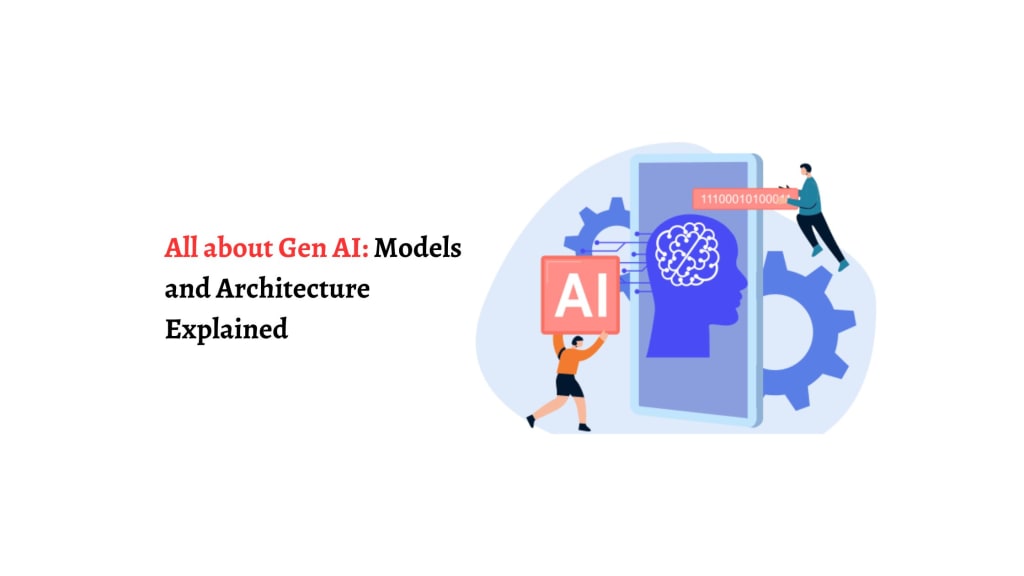
Today’s customers have higher expectations than ever, and Gen AI is a valuable tool for meeting these expectations, enabling unique and personalized experiences and recommendations for customers.
With the help of Generative AI consulting services, many organizations are now implementing this advanced technology in their business processes.
But what happens behind this process, where a machine establishes meaningful connections with customers?
In this blog, we’ll understand the GenAI architecture that helps these models to continuously assist customers.
What are GenAI models?
Gen AI (Gen AI) models are advanced AI systems that are made to produce new content from existing data. These models can understand and interpret human language by using natural language processing (NLP) techniques. This allows them to answer questions precisely, condense data, and translate across different languages. Because of their capacity for meaningful dialogue, LLMs are well-suited for use in chatbot and virtual assistant applications.
Every time a customer interacts with the model, it gains the ability to produce new material that follows the same patterns from earlier exchanges. Any company that uses a Gen AI model as part of its customer experience strategy benefits from the model's ongoing learning, enabling the company to offer relevant solutions, services, and responses.
So, what actually does the heavy lifting behind this capability? Neural networks.
These networks take cues from the human brain and process and interpret large volumes of data by using layers of networked nodes, or neurons, to identify patterns.
Based on these insights, predictions or choices can then be made. Neural networks allow us to produce a wide range of content, including text, music, pictures, and multimedia.
The models undergo continuous training on the data, which helps them optimize their responses over time. A Generative AI model being implemented within the customer experience strategy is typically built and trained on these architectural approaches:
Generative Adversarial Networks (GANs): GANs are a way to train a generative AI model by framing the problem as a supervised learning problem with two sub-models.
GANs use two neural networks - a generator and a discriminator - that compete against each other.
GANs work by creating a new output from the pattern found in the training dataset.
In it, two neurons are pitched against each other and create a new output.
Let's understand this concept with the help of the analogy of a soccer team and a coach when the eleven team players meet for the first time. They don't play properly; they make a lot of mistakes because every player has a different playing style and strategy in mind. Now, the coach trains the players and gives them a tactic and strategy, and the team plays like a charm, just like FC Barcelona's Tiki-Taka style!
Here's what does the coach do,
- Observes the team
- Marks the strengths and weaknesses of players
- The gaps in gameplay
- Gives them feedback
- Improvises the gameplay of a team
Now, compare the above analogy with GANs. The team that plays the game is a Generator because it creates a new football play and works the action. The coach is a Discriminator as he finds the strengths and weaknesses and gives feedback to improvise. A Discriminator has two important tasks: discriminating within the data and giving feedback on the same.
Also read A brief introduction to Generative AI and its relevance in AI research
Transformer Models:
Transformer models are deep learning models widely utilized in natural language processing and other generative AI applications.
Transformer models, such as GPT-3 and GPT-4, are made to learn the contextual links among words in a sentence or text sequence. They do this learning by employing a technique known as self-attention, which allows the model to weigh the significance of distinct words in a sequence based on their context.
This enables them to construct human-like responses by guessing the next word in a series using the preceding words.
Transformer models are trained to understand the interplay of words in a sentence, which helps them capture context.
This happens with the help of an encoder and decoder.
However, what sets Transformers apart is that, unlike traditional models that handle sequences step by step, Transformers process all parts simultaneously, making them efficient and GPU-friendly.
Final Words
The world of AI has come a long way in creating a personalized connection between the human brain and the machinery. Gen AI has proven to be the breakthrough. However, to implement GenAI within the organization, try with a specific use case, within the existing process. Partner with a Generative AI consulting company, that co-innovates with you and help you reduce entry barriers of the technology.
About the Creator
Reader insights
Nice work
Very well written. Keep up the good work!
Top insight
Easy to read and follow
Well-structured & engaging content
Keep reading
More stories from Lucy Zeniffer and writers in Journal and other communities.
Why Is Data Modernization Strategy Important Today?
Since OpenAI launched GPT 3.0 by the end of 2022, many organizations have started paving the way for data modernization. Though Generative AI has increased the demand for using data in use among organizations, there have been companies considered early adopters of data modernization strategy. Having data modernization strategy and practices in place brings organizations many advantages beyond implementing or leveraging generative AI. Let’s explore the blog and understand what data modernization is and why organizations need it now.
By Lucy Zeniffer2 years ago in Journal
Autonomy Is The Real Privilege
Good morning, freedom-seekers! Today we’re gonna be looking at autonomy. A strange word, I know; one many would probably look at blankly and run away from on sight. We’re gonna figure out what it actually means, consider how it’s achieved, and decipher just how deeply most of us are tangled up in dependence without realising it.
By That ‘Freedom’ Guy2 days ago in Humans



Comments (1)
Thanks for the well detailed analysis