
Agriculture Drones Market: How Drones Are Rewriting Agriculture
From crop stress to smarter yields, the rise of aerial farming is reshaping how the world grows food
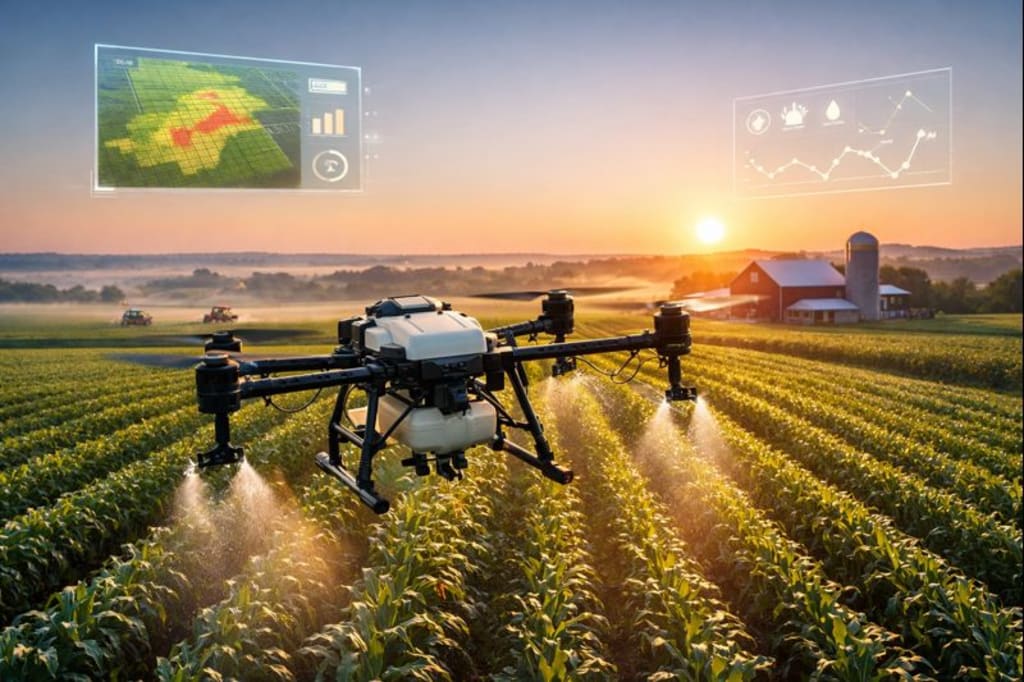
At dawn, when most farms are still quiet, something hums gently above the fields. It is not a bird or a passing plane. It is a drone, small, precise, and packed with sensors, mapping acres of crops in minutes. Below, leaves glisten with dew, unaware they are being measured, analyzed, and compared against thousands of data points that will decide how much water, fertilizer, or care they receive today.
This is already happening across farms of all sizes. Agriculture, one of humanity’s oldest professions, is undergoing a quiet aerial revolution. At the center of it is the expanding Agriculture Drones Market, where flying systems are becoming as essential to modern farming as tractors once were.
The Agriculture Drones Industry is reshaping crop management, resource planning, and pest control. It offers farmers rapid feedback loops and measurable return on precision investments, bringing data driven farming into everyday practice.
The Rise of Eyes in the Sky
For decades, farmers relied on instinct, experience, and slow ground inspections to understand crop health. Walking fields takes time, and problems often become visible only after damage has occurred. Drones changed this process by introducing speed, coverage, and consistency.
Equipped with high resolution cameras, multispectral sensors, and GPS systems, agricultural drones can survey large areas quickly. They capture information that the human eye cannot easily detect, such as early plant stress, irrigation inefficiencies, or nutrient imbalance. This aerial data allows farmers to respond earlier, protecting yields and reducing waste.
The Agriculture Drones market size reached USD 1.8 billion in 2026 and is projected to increase to USD 3.9 billion by 2031, reflecting strong demand for aerial insights in farm operations.According to Mordor Intelligence, the sector is growing at a compound annual growth rate of 16.70 percent, reflecting strong adoption across global farming operations.
Why Farmers Are Turning to Drones
The appeal of drones extends beyond novelty. At its core, agricultural drones address some of farming’s most persistent challenges: uncertainty, labor constraints, and resource waste.
Key advantages include:
Faster field assessment, enabling entire farms to be surveyed in minutes rather than days
Targeted interventions, allowing water, fertilizers, or crop protection products to be applied only where needed
Reduced labor strain by minimizing manual field inspections
Improved planning through historical aerial data that tracks seasonal changes
Farmers can now:
Compare crop performance across zones
Detect pest or disease patterns at early stages
Adjust irrigation schedules based on live crop indicators
Reduce chemical use by applying inputs only where needed
The Technology Behind this Transformation
The adoption of advanced imaging, GPS guided flight paths, and edge analytics is reshaping the Agriculture Drones Industry. Improvements in sensor hardware, battery life, and flight stability support repeated, reliable operations. Meanwhile, software platforms help interpret larger datasets quickly.
Multispectral and thermal imaging technologies reveal how plants manage light and heat, allowing farmers to intervene before visible damage occurs. These capabilities differentiate drones from traditional farm equipment. Drones do not just perform tasks; they inform decisions.
Adoption, Forecast, and Regional Insights
The Agriculture Drones market forecast shows accelerating growth worldwide. In 2025, large commercial farms held about 64 percent of market revenue, while small and medium farms are expected to grow rapidly through cooperative ownership and service models.
By region, North America accounted for the largest revenue share in 2025 at 36 percent, thanks to established precision farming infrastructure and supportive policies. Asia Pacific is projected to register strong growth rates through 2031 as agricultural modernization policies take hold in China, India, and Southeast Asia.
Challenges that Still Shape the Market
Despite strong growth, the Agriculture Drones Industry faces hurdles. Regulatory frameworks for unmanned aerial systems differ by country, influencing how and where drones fly. Training and data interpretation skills remain barriers for broader adoption.
There are also concerns around data ownership, security, and integration. Farmers want assurance that the information collected over their land remains secure and usable across systems. Nevertheless, clearer regulations, training programs, and intuitive software are gradually addressing these issues.
The Human Side of Aerial Farming
Drones are changing how farmers interact with their land. With earlier insights and clearer visibility, decision making becomes more proactive and less reactive.
Many farmers report improved planning, reduced stress, and stronger confidence in their operational choices. Viewing fields from above offers not just data, but perspective. It reminds growers that while farming is rooted in tradition, it can evolve with technology.
What the Future Looks Like from Above
As autonomy increases and analytics become more predictive, drones are expected to integrate further into connected farm ecosystems alongside soil sensors and weather monitoring systems.
The continued expansion of the Agriculture Drones Market reflects more than technological adoption. It signals a shift toward data informed agriculture that blends traditional knowledge with modern aerial insight to support long term global food production.
About the Creator
william jack
i am research analyst
Keep reading
More stories from writers in Journal and other communities.
How AI Agent Development Companies Design Autonomous Workflows
Autonomous workflows aren’t about replacing humans they’re about removing friction from decision-heavy processes. AI agent development companies focus on designing systems that can observe, decide, act, and improve with minimal human intervention.
By Lilly Scott7 days ago in Journal
A Dart at Dusk
Seconds ago, the sullen sun set on the two of us… my exuberant furry companion and me. A fresh breeze embraces us, delivering welcome relief from the day’s oppressive heat. His typical stumbling and staggering along — apace with a sloth — has turned into trip-trapping, high-stepping, almost skipping along.
By Angie the Archivist 📚🪶2 days ago in Petlife
Getting Serious About Comedy (Part I)
If I were asked to remark on my life and the childhood that paved some road leading me to this point, I would have to say something about all the funny people who surrounded me for the last 26,872 days (and counting). Somewhere along that road, I became a big fan of laughter and the comedy that spawns it – and, I mean not only my own laughter, but the laughter of others, some of which I have actually been responsible for inducing.
By John Oliver Smith7 days ago in Humor




Comments
There are no comments for this story
Be the first to respond and start the conversation.