
Agile Software Development: Types, Pros, and Common Misconceptions
Agile Software Development Methodologies

Agile software development methodology was inadvertently introduced in the year 1957. Its roots originated when computer scientists Gerald Weinberg and John Von Neumann used an incremental development approach for developing IBM and Motorola software. Decades later, agile methodology gained popularity and became a widely accepted standard for software development.
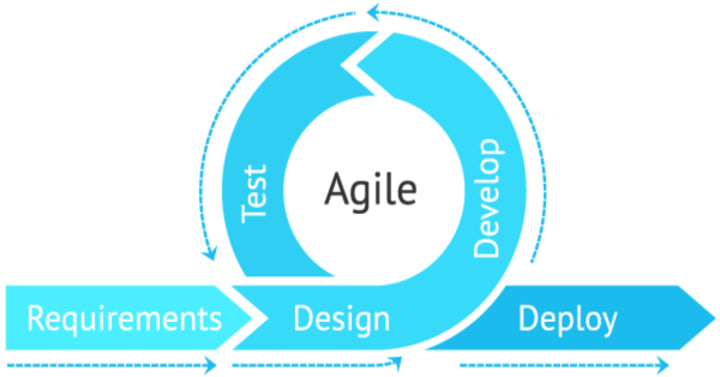
Unlike the regular Waterfall development approach that involves requirement gathering and documentation before the start of the project, Agile approach is all about iteration cycles and incremental progress. In Agile methodology, the development team can start developing the project with minimum requirements and add more features at the later stages of development.
Need and Use for Agile Software Development Methodology
The actual need for agile software development methodology derives from the increasing competition amongst businesses. Due to ever-changing consumer behavior and trends, businesses themselves need to be agile, i.e., to be able to react to changing consumer trends in a short time.
Agile methodology provides this agility via iterative development. For a better understanding, let’s take the example of two rival businesses Brand X and Brand Y. Brand X already has a highly functioning mobile app to deliver its services. Brand Y wants a similar app and opts for waterfall development.
Types of Agile Software Development Methodologies
They are five agile development methodologies that are widely in use across the globe. They all include incremental progress and allow you to return to the requirement gathering stage.
1) Kanban.
2) Scrum.
3) Extreme Programming (XP)
4) Crystal.
5) Dynamic Systems Development Method (DSDM)
Also read more - https://community.growthhackers.com/posts/agile-software-development-basic-principles-team-structure-common-methodologies-and-frameworks
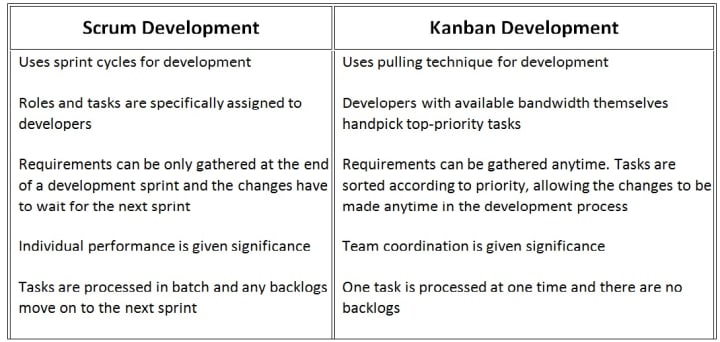
Difference between Scrum and Kanban Development
Pros of Agile Development Methodology
• Market-Fit End-Product: Agile methodology ensures that the end-product is up-to-date with the latest trends. It makes the product truly state-of-the-art and responsive to market needs, ensuring conformity to the expected user experience.
• Continuous Improvement: Both Scrum and Kanban development approaches are all about incremental improvement. After each iteration, the end-product becomes a better version of itself. Thus, ensuring continuous improvement to the first-planned version and an end-product that exceeds the client’s expectations.
• Highly-Flexible: Agile development approaches are highly flexible. They leave scope for the client to add or remove any features or ask for design changes after the pre-development information gathering. Leaving, no scope for later regrets and providing an efficient way to resolve product development complexities.
• Efficient Management: Managing changes in the Waterfall model isn’t possible as any change would require the development team to begin the development from scratch. In agile development, managing the entire development process is much easier and efficient. Coordination between the client and the development is also not a problem as the client plays an active role in the development process.
• A Transparent Approach: Agile development involves a complete contract life-cycle. The development company updates the contract from time to time and the client can negotiate the updated terms. This allows for more transparency along with the fact that the client does not need to wait for a deadline to see the final end product.
Common Misconceptions about Agile
• There is No End to Agile Development
• There is No Fixed Budget in Agile
• Agile Development is Poorly Planned
There are various reasons to opt for agile, such as if you want higher transparency or are unsure about the complete requirements of your project. However, to be more precise, we can conclude that the following businesses can benefit the most with agile methodology:
• Businesses requiring to be an active part of the development process
• Businesses requiring a state-of-the-art product in the long run
• Businesses emphasizing research-based development of their software and a market-fit end-product
• Businesses planning to deliver SaaS or long-term services through the software, such as food delivery and cab booking services
• Businesses with frequently changing market trends
Further more information checkout this website
About the Creator
Rajneesh Kumar
Rajneesh is working at FATbit Technologies as a Sr. business consultant. From choosing the right business idea to executing it, he assists aspiring entrepreneurs in all aspect of starting a business.
Keep reading
More stories from Rajneesh Kumar and writers in Journal and other communities.
Readymade Solutions Make it Easier to Start an On-Demand Marketplace Business
Nowadays, traditional handyman and daily-delivery businesses are transforming into on-demand services platforms. On demand services are very much flexible and easy to handle. As we all know that with the support of relevant on-demand services apps, the instant provision of goods and services is possible. On-demand services have gained more attention, popularity and response in recent times.
By Rajneesh Kumar4 years ago in Journal
The goals I did not achieve
Every writing goal I made for the year is a wash. It has been this way for a while, but I think it's important to be open about my failures and the reality of how life can get in the way. This is especially true considering the several times I have posted on Vocal about my writing goals, how I was changing my approach, and where I was hoping to be for the upcoming year. I will probably do that again in a couple months, but for now, it is time to acknowledge where I am today.
By Kay Husnick24 days ago in Journal
Rightwingers of the World Unite to Endorse Orbán Ahead of Hungary’s Election
As Hungary gears up for its next parliamentary elections, Prime Minister Viktor Orbán has found support not just at home but across the global right-wing spectrum. From Europe to the Americas, conservative leaders, nationalist movements, and far-right political organizations are openly backing Orbán, citing his policies on national sovereignty, immigration control, and cultural conservatism as a model for their own agendas.
By Fiaz Ahmed Brohi3 days ago in Journal



Comments (1)
Useful guide, thanks! Can I use your thesis in my article about agile software development? In this one: https://www.cleveroad.com/blog/agile-software-development/