
After Dumping Tonnes of Sand Into the Ocean for More Than 12 Years, China Has Succeeded in Creating Entirely New Islands From Scratch
How large-scale land reclamation reshaped the South China Sea—and rewrote regional geopolitics

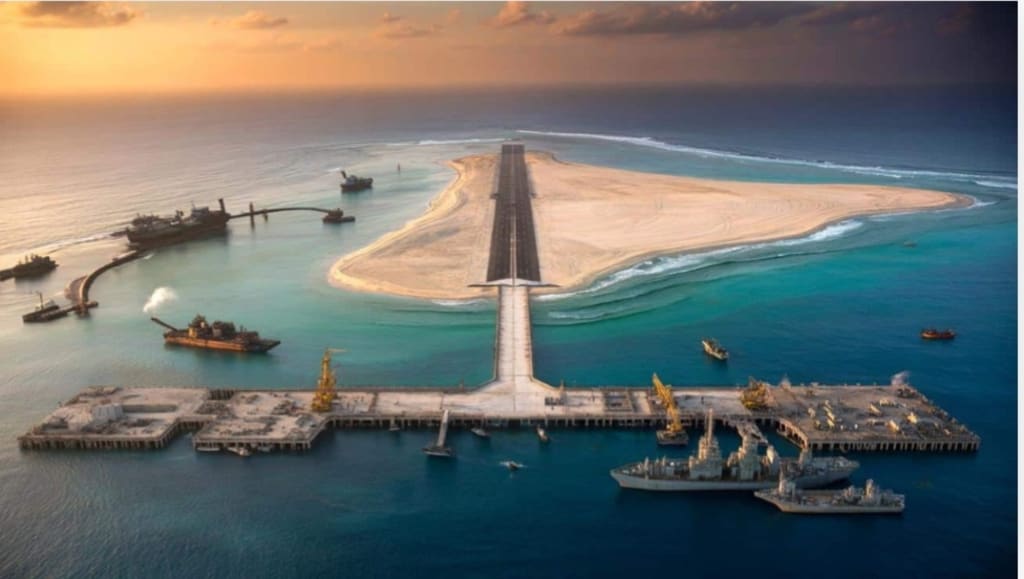
For more than a decade, China has carried out one of the most ambitious and controversial engineering projects in modern history: the creation of entirely new islands by dumping millions of tonnes of sand and dredged material into the ocean. After over 12 years of continuous land reclamation, what were once submerged reefs and shoals in the South China Sea have been transformed into artificial islands complete with runways, ports, radar systems, and military infrastructure.
This unprecedented effort has not only altered the physical geography of a strategically vital waterway but has also redefined maritime power, sovereignty claims, and environmental risk in one of the world’s most contested regions.
---
From Coral Reefs to Concrete Islands
China’s island-building campaign began in earnest in the early 2010s, focusing on remote reefs in the Spratly and Paracel Islands. These formations were often underwater at high tide, making them unsuitable for permanent human presence. Using massive dredging ships, China extracted sand from the seabed and deposited it onto reefs, gradually raising them above sea level.
Over time, these reclaimed areas expanded dramatically. Tiny outcrops became multi-square-kilometer landmasses capable of supporting airstrips, deep-water harbors, housing facilities, fuel depots, and communication towers. In some cases, the scale of transformation was so rapid that satellite imagery showed islands doubling in size within months.
By the mid-2020s, China had effectively created a network of artificial islands from scratch, reshaping the maritime map of the South China Sea.
---
The Engineering Feat Behind the Islands
From a purely technical standpoint, the project represents a significant engineering achievement. China deployed advanced cutter suction dredgers—some of the largest in the world—capable of relocating vast quantities of sediment with precision. These machines worked around the clock, often in harsh marine conditions.
Once the land was formed, engineers reinforced it with concrete, seawalls, and drainage systems to prevent erosion. Infrastructure followed quickly: runways long enough for military aircraft, radar domes, missile shelters, and logistical hubs capable of supporting sustained operations far from the mainland.
Supporters within China describe the project as a demonstration of technological strength and maritime development capability. Critics, however, argue that the scale and speed of construction came at an enormous cost.
---
Environmental Consequences Beneath the Surface
One of the most serious concerns surrounding China’s island-building campaign is its environmental impact. The South China Sea is home to rich coral reef systems and diverse marine ecosystems. Large-scale dredging has destroyed coral habitats, increased water turbidity, and disrupted fish breeding grounds.
Marine scientists warn that many of the damaged reefs may take decades to recover—if they recover at all. Coral reefs act as natural barriers against storms and provide food security for coastal communities across Southeast Asia. Their destruction threatens biodiversity and regional fisheries that millions of people depend on.
Environmental groups argue that the long-term ecological damage far outweighs any economic or strategic benefit gained from the artificial islands.
---
Strategic Power and Military Expansion
Beyond engineering and environmental issues, the islands carry immense strategic and military significance. The South China Sea is one of the world’s most important shipping routes, with an estimated one-third of global maritime trade passing through it.
By constructing artificial islands, China has extended its operational reach deep into contested waters. The installations allow for surveillance, rapid military deployment, and control over surrounding sea and airspace. This has raised alarms among neighboring countries and global powers concerned about freedom of navigation.
While China maintains that the islands serve defensive and civilian purposes, the presence of military-grade infrastructure has fueled fears of regional militarization.
---
Legal Disputes and International Pushback
China’s island creation efforts have also sparked intense legal and diplomatic disputes. Several Southeast Asian nations—including the Philippines, Vietnam, and Malaysia—have overlapping claims in the South China Sea.
An international arbitration ruling in 2016 concluded that artificial islands do not generate territorial waters or exclusive economic zones under international law. China rejected the ruling, asserting historical rights over much of the sea.
Since then, tensions have remained high, with regular naval patrols, diplomatic protests, and warnings from other global powers who view the island-building campaign as a challenge to the existing international maritime order.
---
Why the Islands Matter Beyond Asia
The implications of China’s island creation extend far beyond regional politics. The project has become a case study in how modern states can physically alter geography to strengthen strategic claims.
Other countries are closely watching how artificial land reclamation intersects with international law, environmental accountability, and military balance. The precedent raises difficult questions: Can engineering redefine sovereignty? How should international rules adapt when coastlines and islands are no longer natural?
These questions are likely to shape future debates on maritime law and global security.
---
A Transformation That Cannot Be Undone
After more than 12 years of dumping sand into the ocean, China has undeniably succeeded in creating new islands where none existed before. Whether viewed as a marvel of engineering, a geopolitical power play, or an environmental warning, the transformation of the South China Sea is profound and largely irreversible.
The artificial islands now stand as permanent features—symbols of technological capability, contested sovereignty, and the growing tension between development and environmental preservation.
As global attention remains fixed on the region, one thing is certain: China’s man-made islands have changed the strategic landscape of the South China Sea forever, and their consequences will be felt for decades to come.
About the Creator
Keep reading
More stories from Salaar Jamali and writers in Journal and other communities.
Local Gold Plunges by Rs35,500 per Tola, Shaking Pakistan’s Bullion Market
Pakistan’s local gold market witnessed a dramatic shock as prices plunged by Rs35,500 per tola, marking one of the steepest single-day declines in recent history. The sudden fall caught investors, jewelers, and consumers off guard, especially after weeks of record-breaking highs that had pushed gold beyond the reach of many buyers. The sharp correction reflects a combination of global price movements, profit-taking, currency factors, and changing market sentiment, highlighting the volatility that increasingly defines precious metals trading.
By Salaar Jamalia day ago in Journal



Comments
There are no comments for this story
Be the first to respond and start the conversation.