
A Tense Response: Israel's Call to Neutralize khamenei After Hospital Strike
Israel's defence minister vows greater strikes
Introduction: A Conflict Crosses a Red Line
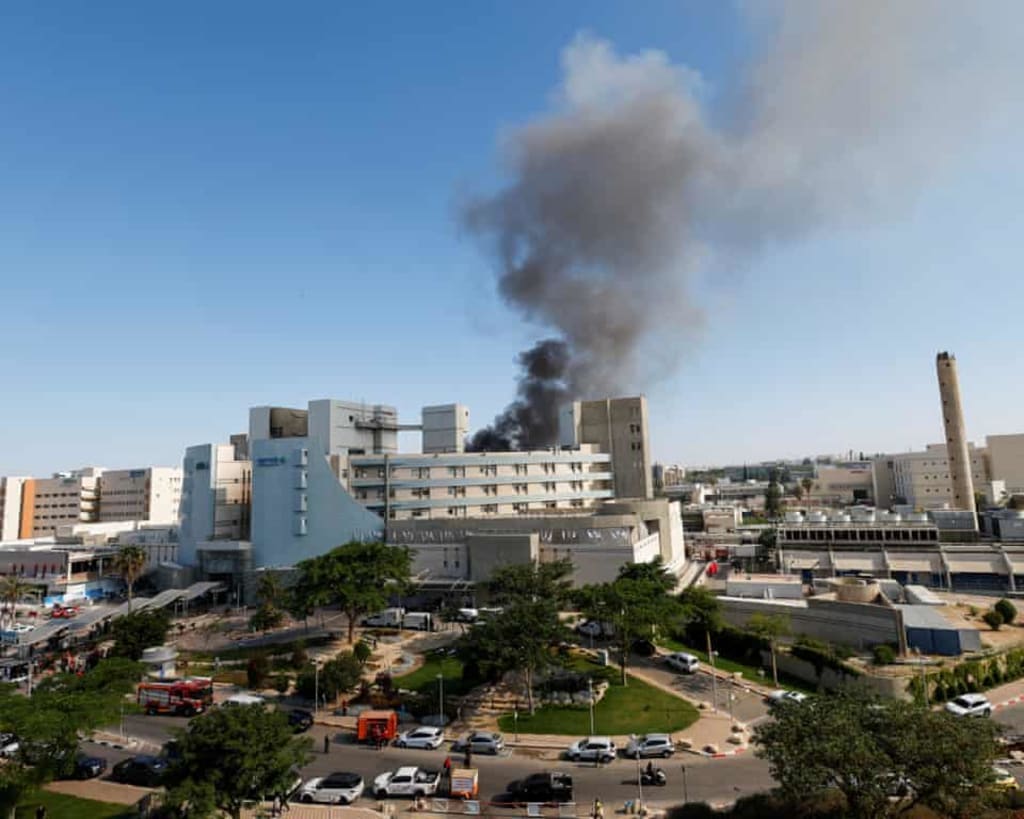
On June 19, 2025, the Israel–Iran confrontation reached a new peak. In a bold, public declaration, Israeli Defence Minister Israel Katz stated that Iran’s Supreme Leader, Ayatollah Ali Khamenei, “can no longer be allowed to exist.” This shocking pronouncement came in reaction to an Iranian missile strike on Soroka Hospital in Beersheba—a civilian medical facility that Israel deems off-limits under international norms.
The Hospital Strike: Catalyst for Crisis
• Earlier that day, Iran launched a missile barrage targeting key sites across Israel, notably striking near Tel Aviv and hitting Soroka Medical Center in Beersheba. The attack caused extensive damage and injured dozens—alongside other casualties across the country.
• Iran claims its aim was to hit a nearby military intelligence site, not the hospital, and says any damage to the medical facility was unintended collateral from blast effects .
• Israeli President Isaac Herzog later visited the site, praising staff for wise evacuation decisions and condemning the attack as a blatant strike on civilians .
The Prime Minister’s Warning & International Reactions
• Prime Minister Benjamin Netanyahu pledged strong retaliation, stating Iran “will pay a heavy price” for targeting a hospital, which he described as an act of terrorism .
• The U.S. and European allies are urging calm while Israel has already struck Iran’s Arak heavy-water reactor and other nuclear-linked sites in response .
• China and Russia have called for immediate de-escalation, and several countries (including the UK, Lithuania, the Philippines, and Australia) began evacuating citizens from Israel amid concerns over a broader conflict.
• Meanwhile, quiz: Is regime change now on Israel’s agenda? Israel Katz’s statement marks a significant shift: while Israel’s official objective remains dismantlement of nuclear/missile threats, Katz’s words strongly suggest removing the leadership itself. He went so far as to label Khamenei “a modern Hitler”.
Israel Katz’s Stark Declaration
Spoke in Holon near Tel Aviv, Katz declared:
“Khamenei openly declares that he wants Israel destroyed – he personally gives the order to fire on hospitals… Such a man can no longer be allowed to exist.”
He compared the Iranian leader to Adolf Hitler, warning that Israel would not allow another genocide, framing Khamenei as a modern-day Adolf Hitler whose elimination might be necessary to protect the Jewish state .
Humanitarian Front: President Herzog’s Stand
President Herzog’s visit affirmed the hospital’s evacuation as critical in minimizing casualties. He emphasized the shared humanity of all patients—Jews and Muslims alike—underscoring the attack as not just a military blow but a symbolic assault on life and coexistence .
The Nuclear Dimension & Military Escalation
• In retaliation, Israeli strikes have targeted Iran’s nuclear infrastructure, hitting facilities such as Arak reactor—a site crucial for plutonium production.
• Israel claims it has neutralized up to two-thirds of Iran’s ballistic missile launch sites in recent counterstrikes.
• Iran has pledged strong military and diplomatic retaliation. Talks are scheduled in Geneva between Iran and top EU foreign ministers, signaling a push for diplomacy amid rising tensions .
Wider Middle East Jitters
• The conflict ripple effect has already reached Gaza (with 69+ fatalities in ongoing strikes) and Lebanon, where Hezbollah is under scrutiny.
• Grand Ayatollah Ali Sistani of Iraq cautioned against targeting religious leaders like Khamenei, warning of catastrophic regional consequences .
Historical Backdrop: Khamenei’s Rhetoric
Khamenei has long called Israel an illegitimate or cancerous regime. He has publicly affirmed the destruction of Israel several times and framed it as a religious mission (en.wikipedia.org). His recent actions are viewed by Israel as confirmation of these threats, fueling justification for Katz’s assertions.
What’s Next? From Diplomacy to Warfare
1. Geneva diplomatic talks on June 20: Iran’s foreign minister meets EU counterparts to discuss possible de-escalation .
2. Military maneuvering: Israel likely to continue targeting strategic Iranian military/nuclear sites; Iran expected to escalate missile/drone attacks.
3. International intervention: With the U.S. debating military involvement, a broader coalition stance could either prevent or expand the conflict.
4. Humanitarian fallout: Civilian toll continues mounting on both sides; hospitals remain flashpoints in warfare.
SEO Optimized Key Takeaways
• Israel Katz Khamenei statement: Israel’s defence minister vows greater strikes.
• Soroka Hospital missile strike: Catalyst for high stakes escalation.
• Regime change discourse: Israel moves from deterrence to advocating elimination.
• Diplomatic truce in sight? Geneva meets might open negotiation channels.
• Back to history: Khamenei’s record against Israel shapes today’s actions.
• International watches: U.S., China, EU—all urging caution or preparing intervention.
Concluding Thoughts: A Region on a Knife Edge
This escalation marks a pivotal moment in the long-running Israel–Iran conflict. The strike on Soroka Hospital triggered a sharp reaction—highlighted by Katz’s incendiary call to neutralize Khamenei. His comparison of Iran’s leader to Hitler signals a framing of the conflict not just as strategic but as existential.
As Israeli airstrikes continue degrading Iran’s nuclear capacity, and diplomatic efforts in Geneva proceed, the world stands at a tense crossroads. Is this the brink of deeper war—or the prelude to a ceasefire that averts disaster at the last second?
One thing is undeniable: the future of Middle Eastern stability—and global security—may well hinge on what unfolds in the coming days.
About the Creator
Author’s Advice
If you would’ve asked me 20 years ago did I know I’d become a writer and an author, I would’ve said “nope, ain’t happening”. As fate would have it I did become an author and I can honestly say I’m loving it so far. It really does feel good to be a writer. I’ve learned a lot on this journey and I feel like with even me being as new to this world as I am, there’s some wisdom I need to share with every other aspiring author.
By Joe Patterson4 days ago in Journal




Comments
There are no comments for this story
Be the first to respond and start the conversation.