
A robot apocalypse for jobs? Not today, not tomorrow: artificial intelligence will transform, but not eliminate, employment.
A study indicates that automation will be selective and that human activities that are difficult to efficiently replace with technology will persist.

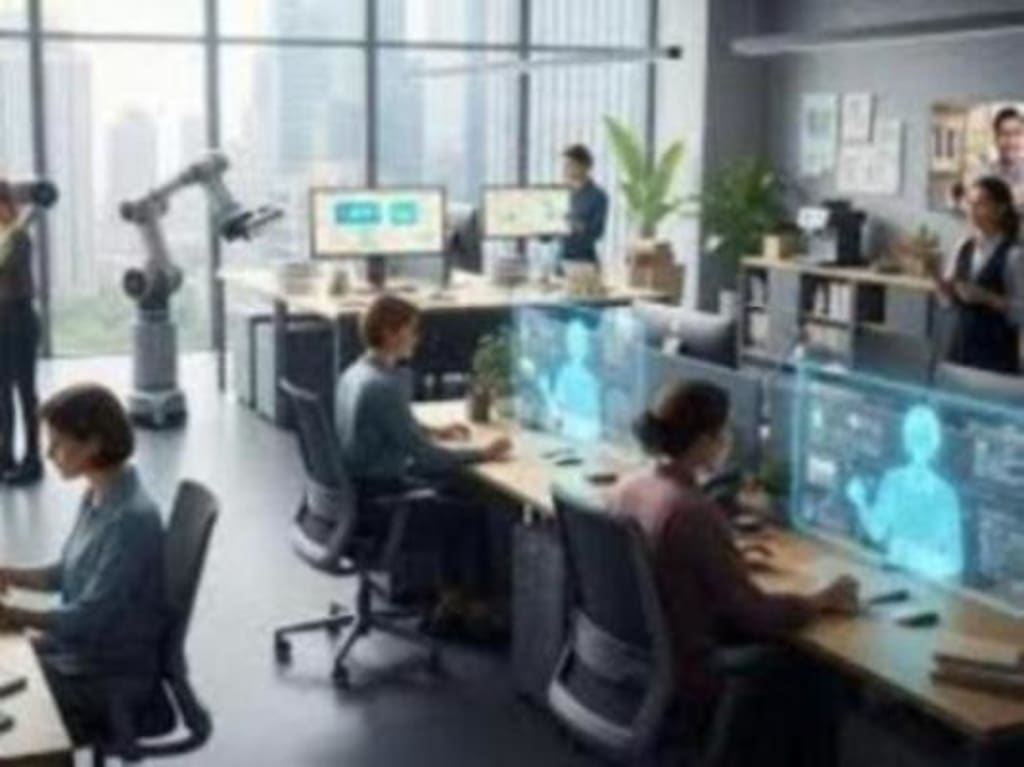
The advent of artificial general intelligence (AGI) has raised concerns about the future of human employment and economic growth. However, a recent theoretical study by Pascual Restrepo, a professor at Yale University and a member of Anthropic's Economic Advisory Council, published in the NBER Working Paper Series, has challenged the idea of an imminent "job-killing robot apocalypse."
According to his analysis, the complete automation of human work is neither imminent nor inevitable, and human employment will persist in tasks where automation is not efficient or cost-effective.
In his research, the author analyzed the long-term consequences of artificial general intelligence on the economy and the labor market. The author defines AGI as the ability to perform any economically valuable task using computational resources, without the need for direct human intervention.
Despite this potential, the study concludes that the complete automation of all human jobs will not occur immediately or absolutely.

The study distinguishes between two types of tasks: “bottleneck work” and “supplementary work.” The first encompasses those activities essential for sustained economic growth, such as energy production, food production, infrastructure maintenance, and scientific advancement. These tasks, according to Restrepo, will eventually be automated as the available computational resources increase.
Conversely, “supplementary work” includes activities not essential for growth, such as the arts, hospitality, design, and customer service. These can continue to be performed by people, as their automation might not be efficient or could be too computationally expensive.
Restrepo emphasized that “AGI doesn't make human work redundant; it makes it reproducible through costly computation.” Thus, although the technology allows for the replication of any human skill, the cost of doing so may mean that certain tasks continue to be performed by human workers.
Wages, Income, and the New Role of Human Work
The analysis reveals that the arrival of AGI radically alters how work is valued. Before AGI, wages reflected the scarcity of skills needed for essential tasks.

In this new scenario, the value of human labor is limited by the cost of the computing power needed to replicate it. That is, wages are tied to the price of the computational resources required to replace a person in a specific task.
Specifically, the study identifies several key implications:
1. Automation of bottlenecks: All tasks essential for growth will eventually be automated, while some supplementary work may remain in human hands.
2. Decoupling of wages and growth: Although average wages may exceed those of the pre-AGI world, their share of the economy will progressively decrease. Most of the income will end up in the hands of the owners of computational resources.
3. Persistence of human employment: People will continue to work on supplementary tasks or those where their contribution saves computational resources, but their compensation will be limited by the cost of automation.
4. Increased inequality: The distribution of income will tend to concentrate among those who control computing power, which raises challenges for redistribution and equity.

The author has stated that “the value of human labor is limited and decreases as a proportion of total production.”
Thus, although society as a whole will be wealthier, labor's share of GDP will be reduced to minimal levels.
Transition Scenarios and the Role of Public Policy
The study explores two possible trajectories toward the AGI economy. If the main limitation is computing power, the transition will be gradual: workers will gradually shift to non-automated tasks, and wages will evolve continuously.
Conversely, if algorithmic advancement is the determining factor, the transition may be abrupt and uneven, with sharp fluctuations in employment and wages for certain groups.

In both cases, the risk of increased inequality is significant. The author has pointed out that “the transition can be gradual and orderly or abrupt and unequal, depending on whether the constraint is computing power or algorithmic advancement.”
Therefore, Restrepo raises the need for public policies that help distribute the benefits of AGI. Among the options, he highlights income redistribution through a universal basic income or treating computing power as a public resource, whose benefits are widely distributed.
The Meaning of Work and the Social Debate in the Age of AGI
Beyond the economic aspects, the study invites reflection on the social meaning of work in a world where AGI can meet all material needs.
Historically, employment has provided not only income but also recognition and a sense of belonging. In the AGI economy, the individual contribution to collective well-being diminishes, and human labor ceases to be essential for progress.
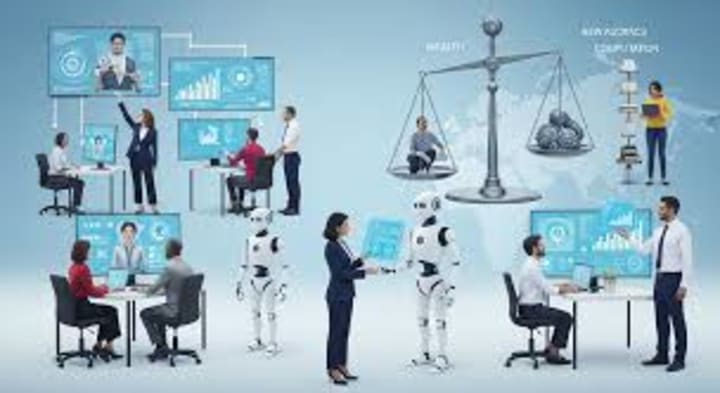
In this new context, society will have to reconsider the value and purpose of work, as well as the mechanisms for recognizing and distributing wealth.
The research debunks alarmist predictions about the total and imminent destruction of human employment. Artificial General Intelligence (AGI) will transform the labor market and the economy, but it will do so in a nuanced and gradual way, opening up new challenges in terms of equity, social purpose, and redistribution policies.
The future of work, far from disappearing, is being redefined based on what technology cannot or should not automate.
Ultimately, the study suggests that, in the AGI economy, the absence of human labor will not lead to a collapse, but rather a profound reorganization of economic and social life, where the presence or absence of workers will no longer be the determining factor for collective well-being.
About the Creator
Omar Rastelli
I'm Argentine, from the northern province of Buenos Aires. I love books, computers, travel, and the friendship of the peoples of the world. I reside in "The Land of Enchantment" New Mexico, USA...
Keep reading
More stories from Omar Rastelli and writers in Journal and other communities.
Adapting to AI is key to keeping your job.
The emergence of artificial intelligence (AI) in the business world is radically transforming the rules of the game for employees at all levels. According to The Wall Street Journal, the classic fear of being replaced by a machine has evolved into an even more immediate threat: the risk of being outpaced by those who are more skilled at using the technology.
By Omar Rastelli2 months ago in Journal
The goals I did not achieve
Every writing goal I made for the year is a wash. It has been this way for a while, but I think it's important to be open about my failures and the reality of how life can get in the way. This is especially true considering the several times I have posted on Vocal about my writing goals, how I was changing my approach, and where I was hoping to be for the upcoming year. I will probably do that again in a couple months, but for now, it is time to acknowledge where I am today.
By Kay Husnick22 days ago in Journal



Comments
There are no comments for this story
Be the first to respond and start the conversation.