
“A Gasp of Wonderment Escaped Our Lips”: The Dazzling Discovery of Tutankhamun’s Tomb
How a Young Pharaoh’s Final Resting Place Captivated the World and Redefined Egyptology
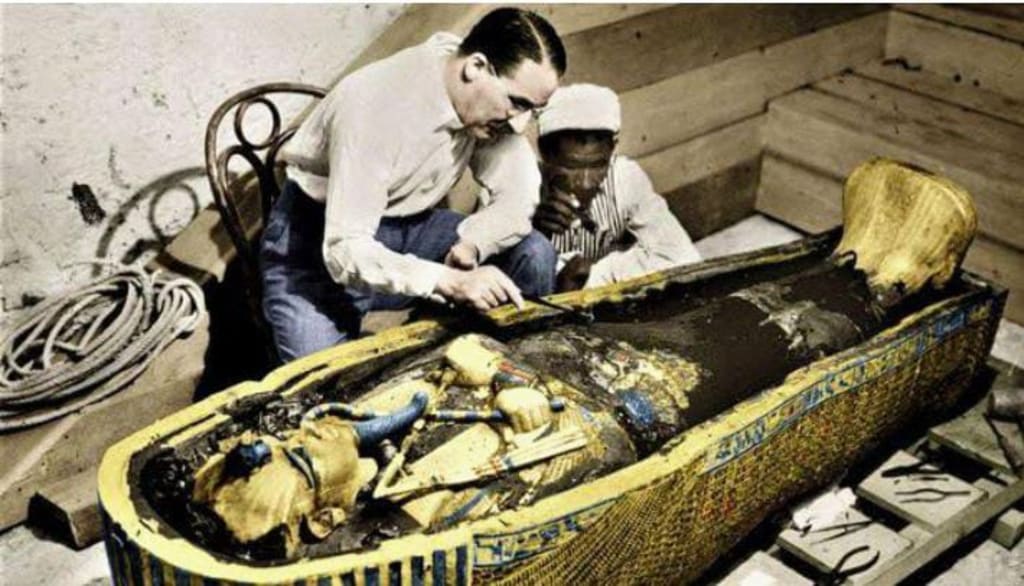
In November 1922, a moment of history unfolded in the Valley of the Kings that would forever etch the name Tutankhamun into the annals of archaeology. British archaeologist Howard Carter, after years of meticulous excavation, uncovered a hidden doorway leading to the tomb of Egypt’s boy king. As Carter peered inside, he famously whispered to his patron, Lord Carnarvon, “At last, wonderful things!” — a gasp of wonderment that captured the world’s imagination.
The discovery was more than just an archaeological milestone; it represented a bridge to a lost civilization, a treasure trove of artifacts, and an enduring fascination with the mysteries of ancient Egypt.
The Road to Discovery
Tutankhamun, often called the “Boy Pharaoh,” ascended the Egyptian throne around 1332 BCE at just nine years old. His reign was brief, ending with his untimely death at 18, yet the young king left behind a tomb that would remain nearly intact for over 3,000 years.
Howard Carter, born in 1874, had spent decades in Egypt, learning the subtleties of tomb excavation. In 1907, he began working under Lord Carnarvon, who financed Carter’s search for unplundered royal tombs. By 1922, Carter’s persistence led him to KV62, a tomb that would astonish the world with its near-complete preservation and dazzling artifacts.
The Moment of Revelation
On November 26, 1922, after careful removal of debris, Carter and his team discovered the sealed doorway bearing the pharaoh’s cartouche. The air was thick with anticipation. Opening the tomb revealed corridors filled with everyday items, ceremonial objects, and treasures intended to accompany Tutankhamun into the afterlife.
Among the most breathtaking finds was the golden mask, later recognized as an iconic symbol of ancient Egypt. Made of gold and inlaid with lapis lazuli and other semi-precious stones, the mask represented the pharaoh’s visage, blending artistry with religious significance. It remains one of the most recognized and celebrated artifacts in history.
Carter’s words to Lord Carnarvon, describing the initial view, captured the emotion of the moment: “A gasp of wonderment escaped our lips.” The phrase reflects the awe not just at the tomb’s contents, but at the glimpse into an ancient world frozen in time.
A Treasure Trove Preserved Through Millennia
Unlike many other royal tombs that had been looted, Tutankhamun’s burial chamber remained remarkably intact. The tomb contained over 5,000 artifacts, ranging from gilded thrones and ceremonial chariots to jewelry, clothing, and sacred statues. Each object offered insight into the pharaoh’s life, death, and the religious beliefs of the New Kingdom period.
Notably, the tomb’s layout, with multiple chambers and a central burial chamber, highlighted the sophistication of Egyptian funerary practices. The use of gold, vibrant pigments, and intricate carvings reflected both the wealth of the pharaoh and the cultural emphasis on the afterlife.
Impact on Egyptology and Popular Culture
Tutankhamun’s tomb redefined modern understanding of ancient Egypt. Before 1922, most discoveries had been fragmentary, with looted tombs providing incomplete narratives. KV62’s preservation allowed archaeologists to study a royal tomb almost as the pharaoh had left it, offering invaluable context about burial rituals, artistry, and daily life in ancient Egypt.
The find also sparked a global fascination with Egypt, influencing art, fashion, and cinema during the 1920s and beyond. Tutankhamun became a cultural icon, symbolizing both the allure of hidden treasures and the mysteries of the past.
The Role of Lord Carnarvon and Patronage
Lord Carnarvon’s financial backing was crucial to Carter’s decades-long search. Their partnership exemplifies the importance of patronage in early archaeology, where excavation costs were immense and often required private funding. Carnarvon’s presence during the discovery added an element of drama, especially given his untimely death shortly after the tomb’s opening—an event that fueled legends of the “Curse of the Pharaohs,” though modern scholars largely dismiss these stories as sensationalism.
Scientific Insights From KV62
Beyond treasures, Tutankhamun’s tomb offered significant scientific insights. Analysis of mummified remains revealed details about the pharaoh’s health, age at death, and potential causes of his demise. Studies of tomb contents also enhanced knowledge of metallurgy, woodworking, textile production, and burial practices in ancient Egypt.
Moreover, the meticulous documentation of the tomb’s contents set new standards for archaeological methodology, emphasizing careful recording, preservation, and analysis.
Legacy of the Discovery
Nearly a century after its uncovering, Tutankhamun’s tomb continues to captivate researchers and the public alike. Exhibitions of his artifacts, particularly the golden mask, have toured the globe, drawing millions of visitors and inspiring a new generation of archaeologists.
The tomb serves as a reminder of the importance of preservation, patience, and dedication in uncovering humanity’s history. As Howard Carter himself noted, the moment of discovery was not just about wealth, but about understanding a civilization’s culture, beliefs, and artistry.
A Gasp That Echoes Through Time
The phrase “a gasp of wonderment escaped our lips” transcends its historical moment. It captures the excitement, awe, and deep curiosity that drives exploration—whether in archaeology, space, or science. Tutankhamun’s tomb remains a testament to the treasures that lie hidden, waiting for discovery, and to the profound human desire to connect with the past.
As modern archaeologists continue to study the tomb, employing advanced imaging and conservation techniques, the spirit of Carter’s discovery lives on—reminding us that even in the sands of time, wonders endure, waiting to astonish the next generation.
About the Creator
Keep reading
More stories from Ayesha Lashari and writers in Journal and other communities.
Pakistan Announces Sadqa-e-Fitr and Fidya Amounts for Ramadan 2026
Islamabad: As the holy month of Ramadan approaches, Pakistan’s religious authorities have officially announced the Sadqa-e-Fitr and Fidya amounts for Ramadan 2026, providing clarity for millions of Muslims preparing to observe fasting and fulfill their religious duties. The announcement aims to guide citizens in calculating their charitable obligations in accordance with Islamic principles and prevailing economic conditions.
By Ayesha Lasharia day ago in Journal
~ Fired ~
— Ai Intrusion ~ Are you Next ~ Is Ai Evolution after your job? — Few workplaces haven't been affected. Ai is in supermarkets, at doctors' offices, and even monitoring farms. I just can't think of anything this machine is not getting into, can you? For instance: Education ~ Law and Tech jobs will one day have a major influence or be taken over by these inanimate machines, with accuracy and vigor. From mechanics' diagnoses to a wide variety of everyday jobs, including fast food workers, with this input having the ability to cut their unnecessary work hours. I'm certain all of us have been touched by this with our short stories and colorful headings, have you? Even comments are very questionable 'Non-Robot' insertions.
By Jay Kantor10 days ago in Journal
US Accuses China of Secret Nuclear Testing: A New Arms Race Shadow?
In a stark escalation of nuclear rhetoric, the United States publicly accused China of conducting covert nuclear explosive tests, breaching the long-standing global moratorium on such activities, the Comprehensive Nuclear-Test-Ban Treaty (CTBT)
By James Marinero5 days ago in Journal
Feelings Never Die
It is Valentine's Day again, and it bought back memories that were over fifty years old. It bought me back to 1971, and I woke up and I knew my baby was due today. I was big and pregnant, and I felt like I was about to burst wide open. Imagine my surprise when the doctor told my I had a due date of February 14. I couldn't believe it, and since my baby was due today, I felt I could indulge myself a bit. I had gained a lot of weight, and chocolate was on the no-no list, but I had came to the end of this pregnancy, and I hoped it would be okay, after all I would deliver this baby today. So I walked across the street to the grocery story, and bought myself, a peppermint patty, covered in chocolate, my favorite. Me and my Valentine's baby would enjoy it together.
By Susan Payton6 days ago in Fiction


Comments
There are no comments for this story
Be the first to respond and start the conversation.