
8 Must-Do Steps to Successful Custom CRM Development
A Practical Guide to Building a Custom CRM Solution That Aligns with Your Business Needs and Goals

Customer Relationship Management (CRM) software has become an essential tool for businesses looking to manage customer data, enhance sales processes, and improve service delivery. According to Grand View Research, the global CRM market size was valued at $65.59 billion in 2023, and it is expected to grow at a compound annual growth rate (CAGR) of 13.9% from 2024 to 2030.
While off-the-shelf CRM solutions like Salesforce or HubSpot are popular, many businesses opt for a Custom CRM Solution tailored to their specific processes and workflows. Custom CRMs provide flexibility, scalability, and integration capabilities that generic solutions cannot always offer.
However, building a successful custom CRM requires a structured development approach. In this article, we will explore 8 essential steps to ensure successful Custom CRM Development.
Step 1: Define Clear Business Goals and CRM Objectives
Before starting development, it is critical to understand why you need a Custom CRM Solution. Businesses should identify specific goals such as:
- Improving lead management and conversion rates
- Enhancing customer support efficiency
- Automating repetitive sales or marketing tasks
- Centralizing customer data for better insights
Define KPIs (Key Performance Indicators) to measure the CRM's effectiveness post-deployment. Involving key stakeholders early ensures that the CRM aligns with real business needs, not just IT objectives. A CRM Software Development Company can help translate these goals into technical requirements.
Step 2: Identify Key Features and Functional Requirements
Once the goals are clear, the next step is to list the core features required in the CRM. These may include:
- Contact and Lead Management
- Sales Pipeline Tracking
- Task Automation and Reminders
- Email and Communication Integration
- Reporting and Analytics Dashboards
- Role-Based User Access Controls
- Integration with ERP, Marketing, or Accounting Systems
Avoid feature overload in the initial phase. Focus on must-have functionalities that directly support your business processes. Future enhancements can be added post-launch.
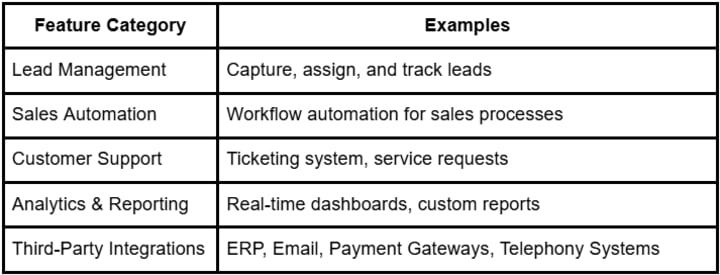
Example Feature Table:
Step 3: Choose Between On-Premise and Cloud Deployment
A crucial decision in CRM development is selecting the deployment model. Businesses must evaluate the pros and cons of on-premise and cloud-based CRM solutions.

Consulting with a CRM Software Development Company can help determine the right choice based on your business size, security needs, and IT capabilities.
Step 4: Design a Scalable and User-Friendly CRM Architecture
The CRM architecture forms the backbone of the system. A scalable architecture ensures that as your business grows, the CRM can handle increased data and user loads without performance issues. Key architectural decisions include:
- Modular Design for adding features easily
- API-First Approach for third-party integrations
- Secure Database Architecture with data redundancy
- Responsive UI/UX Design for accessibility across devices
Focus on creating simple and intuitive interfaces. Complex CRM systems with poor usability lead to low adoption rates among employees. Conduct wireframing and UI/UX prototyping before full development begins.
Step 5: Select the Right Technology Stack
Choosing the right technology stack is critical to ensure performance, security, and future scalability. Typical tech components for CRM development include:
- Frontend: React, Angular, or Vue.js for responsive dashboards
- Backend: Node.js, Python (Django), or PHP (Laravel)
- Database: PostgreSQL, MySQL, or MongoDB
- Cloud Services: AWS, Microsoft Azure, or Google Cloud
- APIs and Integrations: RESTful APIs, GraphQL
A professional CRM Software Development Company will guide you in selecting the tech stack based on factors like scalability, budget, and timeline.
Step 6: Develop CRM Modules in Agile Iterations
Adopting an Agile Development Approach ensures flexibility, faster deliveries, and constant feedback. Instead of building the entire CRM in one go, break down development into manageable sprints focusing on:
- Lead Management Module
- Sales Automation Module
- Reporting and Dashboard Module
- Integrations Module
Each sprint should conclude with a functional deliverable that can be tested and validated by end-users. Agile practices also allow room for changes based on business priorities.
Benefits of Agile for CRM Development:
- Continuous feedback from users
- Faster identification and fixing of issues
- Flexibility to prioritize essential modules
- Progressive enhancement without project delays
Step 7: Rigorous Testing and Quality Assurance
Testing is critical to ensure the CRM functions as expected across different scenarios. A multi-layered testing strategy should include:
- Unit Testing: Testing individual components or functions
- Integration Testing: Ensuring seamless interaction between different modules and external systems
- Performance Testing: Checking CRM response times under peak loads
- Security Testing: Identifying vulnerabilities and ensuring data privacy
- User Acceptance Testing (UAT): Real users test the CRM for usability and functionality
Partnering with an experienced CRM Software Development Company ensures robust QA practices, ensuring the CRM is reliable, secure, and bug-free before launch.
Step 8: Deployment, Training, and Continuous Support
Once the CRM passes all testing stages, it is ready for deployment. However, successful deployment doesn’t end with going live. Businesses need to:
- Provide comprehensive training sessions for employees to maximize CRM adoption.
- Prepare detailed user manuals and support documents.
- Set up ongoing technical support for post-launch troubleshooting and feature enhancements.
- Regularly monitor CRM performance and gather feedback for continuous improvement.
A Custom CRM Solution is a living system that evolves with business needs. Regular updates, security patches, and feature expansions are necessary to maintain its effectiveness.
Key Considerations for a Successful Custom CRM Project

Why Partner with an Expert CRM Software Development Company?
Developing a robust Custom CRM Solution requires a blend of business understanding and technical expertise. A professional CRM Software Development Company offers:
- Expertise in CRM architecture and module design
- Knowledge of latest technology stacks and frameworks
- Experience in data security and compliance standards
- End-to-end CRM development services, including consultation, UI/UX, development, testing, and support
- A proven track record of delivering scalable CRM solutions across industries
Collaborating with the right development partner reduces project risks, ensures timely delivery, and results in a CRM that truly adds value to your business operations.
Conclusion
Building a Custom CRM Solution is a strategic investment that can transform your business operations, improve customer relationships, and drive sales efficiency. However, its success depends on following a structured development process.
By adhering to these 8 Must-Do Steps — from defining goals to ensuring ongoing support — businesses can develop CRM systems that are tailored, scalable, and future-ready. Partnering with an experienced CRM Software Development Company ensures that every phase of the project is handled with precision, expertise, and a clear focus on business objectives.
If you're planning to develop a Custom CRM Solution tailored to your business, consult with experts who understand both technology and your industry's unique needs.
About the Creator
William Smith
I am an informative tech blogger exploring a wide range of topics, including web, mobile, IoT, etc.
Keep reading
More stories from William Smith and writers in Journal and other communities.
Why IoT Apps Are Changing the Way We Interact with Technology
The Internet of Things (IoT) is rapidly transforming how we interact with the world around us. According to a Statista report, the number of connected IoT devices worldwide is expected to reach 30.9 billion by 2025. From smart homes to connected healthcare systems, IoT is reshaping industries, creating a more interconnected and responsive world. At the heart of this transformation are IoT apps—software that facilitates communication between IoT devices and users, enabling more seamless interactions.
By William Smith7 months ago in Journal
Technology In Performance Monitoring
Introduction Technology plays a vital role in performance monitoring within healthcare and behavioral health organizations. Digital tools enable providers to track clinical outcomes, operational efficiency, and financial performance in real time. Implementing technology for monitoring enhances decision-making, reduces manual errors, and ensures accountability across teams. From electronic health records (EHRs) to data analytics platforms, technology supports continuous quality improvement and regulatory compliance. By leveraging modern tools, organizations can measure key performance indicators accurately, identify trends, and implement changes that improve patient care and operational efficiency.
By Abdul Mueed3 days ago in Journal
Two Grumpy Old Men Solve the Problem
Marty and Steve were two grumpy old men who lived together. They had known each other for years. Marty had been a bachelor all his life. Steve said it was because no one could stand to ever live with. Marty’s standard reply was “Well, you are, so what sort of a moron does that make you!”
By Calvin London3 days ago in Humor




Comments
There are no comments for this story
Be the first to respond and start the conversation.